So tightly guarded and last-minute was the Irish Government’s draft proposal for the next seven-year EU budget that Thomas Byrne, the Minister of State for European Affairs, had only one of a few printed copies with him on the Aer Lingus flight from Dublin to Brussels on Friday night.
Even then, he was cautious about reading it on board.
The Irish draft – known as the Negotiating Box, or ‘Nego Box’ – has been the subject of feverish speculation in Brussels and national capitals for weeks.
While the detailed breakdown of the next budget runs to over 50 pages, the greatest heat would be around how much would Dublin cut from the original proposal, where the cuts would hit the most, and how Ireland would magic up new revenue streams to avoid the EU going deeper into debt.
The arguments and number-crunching may appear arcane to the regular reader, but getting the other 26 member states to agree a near €2 trillion budget that aims to cushion citizens against mounting geopolitical dangers has always been the central challenge for the Irish EU presidency.
In short, last year the European Commission proposed a €1.76 trillion budget to run from 2028-2034.
At 1.26% of gross national income, this was already bigger than the current seven-year budget, which is 1.12%.
The Commission also proposed a completely different structure of how the budget would be spent and managed.
The view was that since 2021, the EU had been facing unprecedented geopolitical threats at a time when the fiscal room for manoeuvre in national budgets was decreasing.
The EU was falling behind the US and China in competitiveness and innovation and facing a growing military threat from Russia at a time when Ukraine required increased support in order to survive the invasion.
The Mario Draghi Report was calling for the EU to invest €800 billion a year to boost competitiveness.
In that context, the Commission proposed a radically new structure so that funds could be used more efficiently and deployed more flexibly as new challenges arise.
More emphasis would be put on competitiveness and defence than on traditional spending areas such as the Common Agricultural Policy (CAP), which in 2021-27 accounted for almost one third of the entire EU budget.
Instead of monies going direct to farming and cohesion recipients, much of the new budget would go directly to national governments via so-called National Regional Partnership Programmes (NRPPs).
Those governments would have more discretion over how the money is allocated (although a percentage of the funds would be ringfenced for farming).
Member states largely accepted this new architecture.

Yet, a tug of war was still inevitable between net-contributor member states – Germany, Finland, Denmark, the Netherlands, Sweden and Austria – who want a smaller budget focused on defence and competitiveness, and a larger cohort of 17 countries wanting a bigger budget that preserves agriculture and cohesion spending (cohesion payments are designed to bring poorer regions up to the same level as richer ones).
Despite that, the EU budget commissioner Piotr Serafin argued that the EU budget addresses challenges that cannot be taken on by member states on their own, or if they are, are much more costly.
“Some capitals are continuing to look at the EU budget in the way accountants look at balance sheets: how much do I put in; and how much do I get out,” he told MEPs last week.
“This approach was misguided in the past, but with our modern budget it is entirely flawed.”
The Cyprus presidency presented the first detailed ‘Nego Box’ in June.
It foresaw a modest cut of 2%, or €32.8 billion, from the Commission’s €1.76 trillion opener.
Throughout the summer, richer member states piled on the pressure once Ireland took over the rotating presidency, calling on Dublin to slash “several hundred billion” off the current draft.
“If the Irish negotiating box is to serve as the basis for further discussions, it must set out an overall volume that can realistically be financed by those who carry the main financial burden. This issue cannot be postponed,” stated a joint letter to the Taoiseach Micheál Martin from the leaders of Germany, Denmark, Austria, the Netherlands, Finland and Sweden.
“Almost every EU member state is making painful efforts to consolidate its public finances. There will be no European sovereignty without sound public finances,” the letter said.
“The funding should be focused on common investment in security and defence, competitiveness, innovation and the fight against irregular migration.”
The so-called Friends of Cohesion hit back with their own letter to Dublin calling on the Taoiseach not to touch €900 billion in farm and cohesion spending.
It was signed by no fewer than 17 EU leaders, including those from heavy weights like Italy, Poland and Spain, as well as Bulgaria, Croatia, Cyprus, Czechia, Estonia, Greece, Hungary, Latvia, Lithuania, Malta, Portugal, Romania, Slovakia and Slovenia.
“We… believe that the overall funding for Cohesion Policy and the CAP must be preserved in the next MFF,” they wrote, otherwise the cuts “would only weaken [the budget] and risk undermining public support for the European project”.

There was also a clamour from NGOs and the European Parliament that Ireland should not touch international development spending as an easy target for cuts.
As the neutral chair, the Taoiseach could not throw his weight behind either camp.
In fact, since Brexit, Ireland has had a foot in both: priding itself on fiscal rectitude, as a net contributor, while being a traditional supporter of agriculture and cohesion spending.
As the pressure mounted, the Taoiseach continued to visit other EU leaders, while Thomas Byrne held countless bilateral meetings with his counterparts, either in their capitals or during meetings of the General Affairs Council, the format where EU Europe ministers gather once a month.
According to a government spokesperson, Micheál Martin made further phone calls in the past week with German Chancellor Friedrich Merz, French president Emmanuel Macron and the European Commission president Ursula von der Leyen.
Even choosing the date to launch the Irish ‘Nego Box’ was tricky.
It had to be before next week’s summit of EU leaders, who are supposed to move negotiations to the next level, while the Government couldn’t allow it to clash either with Tuesday’s national budget, or a meeting of EU finance ministers in Luxembourg on Friday.
In the days leading to the Saturday publication, senior Commission officials believed Ireland would be swayed more by the ‘Frugals’ – Germany, the Netherlands, Denmark – than by the Friends of Cohesion.
But when Minister Byrne unveiled the Irish draft to journalists on Saturday morning, it was clear that was not the case.
Rather than cut “several hundred billions” from the Commission proposal, the Government was only cutting €141 billion, or 8%.

Where would the cuts fall?
In simple terms, the seven-year budget operates under four headings: one on the traditional areas (agriculture and cohesion), one on the new spend areas (competitiveness, innovation and defence), one on international development and aid, and a fourth on the EU’s administration costs.
Setting out where the cuts would land, Minister Byrne was at pains to point out some truths which he hoped would mollify critics.
Firstly, that the Irish presidency’s strict mandate was primarily to listen to member states, and not the European Parliament or the Commission, and secondly, that no matter where the cuts fell, the overall budget would still be significantly bigger than the current budget.
While the Commission proposal was being cut by 8%, the Irish draft budget would still be 30% bigger than the 2021-27 budget, or a 47% increase when adjusted for inflation.
“We have listened carefully to all member states,” he told reporters. “We have worked with them to identify their priorities, and we have been open and transparent with everybody.”
But it was clear where the Irish preferences lay.
While farming and cohesion payments were cut by only 3%, the competitiveness and defence heading was cut by 13% and the so-called Global Europe heading (including foreign aid) by 17%.
The allocation for the EU’s administration’s costs was cut by 8%.
Asked how the Irish proposal could be balanced if so much was cut from competitiveness and the Global Europe allocation compared to just 3% for agriculture and cohesion, Minister Byrne insisted that the competitiveness and defence heading would still enjoy a 100% increase on the current budget, while Global Europe spending also represented a 31% increase.
He said: “There was strong support for [farm and cohesion spending] from almost all of the member states, including some of the countries who are considered net-contributors, so we’ve had to balance all of the competing demands from the member states.”
Mr Byrne mentioned several times that the overall balance was designed to be a “catalyst” for a more intense set of negotiations which will now take place between EU leaders themselves, first at a summit in Brussels on Thursday, with follow up meetings at the end of November and in mid-December.
Irish officials insist the cuts were targeted across all headings and in each case simply represented the priorities of member states, as outlined to Dublin during repeated encounters.
Another keenly watched aspect would be what new revenue streams could realistically generate income for the EU budget that would avoid member states having to increase their own national contributions, while also meeting the debt repayment schedule for the post-Covid recovery spending, which required the EU to borrow in the markets and which will mean repayments worth €24 billion per year, starting next year.
The so-called ‘New Own Resources’ are a set of revenue-raising ideas from the European Commission designed to drum up some €60 billion annually.
The Commission’s initial proposal recommended boosting revenue from the Emissions Trading System (ETS), whereby heavy industry pays for the ability to generate carbon, as well as revenue from third country importers under the Carbon Border Adjustment Mechanism (CBAM).
More funds could be raised through levies on electronic waste and tobacco.
The Irish draft keeps these in place, although it proposes that eastern European member states, which still heavily rely on fossil fuels, could phase in some of the ETS levies.
However, despite every indication that it would not fly among member states, the Government has also kept a Commission proposal for an annual lump sum contribution from large companies operating in the EU with a net annual turnover of at least €100 million.
It also goes without saying that this revenue raising idea has not gone down well with Irish officials, pre-Presidency.
The Irish draft also did not mention other revenue raising ideas from the European Parliament, such as a tax on gambling, crypto-currency profits and a tax on large tech companies, despite calls from the President of the European Council Antonio Costa for such measures to be considered.
Mr Byrne told reporters that these ideas could still be in the mix. However, he added that Ireland’s test for such ideas was that they “one, command unanimity; two, that they deliver substantial funds; and three, that they be ready by 1 January 2028”.
In other words, the Government wasn’t convinced that the European Parliament’s ideas could deliver enough cash, be ready on the first day of the new budget cycle and command the unanimous support of member states.
Inevitably, the Irish draft has gone down badly in the European Parliament, which wants the budget to be 10% bigger than the current one.
“The numbers still don’t add up. We cannot accept the [Irish] proposal, which falls short of what Europe needs to meet the challenges ahead,” said Siegfried Mureșan MEP, vice-president of the European People’s Party (EPP) and the group’s chief negotiator on the budget.
“In trying to please everyone, this proposal pleases no one. It cuts funding for new priorities such as defence and competitiveness compared with the Commission’s proposal, while leaving farmers and regions underfunded. The negotiating box reverses the Commission’s efforts to fund Europe’s new priorities.”
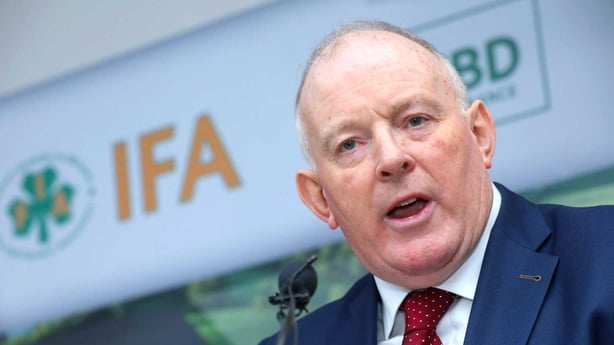
Irish presidency proposal ‘is a huge let down’ – IFA
NGOs were scathing about the cuts to the Global Europe heading.
Dóchas chief executive Jane-Ann McKenna said: “External action funding is one of the EU’s key tools for turning its commitments into action. This includes poverty reduction, humanitarian assistance, peacebuilding, human rights, and gender equality.
“Cutting the Global Europe Instrument by 17% will be a devastating and short-sighted move. Globally, poverty and inequalities are rising, and climate change is intensifying. Europe’s safety, prosperity and resilience cannot be separated from the world around it.”
The Irish Farmers’ Association (IFA), was equally scathing, as the Government had not reversed the 24% cut that the original Commission proposal would have meant for Irish farmers, once the ringfenced amount for farming was taken into account.
IFA President Francie Gorman said: “In the original Commission proposal, the EU CAP budget was cut by 22% which would result in a 24% cut to Irish payments.
“The Irish presidency proposal today has not improved this at all. It is a huge let down for Irish and EU farmers [who will feel] that the EU is turning their back on farming and that the Irish Government is not delivering for them.”
Minister Byrne strongly rejected this, saying that there were sufficient flexibilities in the new NRPP structure to ensure funding can be shifted towards farming and rural development.
“The IFA are completely mistaken on this,” he told RTÉ News. “Agriculture is protected. We’ve introduced new flexibilities into what’s called Heading One of the proposals, which will allow the Common Agricultural Policy to protect it. Those figures they’re putting out are not correct. They’re not comparing like with like.”
It was entirely predictable that the Irish presidency would face hostility from all sides given the frequently irreconcilable positions of member states, the EU institutions and interest groups.
However, officials say that following months of listening and shuttle diplomacy, the Irish ‘Nego Box’ is a “turning point” for serious negotiations to get under way.
The first temperature-taking will be when EU ambassadors meet on Sunday, followed by a meeting of Europe ministers in Luxembourg on Tuesday, and that summit of EU leaders on Thursday.


