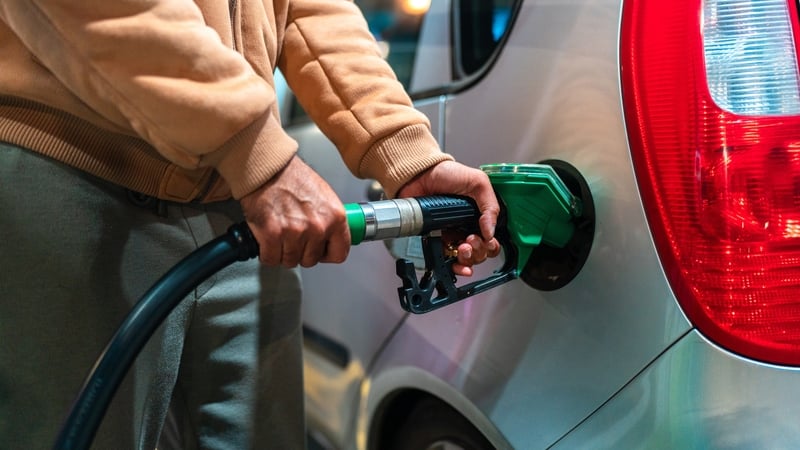
The Government is considering extending the excise cuts on petrol and diesel until late February or early March.
The reductions, which were first introduced in April, were set to be unwound from the beginning of November.
However, both Tánaiste Simon Harris and Minister for Public Expenditure Jack Chambers have indicated that they will remain in place until spring.
The cuts resulted in a 32 cent lowering of the price of a litre of diesel while 27 cent was shaved off the cost per litre of petrol.
It is also understood that a hike of €5 on the weekly fuel allowance payment is also on the cards.
The current rate is €38 per week for the payment which runs from the end of September to April.
Earlier, Minister Chambers strongly hinted that excise cuts on petrol and diesel will be extended in the Budget.
Mr Chambers was speaking during Leaders’ Questions in the Dáil where he pledged that Bugdet 2027 would help working people and specifically address the cost of home heating oil.
“We’ve been clear that is a specific consideration in our tax policy measures, and that will be considered as well as the deferral of excise on petrol and diesel,” he said.
Sinn Féin leader Mary Lou McDonald asked: “Less than two weeks to Budget day, what will Government do to get costs under control?”
“Price hikes mean that households will have to fork out an additional €1,000 this winter.
“And seven out of ten young people are now considering leaving this country because they can’t live affordably here,” the Dublin Central TD told the house.
RTÉ’s Political Correspondent Mícheál Lehane reports from Leinster House on the Govt’s latest Budget considerations
We need your consent to load this rte-player contentWe use rte-player to manage extra content that can set cookies on your device and collect data about your activity. Please review their details and accept them to load the content.Manage Preferences
Govt cannot do everything for everyone in Budget – Martin
Meanwhile, Taoiseach Micheál Martin has said that the Government cannot do everything for everybody in the Budget and “must target our resources”.
Speaking to reporters in New York, Mr Martin said that people are going to have to look at the Budget “in the round” in terms of income tax reductions, a childcare package and cost of disability payments. He said all of those will help reduce the pressure on families and workers.
When asked if he could guarantee that nobody would be worse off after the Budget, he said that he cannot give “cast iron guarantees.”
“We are under severe pressure internationally. We can’t predict where the global situation will go. I am aware yesterday that there would have been a series of talks at the UN in respect of the Iranian issue and the US.
“And indeed, listening to people at Ukraine/Russia, one always hopes that the situation can improve with negotiations” he said.
He added the Government anticipates that after the Budget there will be a public service pay deal which will be of assistance to those who work in the public service.
“Then we’re looking at fuel, additionally to those budget measures with a view to the next six to eight months and a series of measures there to alleviate the pressure on people and that could be a combination of measures,” the Taoiseach said.
Dáil hears call to help ‘people in their hour of need’
The Government must look after people “in their hour of need”, the Dáil heard, as another motion calling for additional fuel supports was tabled.
The Independent Technical Group motion on energy and fuel costs calls for stronger government action to shield households, motorists and businesses from rising fuel and energy prices.
It follows a similar motion from Sinn Féin yesterday.
Noting supports which have already been introduced, Independent Ireland TD Michael Fitzmaurice said that “any money is welcome” but argued that more is needed to avoid dire consequences in agriculture and farming.
Additional carbon taxes on fertiliser mandated by the EU “has driven the price of it mad”, he said, and urged that more money be found to tackle this, as he said that the “paltry” sums offered by the EU are insufficient.

“This isn’t politics. This about people right around our country who are hurting at the moment.
“People afraid to turn on the heat. People afriad to turn on the light. That’s not the Ireland that you and I would sign up to,” he said.
The motion advocates extending fuel cost supports and other cost-of-living measures, arguing that international energy market pressures continue to affect consumers.
Minister of State at the Department of Agriculture, Food and the Marine Niall Collins said the motion failed to grasp the realities which are driving cost rises.
He defended the carbon tax, saying that it has a key role to play in moving away from fossil fuel dependence and Ireland must meet EU commitments in how the carbon tax operates if it wants to retain control over how revenues are used.
Aontú leader Peadar Tóibín said that “people power” has forced the Government to change its approach as “they could not take any more” and took to the streets.
He said that the next steps in that campaign are now being examined, and highlighted his party’s support for those efforts.