
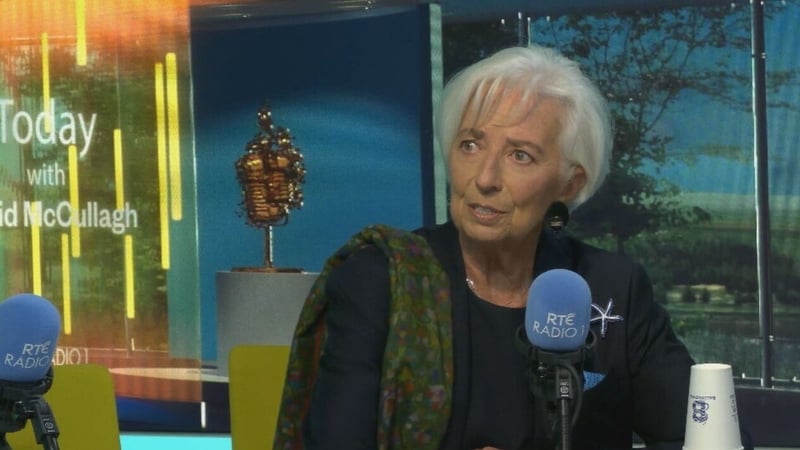
European Central Bank President Christine Lagarde said today that any further interest rate increases by the ECB “will depend on the future.”
Speaking on RTÉ’s Today with David McCullough, Christine Lagarde said we are living “through such uncertain times”.
The ECB has decided to “actually assess the situation, look at the data, look at three things – the inflation outlook, the underlying inflation, and the transmission of our monetary policy into the economy,” she said.
“And it’s on the basis of these three elements and on the data that we receive, the projections that we produce, that we then decide what we have to do,” she added.
She said the “only thing that we are absolutely confident about is the goal. We have to bring inflation to 2% and we have to offer price stability to Europeans,” she explained.
She said the ECB would decide “meeting by meeting” what is appropriate, whether that is to hold, increase, or cut interest rates, although cutting rates “is very unlikely at the moment,” she added.
“There is nothing worse than inflation for people who are vulnerable, and who do not have a large income, and assets that they own,” Ms Lagarde told RTÉ.

Mortgage payers are “absolutely” in the mind of ECB decisionmakers when considering changes to interest rates, she added.
“So the key mission we have is inflation first and foremost,” she stated.
However she said the ECB also pays attention to housing costs, growth, employment, and currently “growth is a little more promising then we had thought.”
“Employment is in a good place and we have low unemployment in most European countries,” she noted.
But she said because of the rising cost of energy resulting from the Middle East war “in particular….we react to the risk that inflation becomes embedded.
The most recent ECB interest rate increase puts Europe in a good position to assess that risk, she added.
We need your consent to load this rte-player contentWe use rte-player to manage extra content that can set cookies on your device and collect data about your activity. Please review their details and accept them to load the content.Manage Preferences
Christine Lagarde also said today that the ECB can not “reopen the Strait of Hormuz, a central bank cannot drill and find fossil energy and a central bank can not just by miracle install solar panels that will replace that”.
“What a central bank has to do is to provide price stability and to do that we have to anticipate the consequences of energy price increases will have on the rest of the economy,” she said.
“And we have to signal to everyone we are damn serious about maintaining prices [inflation] at 2%,” she stated.
“For the moment we have inflation rates depending on the member states at 3.2%, our forecast for this year is 3%, we have to rein that in. We have to bring it to 2%,” she said.
Ms Lagarde said ECB policy on measures by national governments to address rising energy costs for consumers should be “targeted, temporary, and tailored.”
She said this ensures that when energy costs become, “smoother, better, cheaper,” the measures can be “removed instantly.”
That is why the “principles [the ECB] has repeated over and over is triple-T – targeted, temporary, and tailored,” she explained.
On housing, Ms Lagarde said housing costs are “high” and they are “much higher” in some European countries than in others, but that the issue was also one of the “housing offer.”
“How much housing supply is there on the market, how much social housing is in development, how much effort is there to increase the volume of housing,” she said.
“That matters a lot,” she added.

Meanwhile, ECB President Christine Lagarde today kept the door open to leaving her post early, replying “we’ll see” when asked if she would remain in the position until her term ends in October 2027.
“I leave in 2027,” Lagarde told David McCullough in response to a question on rumours of her early resignation that have persisted for most of this year.
When asked if that meant October 2027, Lagarde replied: “We’ll see.”
“What I can tell you at this point is that whatever the time, it will be handled in the most professional way as it should be,” she added.
Sources told Reuters this week that France would back Dutchman Klaas Knot to succeed Lagarde as part of a bargain in which a French candidate would be picked for chief economist.
Former Irish Central Bank governor Philip Lane is the current chief economist at the ECB and his term is due to expire in May.
Additional reporting from Reuters