
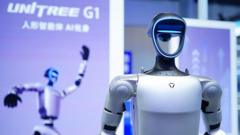
The world’s biggest humanoid robot maker Unitree Robotics made its stock market debut in Shanghai on Wednesday, with its shares soaring by more than 600% in early trading.
In the highly anticipated initial public offering (IPO), the Chinese firm’s shares opened at 1,100 yuan (£120.60; $163.12), before giving up some of the gains to trade at around 900 yuan.
The listing on the technology-focused Star Market – which is widely known as China’s Nasdaq – marks a milestone for Beijing’s ambitious plans for the country’s robotics industry.
It comes as the US and China are battling to dominate the global market for robots and artificial intelligence (AI) models that power them.
While Unitree is not the first Chinese humanoid robot maker to list on the stock market, its debut marks the first in mainland China.
Robots like automated industrial equipment and smart vacuum cleaners are already widely used in factories, warehouses and homes.
Now, the humanoid robotics industry is attracting huge amounts of investment as major companies – including Tesla, BYD and Amazon – are developing two-legged machines capable of performing tasks usually carried out by people.
Unitree, officially known as Yushu Technology Co Ltd, was founded in 2016 and now plays a key role in Beijing’s ambitions to develop advanced technology.
It has become a robotics industry leader, selling devices from sensors and automated arms to four-legged and human-like machines.
The firm shipped more than 5,500 humanoid robots last year as demand for the technology grows.
Unitree is one of the few companies in the sector to make money, delivering a net profit of 278 million yuan in 2025.
It is a fierce rival to developers in the US as it produces robots with similar features but at lower prices.
The company is based in Hangzhou, in eastern China. The region is home to a so-called golden cluster zone of robotics firms, which have benefited from huge government investments.
That support helped drive a more than threefold increase in the number of Chinese robotics firms between 2020 and 2024, according to state-run China Daily.
Robots are also seen as a potential solution to issues posed by China’s ageing population, which is expected to lead to a shortage of workers in the country, according to Fei Qin, an associate professor at the University of Bath.
Beijing considers the robotics sector a “strategic priority” in its pursuit of leadership in advanced technology, she said.
“Robots are where AI leaves the screen and enters the economy” in factories, hospitals and, potentially, the home, Qin added.
So far, Western robots have not made the same impact on factory floors or in the consumer market.
Boston Dynamics, a major US robotics developer, has said it will roll out human-like machines in car maker Hyundai’s factories in two years’ time. The South Korean firm has a majority stake in Boston Dynamics.
Other US firms, like Amazon and Tesla, have also announced plans to use humanoid robots in their operations.
Earlier this year, Musk’s firm announced that it would use its manufacturing plant in California that made Model S and X cars to produce its line of Optimus humanoid robots.
Amazon, which tested the use of humanoid robots in its warehouses in 2023, told the BBC it is continuing its research into next-generation robotics.
The BBC has also contacted Tesla and Boston Dynamics for comment on their humanoid robot plans.
One thing is clear, said Hsu, the US has lost its lead in robotics.
“We no longer hear about American robotics companies in the news. It’s the Chinese robot companies that are making news today,” he added.
“They have replaced America as the cool kids on the block.”
Listen to the BBC News World Service Asia Specific podcast:
China’s humanoid robot boom