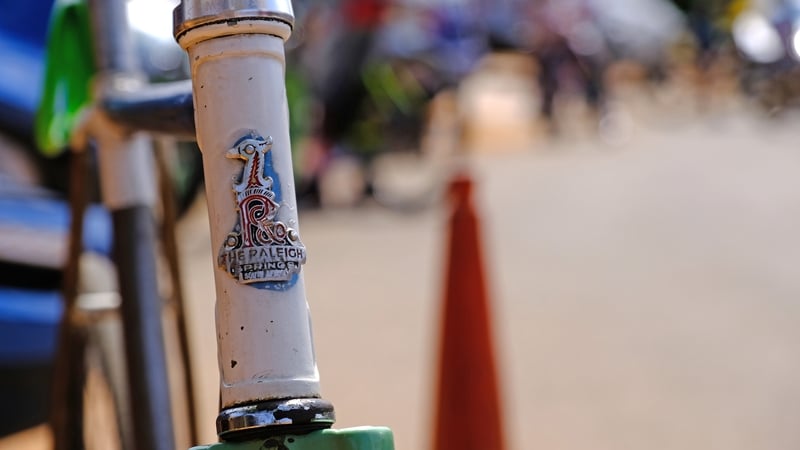
Raleigh is likely the first brand many people think of when they think of biking. For some, it may be the only bike brand they know. So it may be a shock for them to hear that such an iconic name, with a legacy of Tour De France and Olympic-level success, has gone out of business.
But it has.
Last week its parent company – Accell Group – filed for insolvency, putting the brand’s future in doubt.
But as surprising a turn of events as this may seem to the casual biker, those paying close attention to the industry are unlikely to have been all that surprised.
Because at the elite level, Raleigh hasn’t been a force for close to 30 years now – and that’s often a bit of a red flag when it comes to a sporting brand. It’s also damaging at a consumer level – because the average buyer tends to be drawn to the most successful brands.
That’s not to say it’s impossible to exist purely as a consumer-level brand – and much if Raleigh’s success through the decades came from catering to that market alone.
After all, one if its biggest sellers was the Chopper, inspired by Harley Davidson-style motorbikes. That was anything but a race bike, but it sold extremely well nonetheless.
However, falling away at an elite level was just one of the issues that hurt Raleigh.
The brand had changed hands a number of times over the years, while it also gradually shifted manufacturing away from its roots in Nottingham, England and towards lower-cost bases in Asia.
Again, there’s nothing necessarily wrong with that – most of the big bike brands of today are manufactured or partially-manufactured in the likes of China, Taiwan and Vietnam.
But Raleigh opted to focus more on volume rather than quality – slowly its reputation dwindled as a result, and sales went with it. And despite a number of attempts to turn things around in recent years – including redundancies and restructuring – things failed to improve, and the owners moved for insolvency.
A Raleigh Rally?

This is an insolvency rather than a liquidation – so there is the potential that the company strikes a deal with its creditors, or finds a buyer or investor.
At the time of its filling, Accell said it had explored every possible avenue for its future already – but sometimes a company going through the insolvency process can make a deal possible.
In recent days there have been reports that Mel Suthcliffe – former Irish cyclist and founder and CEO of Dublin-based investment company Quanta Capital – was eyeing a bid for Accell.
Other companies may seek to buy the brand too so, while no-one knows for certain, it’s quite possible that Raleigh will live to fight another day – even if it’s purely as a brand that exists in name only.
There are in fact lots of companies out there today that specialise in buying up former prestige brands that have fallen on hard times.
British businessman Mike Ashley is an old hand at this, for example.
He owns Frasers Group, which includes retailers like Sports Direct, House of Fraser and Flannels. Just this week he agreed a deal with administrators to buy Harvey Nichols.
He has done the same with sporting labels too – which has given him ownership over formerly well-respected brands like Everlast, Lonsdale and Slazenger (the latter of which was once the brand of choice for pro-tennis players and golfers, and even a go-to for Sean Connery’s James Bond).
But like Raleigh, they all saw their stature decline over time – and eventually Mike Ashley bought them. In many cases, from liquidators or receivers for pennies on the pound.
Flight of fancy

Raleigh’s journey from industry icon to the brand bargain bin is not unique. It’s a path that been laid by many before it – including Hoover.
While Raleigh may have been synonymous with its product category, Hoover was eponymous. To this day people in Ireland will refer to their vacuum cleaner as a ‘hoover’, no matter what the actual brand is.
But while the Hoover company – or the Electric Suction Sweeper Company as it was originally known – was, like Raleigh, a market leader for decades, it lost its crown for a very different reason.
In the early 1990s it was trying to tackle declining sales, particularly in the UK and Ireland. That was, in part, because of the arrival of innovative rivals like Dyson, but also due to the recession that hit at the start of the decade.
To try to reverse the UK sales slump, its executives hit upon the idea of offering two free flights to customers who bought £100 worth of Hoover products. After a short time the company extended the promotion to include transatlantic flights – something that would have cost hundreds of pounds to buy outright at the time.
In one way the promotion was a roaring success – sales of Hoover products surged, to the extent that the company had to hire staff to deal with the spike in demand.
Company bosses said this sales jump would more than make up for the cost of the ticket giveaway too, and they predicted most customers wouldn’t actually go through with availing of their free tickets.
Their confidence in that regard was based heavily on the fact that they had made the application process as awkward as possible.
Someone who had bought their Hoover goods and wanted to get their flights first, had to send off their receipt within two weeks of purchase.
Once they did that, they were sent a form which had to be filled in and returned within two weeks.
If they managed that, they would receive a travel voucher, which required the customer to select the flights they wanted within 30 days.
At this point customers had to designate which routes and dates they preferred, however Hoover held the right to reject that request and offer customers a completely different route on different dates.
Given how inconvenient this was, Hoover apparently anticipated 50,000 successful applications.
But this was the 90s, and it was in the middle of a long-running recession. It turned out that many people were willing to go to great lengths to get cheap holidays to the US.
In the end Hoover got 300,000 applications – easily representing £150-180m worth of plane tickets at face value.
In a lot of cases the people behind those applications had just about spent the required £100 to qualify – meaning it quickly turned into a huge financial loss for the company.
Hoover cancelled the promotion without honouring many applications – which led to lawsuits, a massive campaign and lots of bad publicity. Eventually its US parent decided to sell Hoover’s European arm to rival Candy.
But it never really recovered its market share, and both brands continued to suffer declining sales.
Eventually they were acquired by Chinese company Haier, which now sticks the brand names onto some of the products it was already making for the European market.
Stuck in a moment

Sometimes a company’s mistake isn’t doing the wrong thing, it’s not doing anything at all.
Kodak was once a global photography powerhouse.
It was one of the main brands to bring photography to the mass-market – and to this day people will talk about the perfect ‘Kodak moment’.
(At one point it was a leader in lots of other types of media – including recordable CDs, which it briefly manufactured in Youghal in Co Cork.)
But, of course, the world changed around Eastman Kodak from the 1990s on.
Digital photography rapidly replaced film – meaning people didn’t need to get photos developed anymore. Eventually people didn’t even need to buy cameras.
And even though Kodak was a digital photo pioneer – it had a prototype digital camera in the 1970s – it took too long to reorientate its business in the face of this new reality.
It ended up filing for bankruptcy protection in the US in 2012.
However, that was not the end of the brand.
Today Kodak’s branding can still be found on a handful of consumer products – largely novelty items like disposable cameras or ultra-niche products for analogue photo purists.
But its main focus nowadays is commercial and industrial – including high-quality printing, advanced chemicals, as well as film for cinema.
And to that end, Eastman Kodak is actually enjoying a bit of a renaissance, given the preference some major movie directors have for actual film rather than digital.
While there was a lot of talk recently about Christopher Nolan’s use of IMAX cameras for The Odyssey, the actual film inside those cameras was made by Eastman Kodak.
Loss of lustre

Eastman Kodak managed to find a second life after its consumer business flopped. Others manage to stay in business, but perhaps with less prestige than they once enjoyed.
That tends to happen a lot in the fashion industry, as well as in the car industry – and it can be for many different reasons.
MG, for example, used to be a premium, British car brand. At one time it was known for highly specialised models, and an old-fashioned production line where the cars were essentially hand-made by skilled workers.
But over time the brand struggled – it changed owners a few times, it was semi-retired and revived, and eventually it was acquired by China’s Nanjing Automobile Group (which in turn merged with China’s SAIC Group).
And while there’s not necessarily anything wrong with MG cars today, they are no-longer hand-crafted and high-end. They’re fairly standard mass-produced, mass-market cars.
Once prestigious US car brands have also gone down in the public’s estimation – even in the US itself.
The likes of Cadillac – once a by-word for the best of the best – would have been a status symbol in the US and in Europe. Today, though, they’re at best seen as entry-level luxury.
In fact, the reputation of the US car industry as a whole has declined in recent decades, in part due to the higher standards that have been set by Japanese, Korean and European rivals.
On the fashion side, a good example of dwindling prestige is Michael Kors.
Michael Kors was a so-called affordable fashion brand – so it never tried to be a Gucci or Louis Vuitton.
But when it found popularity its bosses quickly gave into the temptation of making too many products to cater to consumer demand.
That over-supply led to products being sold at a discounted price, which ultimately damaged that ‘luxury’ image. And that damaged sales.
Its parent company Capri Holdings went from a net profit of $881m in 2015, to a near $1.2 billion loss in 2025 (though it did manage to return to a small profit last year).
Michael Kors’ mis-step is something that fashion brands regularly get caught on – trying to balance luxury and exclusivity against sales growth.
Something similar happened to Burberry. It went from being an old, exclusive brand – associated with the British aristocracy – to becoming a short-hand for so-called ‘chav’ culture.
Part of that was, again, because the company gave into the temptation of cashing in on its prestige. That included selling licenses to allow other companies to sell products under the Burberry name, or using its iconic chequered pattern.
The end result was a market flooded with less-than-great-quality Burberry-branded goods.
Over the past decade the company has had some success in rebuilding its reputation – part of which came by it buying back the brand licences it sold.
However, last year it did announce a round of cost-cutting and redundancies, suggesting that it hasn’t quite yet returned to premium luxury status.
Reputational rehab

Executives at these companies will take heart from the fact that it is possible to shake off a bad brand reputation.
Skoda, for example, was once a bit of a joke in the car industry – at one stage it would have been held in the same regard as Lada. But today it’s quite a well-respected brand.
That shift started after the Velvet Revolution, with Czechoslovakia decoupling from the Soviet Union, which opened the door to private investment at the car-maker. Germany’s Volkswagen becoming a shareholder of Skoda, eventually taking full control.
And while it took time to rehabilitate its imagine, and while it’s still towards the budget end of the market (at least within the VW group), it’s far from the cheap and unreliable car-maker it used to be.
Arguably Fiat also had a bit of a brand revival – going from the ‘Fix It Again Tomorrow’ era of the Uno and Ritmo, to the massive success of the Punto, followed by its iconic Fiat 500 revival.
Another brand that’s rehabbed its image is Old Spice – which went from being the bottle of cheap aftershave your dad hadn’t touched in years, to being seen as cool once again.
That was thanks largely to the very self-aware ‘the man your man could smell like’ ad campaign.
But maybe the most remarkable brand revival of all was Chivas Regal, a brand of blended Scotch.
The story goes that The Chivas Bros were trying to break the US market in the 1930s and 40s, but was having little joy.
And so, to tackle lacklustre consumer interest, the company opted to double the price of a bottle. Which is pretty much the opposite of what the laws of supply and demand would tell us a company should do.
But the move worked – and led to a jump in sales, even though the Scotch inside the bottle hadn’t changed in any way.
But while the move might run counter to many strands of economic theory, it matches with something that we see time and time again.
Humans are not entirely rational economic units – and they don’t always behave logically. Perception – and the status that a product infers on the buyer – can be as much of a consumer motivator as the actual quality of the product itself.
In other words, people will sometimes buy an expensive product just because it’s expensive.