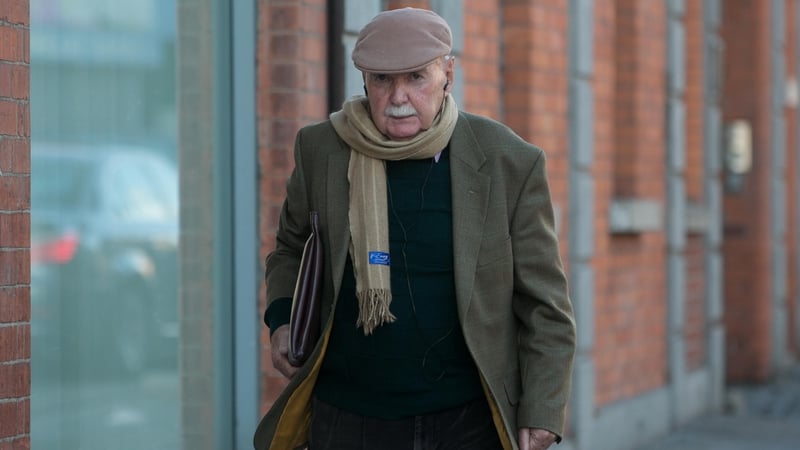
Former chief executive of the Irish Nationwide Building Society Michael Fingleton has died at the age of 88.
Mr Fingleton was one of the most central and controversial figures of the financial crisis over a decade ago.
He led the building society for almost four decades before he retired in 2009, a year after the State guaranteed the liabilities of all the main lenders, including Irish Nationwide.
The following year, the institution was taken over by the State and ultimately cost the exchequer €5.4bn to deal with the consequences of its bad loans arising from its poor lending practices.
The son of a garda, Mr Fingleton was born in Tubbercurry, Co Sligo in 1938.
He initially toyed with the idea of becoming a priest and attended a seminary, but left before taking his vows.
He later studied for a B Comm in UCD at night while working full-time at Allied Irish Finance in the early 60s and graduated in 1967.
Mr Fingleton then went on to work for the Dairy Disposal Board, the State organisation that took over failing creameries, and studied to become a chartered accountant.
He also spent some years working for the aid agency Concern in the late 1960s and early 1970s.
In 1971, he joined what was the Irish Industrial Building Society, which later became Irish Nationwide Building Society, as its secretary.
At that time it was still a very small organisation with just a handful of staff.

He qualified as a barrister in 1973, and quickly grew the customer base of Irish Nationwide, gaining the society public attention, not least through his gregarious personality and friendliness with journalists.
But he also built a reputation as a tough lender, who kept a tight rein on costs, charged relatively high interest margins and took a clinical approach to dealing with those in arrears.
His approach earned him a reputation for running the building society with a tight grip.
Mr Fingleton was also well rewarded for his efforts, earning increasingly large salaries that garnered public attention.
Bit by bit, he expanded the building society’s activities beyond personal savings and mortgages and into commercial lending, including property.
From 2001, loans for commercial development rose rapidly and it grew a very sizeable exposure in the UK in the process.
Mr Fingleton took great advantage of the Celtic Tiger property boom and built a very profitable business around it, with the loan book growing from €4.3bn to €10.4bn between 2003 and 2008.
However, the lending practices and corporate governance of the society at the time were later found to be far from normal.
The lender took equity stakes and agreed profit-sharing arrangements in projects into which it was lending; for example, loans of up to 100% were sometimes advanced.
Mr Fingleton aligned himself and the society’s activities closely with a small number of the top property developers in Ireland and became personally involved in all big lending decisions.
It was later claimed that loan approvals often bypassed the normal procedures of the credit committee, no security at all was taken for certain loans and required documentation was often brief or non-existent.
It was often suggested that Mr Fingleton ran Irish Nationwide as though it were a personal bank, claims he strongly rejected.
His approach though, proved a very profitable one for the building society and for Mr Fingleton personally, who between 2005 and 2008 took home remuneration of over €8.5m.
But it also led to the lender exposing itself to what would prove to be significant, overly concentrated and terminal risk, with 80% of its €10.5bn loan book ultimately exposed to commercial property loans.
During the mid-2000s, Mr Fingleton tried to line the society up for demutualisation and a sale for up to an estimated €1.5bn – a process which would have generated a significant windfall for its more than 120,000 members and management, including Mr Fingleton.
The legislation to allow the sale to happen was passed in 2006.
In 2007, Irish Nationwide made record profits of €391m and Mr Fingleton received a remuneration package of €2.3m along with a €28m pension top-up from the society.
It should have been the perfect time to sell the business and significant interest was expressed in it from a number of buyers.
But the same year it also emerged that over a nine-year period Irish Nationwide had controversially refinanced multimillion euro personal loans that Seán Fitzpatrick had borrowed from Irish Anglo Bank while he was its chief executive and chairman.
Then the financial crisis hit and Mr Fingleton’s plans for a sale of the building society were scuppered.
In 2008, as the credit crisis hit, Irish Nationwide’s frailties were exposed and it was covered under the Government’s €400bn blanket bank guarantee.
The following year, Mr Fingleton received a €1m bonus. When he came under severe public pressure, he later said he would pay the money back, but ultimately never did.
In April 2009, after 37 years at the helm of the building society, he agreed to retire, following a meeting between the board of Irish Nationwide and the Department of Finance.
Ultimately the society’s balance sheet became swamped by bad loans and in 2010 it was nationalised by the State.

It was merged with the remnants of the failed Anglo Irish Bank the following year, and most of its loans were moved to the National Asset Management Agency, where they were written down by 61%, with the remains of the organisation wound down through the Irish Bank Resolution Corporation.
The final cost to the exchequer of the failure of Nationwide was €5.4bn, proportionate to its size, the biggest loss of all the Irish banks.
In 2015, Mr Fingleton appeared before the Oireachtas banking inquiry and told it that he regretted very much that the State and taxpayer had to pick up the bill for the financial crash.
But he also said he did not regret any decision he took during his time at the helm of Nationwide, although he did regret that the society had grown a loan book that was too large.
He also said that he had paid a personal price and was continuing to do so and claimed Nationwide was not insolvent on the night of the bank guarantee.
The same year, the Central Bank launched an inquiry into alleged regulatory breaches by Mr Fingleton and other executives at the building society between 2006 and 2008.
The former Nationwide boss took a case to the High Court to try to prevent the probe from going ahead, but failed. The inquiry began public hearings in December 2017 and initially Mr Fingleton took part.
He claimed that the building society may not have needed a bailout had the Government extended the deposit guarantee scheme to €100,000 sooner.
Mr Fingleton also told the inquiry that he had failed to read internal audit reports and denied being on the credit committee which reviewed big commercial loans, even though records suggested he was.
But he later claimed he was unable to continue participating in the inquiry due to ill-health and in September last year his son, Michael Jr, asked that it be terminated.
In December 2019, the inquiry decided to permanently halt its investigation in as far as it relates to Mr Fingleton.
He is survived by his wife Eileen, and children Anne, William, Eileen Jnr and Michael Jnr.
His funeral will take place at St Anne’s Church, Shankill, Co Dublin on Friday.
Additional reporting: Fergal O’Brien