
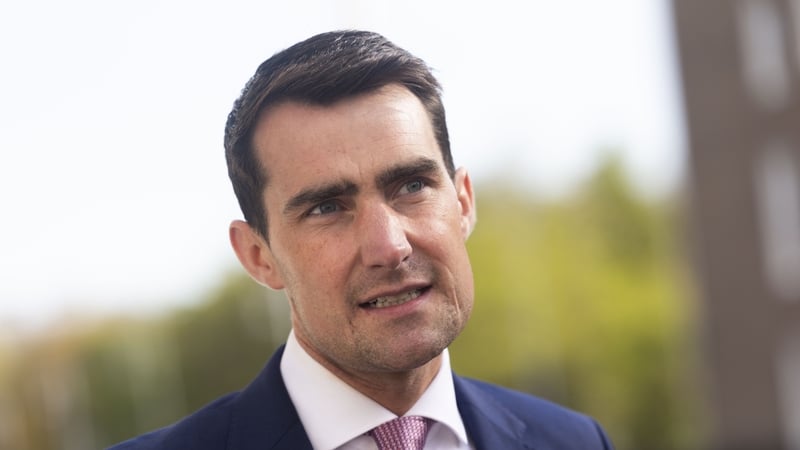
A senior Government minister has told the HSE to introduce “much greater efficiencies” around staffing levels, saying there is a “need to focus on frontline deployment” rather than “management and administrative staff” appointments.
Minister for Public Expenditure Jack Chambers criticised the existing situation, saying the current system is “not acceptable” and that there needs to be a “much greater focus on frontline deployment”.
Speaking to reporters at Government Buildings during the launch of his department’s Mid-Year Expenditure Report, Minister Chambers said “there will have to be choices around future staff deployment” in order to ensure the health service stays within budget.
He said the main focus should be on “where the greater service need is” when it comes to any future budget plans.
“That’s what citizens want to see,” he said.
“There has to be much closer alignment between growth in public sector staffing and the available budget, and clearly we’re monitoring the public sector expenditure in future years,” Minister Chambers added.
He said there is a need “for much greater efficiencies in how we deploy public sector staffing”.

The minister said: “We’ve had significant growth for example in management and administrative staff in recent years, but in my view we need to focus on frontline deployment.
“If we take the health service for example, the report [the Mid-Year Expenditure Report] outlines in some instances a greater level of growth and administration than frontline capacity.
“For me that’s not acceptable into the medium term and we have to have much greater focus on frontline deployment.”
Mr Chambers said the Government has been “very clear growth needs to be aligned with service needs and priorities, not growth everywhere”.
“That’s why there’ll have to be choices around future staff deployment, where the greater service need is because ultimately that’s what citizens want to see around better delivery, a better focus in terms of frontline deployment,” he said.
Asked if he believes there are too many managers and middle managers in the HSE, Minister Chambers said: “I think there’s elements of our health system that need to be much more efficient.
“We know the input costs and the level of expenditure has not been connected to the level of outputs.
“Just endless recruitment everywhere does not improve outcomes for citizens or for people who want a better public health system.”
Mr Chambers said he is “aligned with the Minister for Health” Jennifer Carroll MacNeill on the matter.
Debates over health service budgets and the amount of money being spent on the mutually connected frontline, management and administrative roles in the system has long been a source of significant discussion, with repeated calls since the economic crash for frontline areas to be prioritised over others.
However, while reforms have taken place in the more than 20 years since the HSE was established, management representative groups have repeatedly argued that their roles and those involved in administration are key to what is intended to be the effective running of the frontline system.

The Mid-Year Expenditure Report noted that health is the “second largest share of voted Government expenditure, accounting for approximately 26% of total current Government spending”.
It said that “there is scope to improve spending efficiency across the health service” and that, in the Department of Public Expenditure’s view, “there is a need to consider prioritisation of resource allocation within the sector to deliver on current and future policy objectives”.
The report also said that between 2017 and 2025 there was a 40.9% increase in management and administrative staff in the HSE.
This compares to a 41.6% increase for health and social care roles, a 35.3% increase for nursing and midwifery, a 51.6% increase for medical and dental care positions, a 15.5% increase for patient and client care, and a 10.2% increase for general support roles.
In a page headlined “spending adequacy”, it concluded: “Overall, Ireland’s health service delivers good outcomes for patients.
“There is a need to consider prioritisation of resources within the sector to deliver on current and future policy objectives.”
Chambers warns Govt departments against overspends
Mr Chambers also said Government departments have been warned they will be “architects of their own fiscal space” next year if they overspend and do not find cuts within their existing budgets.
Minister Chambers said while 15 out of 18 Government departments are within budget, he believes Budget 2027 will be dependent on savings in the system.
The Minister for Public Expenditure said next year’s budget is “about choices” and “how we protect and ensure fiscal sustainability”, later saying departments “who want room for significant new measures” will be “the architects of much of their own fiscal space”.
The comment comes after significant internal Government discussion between departments in recent months to find ways to cut other budgets to help address overspend in the Department of Education’s special educational needs budget.
In early summer, Minister Chambers outlined a series of small but significant percentage cuts to other departments’ budgets to cover the overspend to meet families’ needs.
The Mid-Year Expenditure Report stated special educational needs spending increased by 68% between 2019 and 2025.

Overall across all Government departments, the report – which like last week’s summer economic statement is widely seen as a key platform for internal coalition budget negotiations – said total departmental expenditure has increased from €67bn in 2019 to €118.5bn this year.
While the report said this has been supported by “record levels of capital expenditure”, which has increased from €7bn in 2019 to €19.1bn this year, expenditure levels are predicted to rise to €147.3bn by 2035.
“Improving efficiency and productivity, and strengthening governance, are critical to ensuring public expenditure remains sustainable while continuing to support high-quality public services,” the report said.
Responding to the publication of the Mid-Year Expenditure Report, Labour’s finance, public expenditure and reform spokesperson Ged Nash said: “The review, coupled with last week’s Summer Economic Statement, makes it clear that as far as the Government’s figures are concerned, money available for new and expanded public services will be very limited come October’s budget.
“Taken in the round, it will cost close to €7bn on top of what will be spent this year just to keep the current level of school, hospital and welfare services going.
“This looks like bad news for families who are, for example, still waiting for the Government to make good on their €200 per month-max childcare fees cap.
“Government has the option to decide to raise additional revenues to bring our services up to the standards we should expect in a wealthy, growing country, and in a way that does not impact on the productive economy.
“But Fianna Fáil and Fine Gael have been reluctant to do so.”