The Grand Theft Auto series is arguably the most successful – and lucrative – games franchise of all time.
There’s a strong case to be made that it’s the most controversial, too.
So it probably shouldn’t be a surprise that the upcoming iteration – GTA 6 – is currently on track to smash launch day sales records.
It also shouldn’t be much of a surprise that the plan for GTA 6’s release has caused plenty of controversy too. What is surprising, though, is that the backlash has come from some of the series’ biggest fans rather than its long-time opponents.
Liberty for all
It’s a far cry from the game’s humble beginnings.
The first GTA came out in 1997, made by a Scottish studio called DMA Design which – until that point – would have been best known as the creators of Lemmings.
The game put you in the place of a minor player in the crime scene of Liberty City – which was styled on New York – with your character tasked with different missions from other criminals, which eventually brought you to other cities.
As the title suggested, that led you to commit plenty of crimes – including grand theft auto, theft, assault and murder.
You could steal just about any car you came across, over time you could find a variety of weapons, and you could go to great lengths to evade arrest.
But the game got a relatively mixed reception on its launch – in part due to the fact that it didn’t look all that impressive, even for the time.
GTA was a top-down, 2D game at a time when everything was shifting towards 3D. This was the era of Tomb Raider, Goldeneye, Crash Bandicoot and Mario 64, against which GTA looked like a relic of the late ’80s rather than a new release of the late ‘90s.
But what it lacked in graphics, it made up for in gameplay – because it was an open world game, where the player had a significant amount of freedom in what they did in the game.
While there was a relatively detailed plotline and missions the player could follow, it was up to them as to how you went about that. They could dip in and out, or they could ignore the plot altogether and just explore the city.
And there were some surprising elements of depth tucked away in parts of the 2D world.
The other ‘citizens’ of the city would react to what you were doing, if you committed crimes the police would respond- and that response would escalate as your crime-spree escalated – while there were even multiple radio stations that you could listen to while you drove around.
Hard crime

No-one could claim that GTA looked in any way realistic, but it was still a game built around violence and crime. It also would have come out in the same era as other violent games like Mortal Kombat, Carmageddon, Doom and Quake.
So it was almost inevitable that it ended up at the centre of a debate around violent games, which echoed the video nasty controversy of the 1980s. Many worried about the influence these kinds of games had on players – and whether they might encourage them to replicate the game in the real world.
There was – and is – no evidential link between game violence and real-world violence, but that doesn’t really matter in the midst of a moral panic. Fuelling that panic was the fact that, up until that point, many people would have seen gaming as something reserved for kids.
But it also has to be said that the developers of GTA leaned into the public concern. The original game’s marketing campaign was devised by the subsequently disgraced publicist Max Clifford, who used the negative publicity to drum up sales.
And really DMA (which was ultimately acquired by Take Two, which folded it into its Rockstar brand) has had little fear of courting controversy in the years since, with each game getting more violent, more crude, more detailed and more over-the-top.
Future releases allowed players to hire a sex worker and then kill them so they can take their money back, for example, or make it possible for players to drive “drunk”.
Inevitably that has led to countless attempts to have versions of the game banned – or censored in some way. There have also been multiple court cases launched by the families of victims of gun violence, who claimed the game had in some way inspired their loved ones’ killers.
But none of that has served to dent the game’s popularity –some would argue it’s only added to it.
Killer title
That’s evident in the sales figures.
The original GTA performed well, selling about a million copies in its first year. Nothing earth-shattering – but a very good performance for a small studio.
By the time the game went out of production, it had sold six million copies.
It was followed up with two 1960s London-themed expansions, and then a full sequel – GTA2 in 1999.
But while this had a few gameplay and graphical improvements, it ultimately felt like more of the same.
Clearly it didn’t light a fire under gamers, either. In the end GTA2 sold around two million – well below what its predecessor managed.
It was such a drop-off that many started to wonder if the concept had already run out of road.
Third degree

But just two years after GTA 2’s release, Rockstar unveil Grand Theft Auto 3.
And (pun intended) it’s a game-changer.
The third game flips the player’s perspective from its top-down, 2D roots to a third person, 3D point of view. With that shift alone the game suddenly goes from looking old-fashioned to cutting edge.
But does this while also offering players even more in-game freedom, more complicated missions, a more dynamic storyline that reacts to their actions and choices, and lots more side quests and easter eggs for people to find.
And, of course, more weapons, vehicles and potential crimes.
It’s like they took the original idea and turned everything up to 11.
Even the radio stations were fleshed out with their own presenters, funny ads, news bulletin and more.
This may not seem like much by today’s standards, but by 2001 gaming standards this was nothing short of revolutionary.
According to the website HowLongToBeat.com – it would take an average of 19 or 20 hours for a player to complete the game’s main plot, and more than 36 hours if they wanted to do absolutely everything in it.
That’s not taking into account time they might spend just driving around or picking fights for the sake of it.
Of course there had been other games that took a long time to complete – and so-called sandbox games that gave people freedom in how they played – but this was on another level in terms of the graphics, freedom and options it gave people to choose their own adventure.
The impact was so significant that, very quickly, other studios rushed out with their own (generally ill-fated) attempts at open-world crime games.
Over time, though, the trend GTA 3 created led to many other franchises that were more successful in putting their own spin on the sandbox style, including the likes of Far Cry and Assassin’s Creed.
Crime pays

But none have come close to matching the success of the GTA franchise.
GTA 3 was an instant hit, ultimately selling around 14.5 million copies worldwide.
Just a year later Grand Theft Auto: Vice City is launched – featuring similar game mechanics but set against a Miami-style city in the 1980s.
One of the stand-out developments here was the radio. In previous games the developers had largely relied on original songs, but in Vice City most of the music was licenced. That meant you could drive down Ocean Drive listening to Cutting Crew, Flock of Seagulls and Hall and Oates.
That helped Vice City to out-sell its predecessor – shifting around 17.5 million copies.
But even that was out-done by the second GTA 3 spin-off – San Andreas – which was set in the 1990s, California-themed city. Released in 2004, this one managing to rack up 27 million copies in sales.
That performance was then matched by GTA 4 – which was released in 2008.
But all of that was subsequently blown out of the water by GTA 5, which came out in 2013.
Rockstar shipped 29 million copies within six weeks of its release – more than the previous two games had managed in their lifetime.
In the end it sold 230 million copies – making it the third best-selling game of all time, behind Tetris and Minecraft.
The difficult eight album

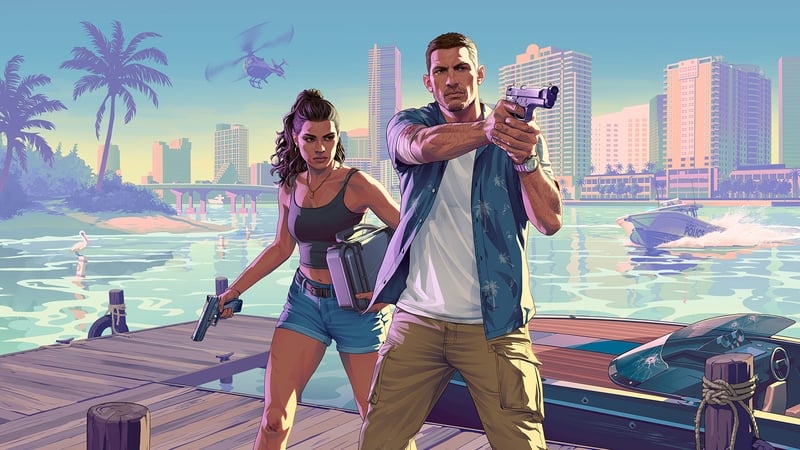
And now the focus shifts to GTA 6 – the long, long-awaited sequel.
Rockstar recently confirmed that it is set to come out on the 19th of November – 13 years after the last instalment. That represents by far the longest gap between iterations.
Part of the reason for that delay is that, back in 2013, Rockstar also launched an online multiplayer version of GTA, which has been getting updates and add-ons in the subsequent years.
That has kept players entertained and – crucially – has kept the money rolling in for the developer.
But GTA 6 has also suffered from multiple delays.
It’s been in development for more than six years now, and is estimated to have cost as much as $2 billion to make. That would put it as the most expensive game ever, by a significant degree.
But the anticipation for the release is so strong that analysts don’t think it will have any difficulty in making that incredible investment back.
At the moment it’s forecast to shift 40m copies on its first day of release alone.
At €80 for the standard edition – and €100 for the ultimate edition – that would be anywhere between €3.2 billion and €4 billion dollars. In one day.
That would blitz the current record for fastest-selling game ever, GTA 5, which sold 11 million copies in one day, making over $800m in the process.
Despite that, there is no chance of GTA 6 coming close to the ‘best-selling game of all time’ title. At least not in the foreseeable future.
That’s because it’s initially only launching on PS5 and Xbox Series X/S- and, at the moment, there are roughly 130m of those consoles in the world.
So even if every single one of those bought a copy, it would still be 100m copies short of its predecessor – and hundreds of millions shy of Minecraft and Tetris.
It is likely that such a big game will encourage more people to buy a PS5 or Xbox – GTA has been a major driver of console sales in the past – but realistically it will probably take a PC launch before it has a chance of threatening the top spots.
Disc-less wonder

The fact that it has irritated gamers – and games retailers – won’t help its record-breaking chances either.
Part of that is because of Rockstar’s plan to lock some features of the game behind the more-expensive Ultimate edition.
This, though, is part of a broader industry trend that’s become a norm – much to the annoyance of many players.
This is where, having paid full price for a game, people are encouraged (and perhaps even required) to pay more for DLC (downloadable content).
This could be anything from a superficial object, like in-game clothes, to an item that improves a players’ performance, to a whole new section of the game.
But as disliked as this sales tactic is, the main source of public anger is the decision by Rockstar not to make physical copies of the game.
It means that, even if someone goes to a bricks and mortar shop and buys a copy, all that will be inside the box is a code that they can use to redeem the game through their console’s digital game store.
This decision has angered retailers – because they see it as another step towards them being taken out of the gaming equation. They’re right to worry, too, because the industry is clearly shifting towards being digital only.
All consoles now offer digital downloads of games – and the entry level Xbox and PS5 come with no disc drive at all.
Recently Sony also revealed that its next console – the PS6 – won’t have any version with a disc drive.
Second hand news

The argument the industry makes to justify this shift is that most gamers want to move away from discs and cartridges – and industry data does suggest that the vast majority of purchases today are digital.
Getting rid of physical copies also helps to tackle issues like piracy, the developers say, while also cutting costs.
Many gamers are unconvinced by these arguments, though, and annoyed that the disc option is being taken away from them.
With GTA 6 the move to digital only is certainly not cutting costs – €80 is a step above the normal retail price for most new games. It is also a lot to pay for something that you don’t really own, too.
And this has led to questions about what will happen to these games in the future.
If a gamer has to change their console – or they upgrade to the next generation of device – will they have to buy another copy?
Or if the company that makes the game – or the console – ends its support down the line, will they lose access to it too?
Perhaps crucially, the end of physical copies will also kill the second-hand market.
This has been a huge part of gaming for decades – and helped to make gaming more affordable to customers.
Someone who bought the game new could sell it on to someone else – or to a retailer – which meant they got a bit of their money back. At the same time another gamer would get a chance to buy the game they want for a discount.
But the games industry has long hated the second-hand market – because they’re not getting a cut.
And if they succeed in wiping out physical games, they’ll wipe out the resale market too.