
Updated / Wednesday, 15 Jul 2026 18:08

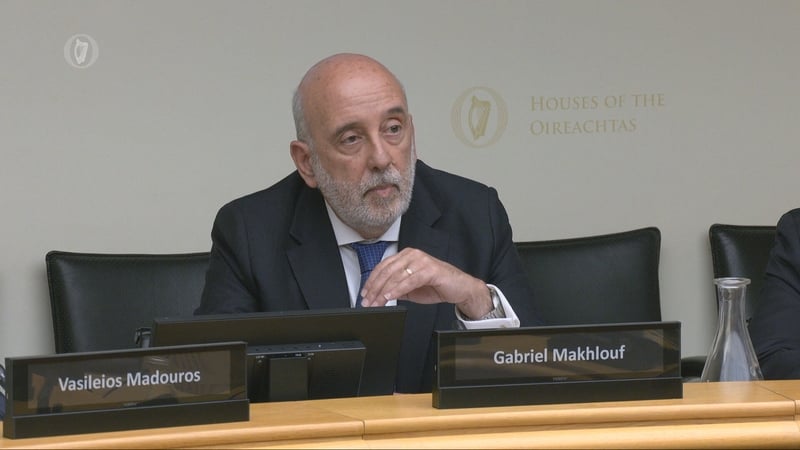
The Governor of the Central Bank of Ireland has insisted that the institution has acted lawfully in its handling of controversial Israeli war bonds.
Gabriel Makhlouf said he appreciates how important the Israeli Bond Programme is to the Irish public.
But he rejected claims that the bank could have prevented those bonds from being issued last year, nor does he believe that he can prevent their being issued again this year.
He made the comments while appearing before a sitting of the Oireachtas Joint Committee on Finance.
Last year, the authority to give EU approval to Israeli war bonds was temporarily switched from Ireland to Luxembourg.
Mr Makhlouf pointed out that “these bonds were not marketed in Ireland last year at all”, and he insisted that there were “no grounds to refuse the transfer of the approval process”.
“I note that there have been a number of statements that the Central Bank could refuse to approve a prospectus [eg for war bonds] – or indeed its transfer to another competent authority for approval,” he said.
He noted that some commentators have suggesed that this could be done “on the basis of the ICJ [International Court of Justice] provisional rulings in the ongoing South Africa – Israel case,” and a case being brought against Israel for its occupation of the Palestinian Territory.
South Africa alleges Israel is committing genocidal acts in Gaza, violating the 1948 Genocide Convention.
But Mr Makhlouf pointed that, “These cases are ongoing”, and no final judgements have been made.
“While these cases could lead to EU sanctions being imposed upon Israel, as matters stand there are no EU sanctions imposed upon Israel restricting its ability to issue securities.”

Such sanctions were “imposed upon Russia following its invasion of Ukraine,” he noted, but as they have not been imposed on Israel, that has consequences for the Central Bank.
The governor stated that he must obey the relevant laws, “though”, he added, “I understand that can be difficult and frustrating for the committee in the current circumstances”.
Any change in how EU prospectus regulations operate has to come from the European Commission, he said, noting that the Government has raised the matter with Brussels.
“I am not aware if the other side has responded,” he told Fianna Fáil TD Shay Brennan.
Independent Senator Alice Mary-Higgins suggested that a failure to block the war bonds was a breach of international law, which prohibits funding genocide, given Israel’s actions in Gaza.
The senator accused the bank of taking a “piecemeal” and “dismissive approach” on this issue, one which she claimed is rooted in a “fundamental misunderstanding” of the facts.
Sinn Féin TD Pearse Doherty also challenged the bank’s actions in the context of the UN Genocide Convention.
While Mr Makhlouf said that Israel’s “collective punishment” of Palestinians was “awful”, he refused to be drawn on whether it constituted genocide, as he said that it is a legal definition which is determined by the ICJ, something it has not yet done.
Mr Makhlouf stated that the bank has acted legally, but was constrained in the detail he could give about the upcoming prospectus in September, as he said he is bound by confidentiality.
He sketched out four possible scenarios to the committee which include that if Israel continues to issue bonds worth less than €1,000 – as they have been doing – they could ask Ireland to transfer approval to another state, as they did last year.
They could simply ask Ireland to approve the prospectus, as it had been doing up to last year.
Israel could also choose “not to issue any more” bonds; or it could decide it could issue “bonds of a value over €1,000,” which would allow it to simply choose which EU state would provide approval.