Oil prices are not cheap in the summer and expensive in winter.
The price is driven by the global economy and speculation on the futures market, not the weather.
As the futures market is very speculative and reactive to factors including global demand, shipping and exchange rates, future prices are difficult to predict.
Heating oil prices change all the time.
Before the Middle East conflict began, the cheapest price for 500 litres was €473.43 on 18 January, according to oilprices.ie.
It recorded the highest price for 500 litres at €903.00 on 7 April, around five weeks after the US and Israel attacked Iran and the Strait of Hormuz closed.
This week, on Thursday 8 July the average cost for 500 litres was €595.81.
On that day global oil prices rose briefly above $80 a barrel in light of US President Donald Trump saying the ceasefire with Iran was over, and after renewed strikes in the Middle East.

On Friday 9 July, an average 500 litres rose to €619.74, although it’s unlikely the change in price was directly linked so quickly to the strikes.
Global prices lurched after the fresh attacks and retaliatory strikes.
But as the day went on oil prices eased again on Friday as markets assessed the escalating conflict between the US and Iran and its implications for efforts to end the war and fully reopen the Strait of Hormuz.
Brent crude futures were down 11 cents, or 0.1%, to $77.91 a barrel on Friday afternoon, US West Texas Intermediate crude futures dropped 38 cents, or 0.5%, to $73.14 a barrel.
At the peak of the conflict, oil prices rose to $120 dollars a barrel, they peaked at $122 a barrel on 29 April after the US said it was preparing for an “extended” blockade of Iran.
This week’s fluctuations are still way below that figure, indicating there’s no full-blown panic.
Repeated promises of breakthroughs from Donald Trump have seen oil prices fall, while tit-for-tat attacks see them climb again.
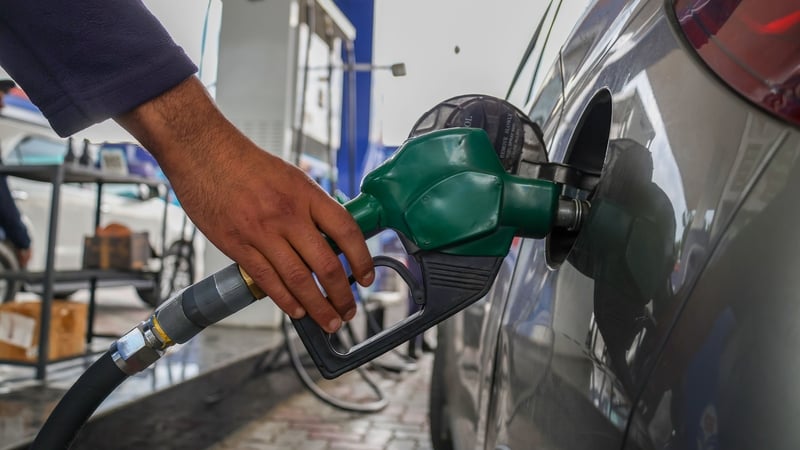
Where is the price of petrol and diesel at now?
With the price of oil falling since an interim deal, albeit fragile, was signed last month the price of a barrel is not far off pre-war prices, for now.
In March diesel prices rose to between €2.20 and €2.30 a litre, and petrol was costing motorists around €2.
Under pressure politically to tackle rising fuel costs, the Government has made two rounds of temporary cuts to the excise duty on fuel.
The cumulative reduction on diesel is 32 cent and on petrol it’s 27 cent.
But these will be reversed.

The full excise duty will be gradually phased back in across four increments from 1 September through 1 December.
Aside from these cuts, these are the figures on the ground this week:
The average price of petrol was between €1.68 and €1.76 per litre depending on where you filled up.
The average price of diesel was also around €1.68 to €1.76 per litre.
These are average prices and both petrol and diesel may be found cheaper or more expensive depending on the service station and where you are in the country due to price competition.
On Thursday afternoon, RTÉ’s Consumer Affairs Correspondent Aengus Cox reported that forecourt retailers have said they expect diesel prices at the pump to rise by around 10 cent per litre by this weekend.
The Convenience Stores and Newsagents Association (CSNA) said the wholesale price of diesel being delivered to forecourts today is 8 cent (plus VAT) higher than yesterday’s deliveries.
As a result, the CSNA – which represents over 1,500 retailers including 300 filling stations – expects to see this increase reflected on many forecourts across the country.
It could see diesel prices rise from roughly €1.70 to above €1.80 per litre at a lot of pumps.
Meanwhile, the price of wholesale petrol delivered today is up by around 2 cent per litre, which should also feed through to pump prices for motorists.
Tánaiste and Minister for Finance Simon Harris has said it was the Government’s intention to fully restore the excise duties by the end of the year, but that they would monitor the situation.
Mr Harris accepted that the overall cost of the excise cuts would be around €1 billion.

He said that there were some other costs included such as expanding the fuel allowance and specific supports for different sectors of the economy.
Speaking on RTÉ’s News at One, on 30 June, he said he wants to engage with the industry to discuss fuel pricing and why prices have not come down more.
“I expect to have an understanding from industry and engage with them directly in fairness and not through the airwaves,” said Mr Harris.
The CEO of industry lobby group Fuels for Ireland said he has been trying to meet with the minister since 28 February and spoke with his office multiple times this week.
“The minister says he wants to engage with industry,” said Kevin McPartlan, “we’ve communicated with him that we’ll make ourselves available anytime, anyplace, anywhere, and he’s not responding.”
Mr McPartlan believes if the situation continues in the Middle East as it is, it would be “an act of folly” to reinstate the petrol and diesel levies.
He said it’s very likely that if there is a return to as grave a situation as it was at the time the excise cuts were implemented, then the country would be back in exactly the same place.
“We saw the reaction, not a reaction that I support, but we saw the reaction of protesters earlier on in the year, and I think the Government would be reckless to try and reinstate the excise duty if we have a situation where global commodity prices are as high as they were back in March and April,” he said.
Does Ireland have enough fuel?
Ireland is well supplied, and the industry continues to work closely with the Government to ensure continuity of supply.
The primary concern is around security and ensuring people can heat their homes in the winter months and that transport can continue.
Uncertainty should not be confused with shortages, according to Mr McPartlan.
“We’ve managed the security supply situation, and when I say we, I mean Ireland, I’m not just talking about the fuel industry.
“The Government have been really good on this, I’m critical on a number of other things, but on this [they] have been excellent on ensuring that we have very, very strong, resilient supply chains,” noted Mr McPartlan.
Ireland is in a better position than most of Europe in terms of supply chains because of corporate relationships and geography to the North American markets
But if this conflict remains as it is today or deteriorates, as a small player Ireland has very little say on pricing.
Mr McPartlan says the only levers that can be pulled in relation to fuel pricing in Ireland are in Government Buildings.
He agrees with the Minister for Finance that Ireland needs to move away from knee-jerk responses to every oil.
However, he is critical of the lack of what he calls lack of strategic work to look at how fuel is being taxed and the four-step plan to reinstate the excise duty in full.
“That is a four-step plan to make Irish motorists pay more tax on their fuel than anywhere else in Europe again, because that was the situation before the first attack on Iran.
“All they’ve done is create a plan to bring us back into that situation again, I’m not sure that’s to be desired.”
What about electricity and gas?
The impact of the energy crisis has yet to play out fully across the economy.
The Government has extended the reduced 9% VAT rate on electricity and gas to 2030.
Many suppliers in Ireland hedge their electricity and gas purchases for 12 to 18 months, depending on the supplier and their risk strategies.
This means they can lock in prices on their gas or electricity ahead of time and potentially reduce the risk of market volatility.
This can be why electricity and gas prices don’t always rise or fall immediately when wholesale prices do and the impact on household bills can be delayed.

Recently, Flogas, Electric Ireland, Pre-Pay Power and Yuno Energy all announced increases of between 8% and 10.9% for electricity and 7.7% and 11.8% for natural gas.
That will be a significant burden for thousands of households around the country when consumption rises in the autumn.
What’s happening with inflation?
The annual rate of inflation ease slightly in June, but it is continuing to grow at a slower rate.
Many of the costs households feel most are continuing to rise well above the headline rate, while housing and energy costs remain under pressure.
At the start of the year, annual inflation was at 2.7%. It rose to a high of 3.7% in April, as the effect of fuel prices took hold, due to the conflict in the Gulf region.
Since then it has eased back slightly, falling to 3.4% as of June 2026.
Despite a dip in June’s annual inflation of 0.3% compared to April, Deloitte’s Chief Economist Kate English said annual price increases are continuing to be driven by the cost of energy.
“Electricity, gas and other fuels were trending low at the start of 2026, with annual price growth sub 2%. Today, this sits above 9%,” she explained.
She said this means two things: first, with the situation in the Gulf region still developing and oil prices rising again in recent days, we may see more price changes in the energy sector, which will keep inflation up.
Secondly, while food inflation in Ireland is at its lowest level since September 2021, the price of food and fuel are connected, she commented.
“The ESRI have previously flagged that the strongest price increases in food usually come 8-10 months after fuel rises, so we are likely not yet feeling the effects of the rise in energy prices on our grocery bills,” said Ms English.
While there is plenty of attention on oil, she noted that there should also be a focus on the price of gas.
“We typically associate high gas usage with winter months, but the heat Europe is experiencing is driving demand for air con,” she said.
Gas reserves are already lower than their average over the past five years. Yet the demand for gas isn’t stopping anytime soon and despite the current sunny weather, people potentially will be turning the heating back on in only a few months.
The Eurozone inflation is out next week, and the European Central Bank is less than two weeks away from their next rate decision.
The ECB committee will be analysing the inflation data closely.