
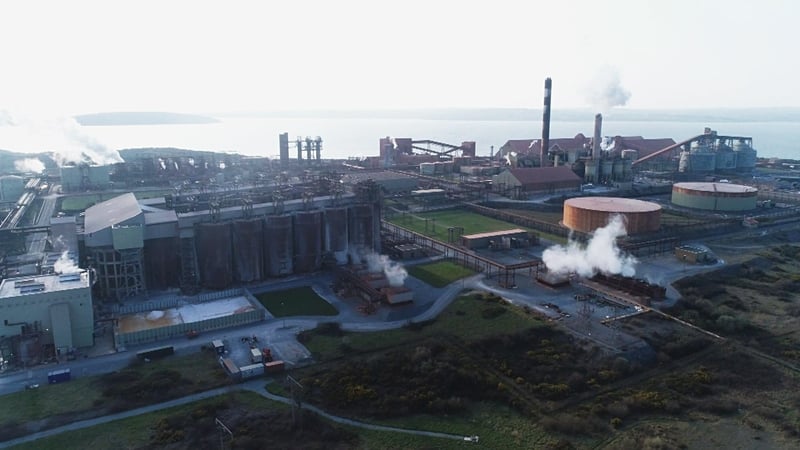
The European Parliament has voted in favour of a proposal to ban alumina exports to Russia.
The measure was contained in two amendments to a vote on a European Commission report on Ukraine’s accession to the EU.
Fine Gael MEPs voted in favour of the proposal, which is non-binding. Fianna Fáil MEPs abstained.
Last week, Taoiseach Mícheál Martin said Ireland would “develop an approach” with the European Commission on how to respond to the shipments of alumina from the Aughinish Alumina refinery in Co Limerick to Russia.
Fine Gael MEP for Ireland South Seán Kelly said: “With this vote we condemn Russia’s war in the strongest possible terms and reiterate our unwavering solidarity with the people of Ukraine and our support for its independence, sovereignty, and territorial integrity of the country, within its internationally recognised borders.
“In order to end the war, greater pressure must be applied on Russia, including increased and more comprehensive structural sanctions, with the aim of depriving it of resources necessary to finance its military machine and sustain its aggression against Ukraine.
“Additionally, no EU-based economic activities should be directly or indirectly contributing to Russia’s ability to sustain the war.
“We welcome the Government’s investigation into the recent reports on Aughinish Alumina and keenly await the outcome of this report.”
Fianna Fáil MEP for Dublin Barry Andrews said: “While I agree that we need to end trade of alumina with Russia, unfortunately, the blunt wording of these amendments did not consider the risks to the European supply chain of this critical resource, or to the risks to the downstream supply of aluminium to Europe.
“The amendments also did not recognise that the Irish Government now sees the need for action and is currently investigating Aughinish Alumina,” he said.
Sinn Féin’s Lynn Boylan voted to ban alumina exports to Russia.
“Sinn Féin firmly believes that Government action is needed to end the exports from Aughinish Alumina to Russia. The workers of Aughnish don’t make export decisions and their jobs need to be protected,” said Ms Boylan in a statement.
“Therefore, we will be supporting both the amendments from EPP and S&D regarding ending exports of Alumina to Russia.
“We cannot have a situation where profits can flow to a country violating international law. However, the Government are not passive bystanders, they must use their position to ensure that the EU steps in and purchases the alumina.
“The EU has said that the alumina is a critical material to the bloc so now they must demonstrate that through action.
“We welcome that the European Parliament is taking an interest in this issue. However, we do find it hypocritical that they cannot apply the same standards or urgency to arms exports to Israel or banning trade with illegal settlements.
“Our position is clear and based on the universality of international law, not the shocking double standards of European leaders and Fine Gaels EPP group in particular.”
Kathleen Funchion MEP did not attend this week’s plenary session in Strasbourg due to a family bereavement.
‘We are not the ones that decide the sanctions’ – Kelleher
Fianna Fáil MEP Billy Kelleher said he will wait for the result of an investigation by the Government into Aughinish Alumina to determine if “strategic” raw materials are making their way into Russia for its war efforts.
Speaking on RTÉ’s Drivetime, Mr Kelleher said: “First and foremost, it is the commission that decides on sanctions on Russia. We have had 20 rounds of sanctions on Russia.”
He said there has never been a reference before to Aughinish Alumina being sanctioned for exports to Russia.
“There is nobody saying that we shouldn’t have sanctions but we are not the ones that decide the sanctions. It is for the commission and what is happening in the meantime and in tandem, is that the Irish Government … is carrying out a full investigation into Aughinish to see where the alumina is going.”
He said the first priority of a sanction is that it “must hurt the enemy more than it hurts yourself.”
There are ‘other markets available’ for alumina – Doherty
Speaking on the same programme, Fine Gael MEP Regina Doherty, who voted for a full ban on all EU alumina exports to Russia, said she and those who voted with her “made a political statement”.
“I really don’t believe we should be supplying strategic materials to a country that is waging an illegal war against a European country that is costing the taxpayers in support of that country, to sustain itself and hopefully win the war, billions of European taxpayer money,” she said.
Ms Doherty said “what is absolutely undisputed”, is that the alumina that is being created in Limerick and Sweden, “is ending up in Russia”.
She added that before the invasion, that alumina was exported to other European countries, adding that there are “other markets available”.
‘Any amount of raw material that goes to Russia is too much’
The Director General of the Department of Sanctions and Strategic Export Control at the Estonian Ministry of Foreign Affairs said Estonia will seek the banning of alumina exports regardless of the findings of the Irish Government’s report.
Estonia is seeking the ban of alumina and all raw material exports to Russia and will seek such a ban at the earliest opportunity, which it expects to be in the 22nd EU sanctions package.
Speaking on RTÉ’s Drivetime, Kadri Elias-Hindoalla said: “We have been asking for the ban on all of the goods…so not only alumina, but also the other products that are being used in the war, and at least from the sixteenth package.”
Ms Elias-Hindoalla said: “We know from investigative journalism, that the amount of alumina that is going to Russia is pretty big.
“So actually, any amount of raw material that goes to Russia is too much.”
She said there is always an effect on EU business and the EU economy when there is a ban on something, “because our economy obviously is interconnected”.
“But we think that it’s much more expensive for us to support this war by supplying Russia with raw materials.
“So we have to take some losses in ourselves in order to end this war.”