
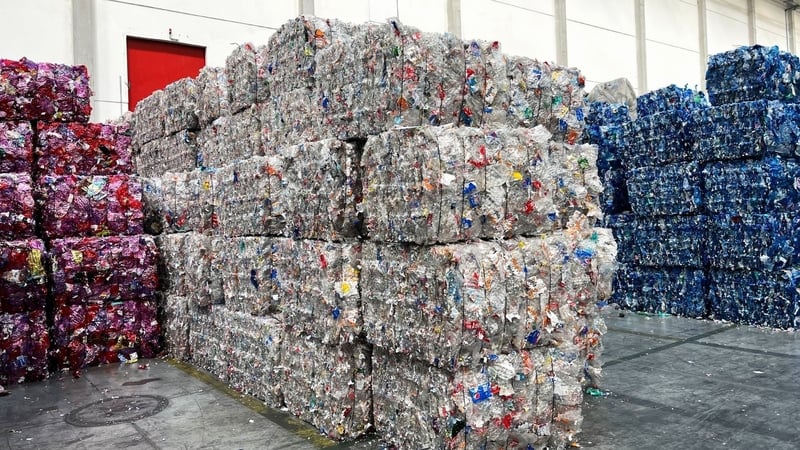
The Deposit Return Scheme (DRS) has reported some impressive figures this week.
Since its launch in 2024, more than 3 billion bottles and cans have been returned.
It’s highest single day in terms of returns on 27 June saw 5.8 million returns.
For comparison, a typical day last month saw less than 5 million returns on average.
Re-turn, the private, industry-led, not-for-profit company that operates the scheme, says it is on track to meet its targets.
It’s aiming to get to 90% recycling by 2029, and is currently at 78% to 79%, with 14% still going through mixed recycling.
The operator says around 800 million additional bottles and cans are now being recycled each year.
Ciaran Foley, CEO of Re-turn said: “The Deposit Return Scheme is performing strongly and continues to build momentum.”
Re-turn recorded €66.7 million in unredeemed deposits in 2024, these are one of three revenue streams used to fund the DRS, alongside producer fees and the sale of recyclate material.
It said all income is reinvested in operating, expanding and improving the scheme.
The company said this includes funding consumer education and awareness campaigns, paying retailer handling fees, transport and logistics, processing and recycling costs, and ongoing investment to improve return rates and scheme accessibility.
Despite the strong figures the scheme is not without its critics.
Consumers complain of having to hoard bottles and cans at home and then bring them to a return machine where they often must queue, and that bins are regularly full or out of order.
Some consider the refunded 15c or 25c per bottle or can like an extra tax on goods that they previously were able to put in their green bin but now must go out of their way to reclaim it.
And in other cases, Dublin businesses say they believe organised gangs and vulnerable individuals are among those who are searching in bins for bottles and cans to recycle, which Dublin City Council said cost €500,000 last year to clean up after.

Re-turn says independent monitoring shows bottle and can litter has reduced significantly.
It noted that Irish Business Against Litter’s (IBAL) latest survey showed that litter from cans and plastic bottles in towns and cities has more than halved since the scheme was introduced.
IBAL spokesperson Conor Horgan said the scheme has made a serious contribution to cleanliness,
However, he also said it’s disappointing that in the third year of the system its still not fully embedded.
He expected that it would become part and parcel of people’s everyday lives to return their cans and bottles.
“That’s not happening across the board and we’ve actually seen a slight increase in this form of litter in the last few months,” he said.
Based on the prevalence of this type of litter, people don’t see the value in returning it, according to Mr Horgan.
“I think the 15c probably does need to be reviewed, it’s not enough for people to put that can in their backpack.
“Certainly, if we were to increase it, that would bring about the change, but I can imagine there’d be public resistance to it,” said Mr Horgan.
He also noted that it’s something of an anomaly in cities that there’s scavenging for bottles and cans from public bins, while the same type of litter is on the ground a couple of streets away.
“That is a hard one to square exactly,” he said, “but there’s no doubt that the scavenging is a problem and its costing money to the local authorities to clean it up,” he said.
Exchange for Change, the operator in the UK that will be introducing the DRS in Northern Ireland next year, carried out behavioural market research to test consumer response to deposit levels ranging from 10p to 30p.
It’s going to introduce a flat fee of 20p for containers between 150ml and 3 litres.
Their research showed deposit levels below 15p are unlikely to provide sufficient incentive to help achieve target return rates of 90% of containers within three years, while a 30p level could result in disproportionate consumer cost exposure at the point of purchase.
The Convenience Stores and Newsagents Association (CSNA) has highlighted that the scheme across the border will offer higher grants that will automatically be given to all small retailers.
The CSNA says that the DRS scheme is now costing small retailers in the Republic of Ireland money.
There are also concerns among smaller retailers over how long they can cover the costs of maintaining these machines, particularly in villages.
The initial grants were given to businesses who collected up to 250,000 cans and bottles a year.
They say that a lot of people bring their deposits back to their smaller local shops, particularly the shops that have chosen to put the machine outside.
The President of the CSNA said there are around 2,850 reverse vending machines in the country and around 1,000 qualified for the grant in the first year.
The grant which is up to €3,000 per year if you collect less than 250,000 units is due to run out next year.
Following a survey with their members, they found that indoor machine installation costs for a basic model were around €13,000 plus VAT, with the majority buying models for around €16,000.
Outdoor installations, according to members, cost an additional €15,000 approximately for building works and connectivity.
They reported additional costs for labour costs for staff to empty and clean the machines of around €178 per week or around €9,000 annually, and a yearly maintenance fee of up to €1,000.
They also cited loan repayments, rising electricity costs, cloths and paper for the machine and grit in the winter and deodorisers in the summer, bringing the total running costs to around €15,000.

CSNA President Sara Orme said at the beginning customers returned small numbers of cans and bottles and spent the money in the shop.
But now she said it’s often big refuse sacks to the value or €20 or more and people are just collecting the cash.
“We get 2.2 cents per unit,” said Ms Orme, “that’s a lot of cans to make up €15,000.”
The 2.2 cents is based on what is the norm in Europe.
The labour costs, electricity costs and day to day running costs in Ireland are much higher than it is in Europe, commented Ms Orme.
“We’re really looking at now is everyone else in the return chain is getting paid fairly.
“But the people at the bottom, which are the retailers who are making this work in the community, are actually the ones now that are bearing the brunt of the cost of it”, she said.
The Joint Oireachtas Committee on Climate, Environment and Energy is meeting with Return CEO Ciaran Foley on Wednesday.
Ms Orme said they are going to appear at that meeting as a witness to put forward their case because they’re “technically losing money on this”.
Last October the Business Post reported that five members of senior management at Re-turn, were paid a combined €1.1 million in 2024.
It said the not-for-profit employed an average of 46 staff and had total employee costs of €4 million for the year.
The company is not government funded, it makes its money through funding from beverage producers, uncollected deposits and the sale of recycled materials.
The returned bottles and cans are considered high quality and uncontaminated, making them a valuable commodity that can be sold to offset operational costs.
The Irish Waste Management Association confirmed to RTÉ that cans and bottles disposed in household bins are recycled to the same standard as those processed through the DRS.
It follows comments by Re-turn CEO Ciaran Foley on Radio One’s Today programme with David McCullagh claiming that containers placed in household recycling bins were being “downcycled” and were inferior in quality to DRS materials.
The IWMA said in both instances ‘bottles are recycled into bottles and cans are recycled into cans’.
Despite the mixed recycling company being at 30% to 40% of the number of bottles and cans they previously handled, it said it is supportive of the DRS.
It said it can see how the DRS is increasing the recycling rate for those particular materials, even though the IWMA have lost some value themselves.
The IWMA said they would like to see a Digital DRS introduced in the future for other items such as shampoo bottles.
They proposed it to the Government previously, but it was rejected as the system has not been rolled out nationwide in any country and was viewed as higher risk than the conventional reverse vending scheme.
The digital scheme would require every container to have a QR code which is a unique identifier.
For customers to reclaim their deposit, they could use an app to scan it and scan a QR code on their bin at home, and the deposit is refunded using your phone.
It could potentially be used on items including Tetra Pack, juice cartons and shampoo bottles.
IWMA believes if trialed at scale for any item it could be convenient for the public rather than have to go to the machines.
However, the association acknowledges that there would need to be ‘buy-in’ from producers who would need to absorb the cost of putting QR codes on their products.
There is only one company in Ireland that collects, sorts and reprocesses plastics Shabra Group in county Monaghan.
It says it is the only closed loop recycling, plastic reprocessing, manufacturing and supply company in Ireland.
Speaking on Radio One’s Today programme CEO Ciaran Foley said Re-turn’s bottles and cans are exported for reprocessing.
The operator said its long-term ambition is to support the development of Ireland’s first on-island PET processing plant, helping to keep more material in the Irish circular economy and supporting bottle-to-bottle recycling.