The head of the National Asset Management Agency (NAMA) has said that he will return to the National Treasury Management Agency (NTMA) after NAMA has dissolved.
NAMA was set up in 2009 and is the State body responsible for handling property loans of Irish banks that faced collapse during the financial crisis.
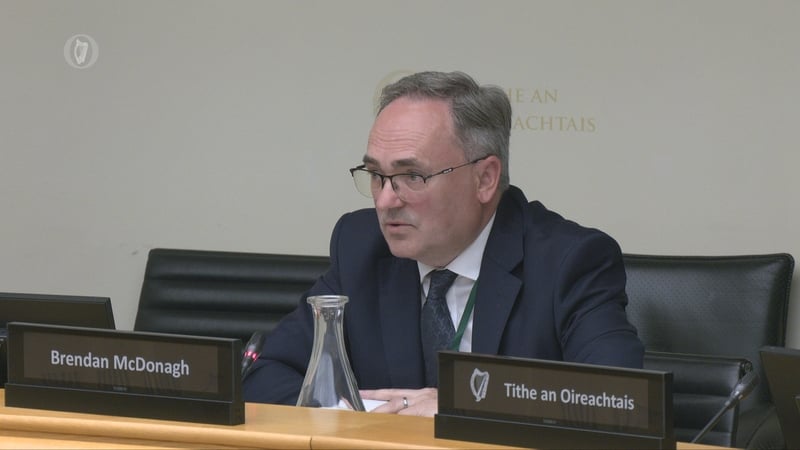
Its Chief Executive Brendan McDonagh appeared before the Public Accounts Committee today to discuss the winding down of the agency.
He said it was likely that NAMA would be dissolved in the coming weeks, after it transfers its remaining activities to a proposed resolution unit in the NTMA.
Mr McDonagh said he was effectively chief financial officer of the NTMA before NAMA was established, and confirmed that he would be returning to the NTMA at an equivalent level.
“I was told that I had to do NAMA, I didn’t really want to do it to be honest with you but I was told the country’s a mess you’ve got to do it,” he told Sinn Féin TD Cathy Bennett.
“After I finish NAMA, I’ve a right to return … and I’m going back to the NTMA at the equivalent level that I was in 2009.”
Mr McDonagh said his exact role has not yet been decided, as he is in discussions with the NTMA chief executive.
“I went into a job to do a job. When NAMA started I didn’t know if it was going to last one year, two years, 10 years … I didn’t expect it to last 16 years. I’ve a right to return, however long that was,” he said.
Mr McDonagh told the committee that NAMA would cease operations after it transfers its remaining activities to a proposed resolution unit in the NTMA.
“We are ready for NAMA to be dissolved but we continue to deal with any remaining assets and litigation until the dissolution date, which is likely to be in the coming weeks once legislation is enacted,” he said.
Mr McDonagh added that NAMA’s remaining activities include a residual asset portfolio worth €22 million, from a starting point of €31.8 billion in borrowings, which will be handed over to the NTMA, alongside around €50m in cash.
He said that NAMA had 81 staff members at the end of 2025.
However, many had left under a redundancy programme, leaving nine employees, including himself.
Mr McDonagh said that eight of them will be going to the resolution unit in the NTMA, but he will not.