
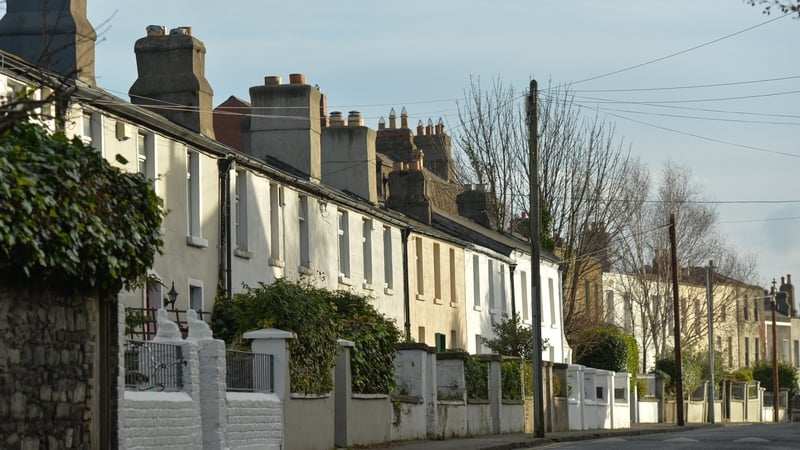
The selling prices of homes in Dublin have begun to fall, according to the latest sales report from property website Daft.ie.
The research found that in June house and apartment selling prices in the capital were 2.3% lower than the same month in 2025 – the first annual decline since 2023.
However, the study noted “this may be revised when further transactions are registered for the quarter in coming weeks”.
The report said the drop is “consistent with a market where supply is recovering, following the long shadow of higher interest rates, and competition between buyers is easing slightly”.
Meanwhile, the findings from Daft suggest a different picture outside the cities.
In Munster and especially Connacht-Ulster, asking-price inflation remains strong – at 6.3% and 8.8% respectively – and little changed from a year ago.
“In these markets, supply remains acutely tight, and new-build activity, though growing, is not yet enough to relieve the pressure,” the study added.
Overall on a national basis, Daft said selling prices rose by 3.2% in the year to June (compared with the first half of 2025) – the slowest rate of increase since 2023.
The research also found that the typical gap between the initial asking price and the ultimate selling price of a home has narrowed to 5.5% nationally, down from 6.8% in June 2025.
Daft attributes this fall to competition between buyers easing.
Asking prices rising at faster rate in rural areas
The research suggests average asking prices for homes in rural areas are rising at a considerably faster rate than in cities – further contributing to what Daft said is a “two-speed market”.
The property website notes that in the year to June average asking-price inflation in Dublin roughly halved to 3%, while the rate is essentially flat (-0.2% year-on-year) in the country’s other big cities.
This compares with strong year-on-year inflation outside the cities in terms of asking prices for homes.
The study said these differences are “closely linked to trends in supply”, noting that at the beginning of June there were just over 13,100 second-hand homes for sale nationwide, up 6% on a year ago “but still only around half the pre-pandemic norm of over 26,000”.

It said the improvement is “concentrated in urban markets: availability in Dublin is now close to its pre-Covid average, while supply remains tightest in Munster outside the cities (66% below the 2015-2019 average) and in Connacht-Ulster (down 64%)”.
The research found that in the year to June average asking prices for homes nationally rose by 3.8% to €445,000, which is down almost half from the rate of 6.8% at the same time last year.
However, asking prices are now on average 44% above their pre-Covid levels and just 8% below the Celtic Tiger peak, according to the study.
Report Author and Professor in Economics at Trinity College Dublin Ronan Lyons said: “The defining theme of the second quarter is a broad-based slowdown in price inflation – but it is far from uniform.
“We are seeing a genuinely two-speed market: cooling in and around the cities, where supply is at last recovering and competition between buyers is easing, but still running hot across much of rural Ireland, where availability remains acutely tight.
“In Dublin in particular, transaction prices have actually begun to edge down, the first annual fall in over two years.”
Prof Lyons added that “what is striking this quarter is where the activity is coming from”.
“In the year to March, the number of homes changing hands rose by just over 3%, but that growth was driven entirely by newly built homes, sales of which were up 17%.
“The second-hand market – still by far the largest potential source of supply – is effectively stuck.
“New construction is hugely important, and the country needs to be building well above 60,000 homes a year, not under 40,000,” he said.
Prof Lyons said new-builds alone cannot rebalance the market.
He added: “That has to come from greater churn among the 1.4 million owner-occupied homes in the country – most likely as more owners roll off the fixed-rate mortgages taken out during the rate shock of the early 2020s.
“Until second-hand supply responds, overall activity will remain well below what a healthy market requires.”
Read more:
Annual house price growth eases to 6.2% in April – CSO
Cost of buying home in Dublin reaches €500,000 – CSO
Average price of second-hand homes in Dublin nears €600,000