
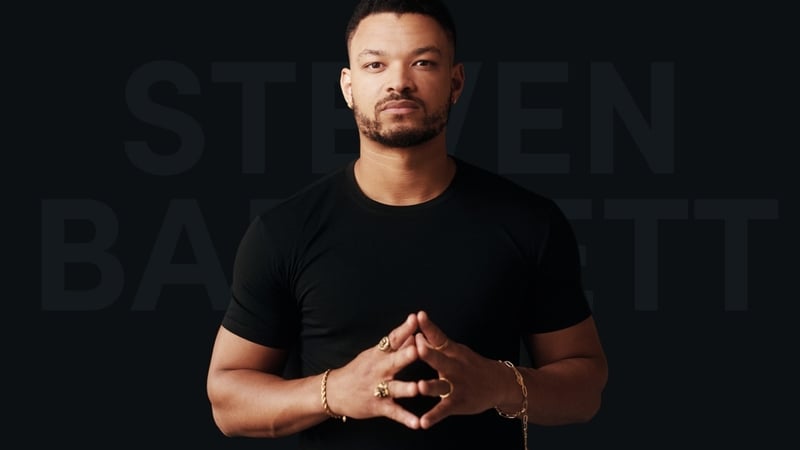
There’s no argument that Steven Bartlett is an incredibly successful businessman. But he’s also very divisive one.
On the one hand, his story follows the kind of rags-to-riches narrative that the business world has always loved. But it’s also drenched in the rise and grind culture that has become so popular on social media.
Over the years Bartlett has been lauded for his honesty, his drive and his marketing nous. But he has also been prone to exaggerating the scale of his success, as well as being an enabler for dangerous misinformation.
At his worst, his critics argue that he acts as a palatable gateway into the Manosphere.
More recently, he’s become a ridiculed figurehead for tech-bros’ obsessive and self-destructive trend towards health-optimisation.
So who is Steven Bartlett, really?
Bartlett was born in Botswana in 1992 to a Nigerian mother and an English father.
He says his mother left school at a young age and could not read or write – while his father was a very smart structural engineer.
When he was two they moved to Plymouth in England, to what he said was a “nice, white, middle-class area”. This, he said, made for a challenging backdrop to the financial struggles his family were facing.
Being black and poor in a white and well-off area gave him a feeling of otherness and of being less than. But that, he’s argued, ultimately ended up being a big driving force behind his success in business.
He said it made him realise from quite a young age that, if he wanted something, he’d have to go out and make it happen. It also made him obsessed with bringing money back to his family.
That gave him an entrepreneurial streak.
For example, he claims that while he was at school he was constantly creating money-making schemes, like securing vending machines for the other pupils and taking a cut of the profits, or organising school trips for other students
Social Empire
He took this business mindset all the way to college, where he took up a business management course in Manchester Metropolitan University.
But his time at third level only lasted for one lecture, as he claimed to have looked at the hungover students and the lecturer handing out felt-tip pens and decide it wasn’t what he needed. So, he dropped out.
He then set up his first business in 2013 – at just 21 years of age. But it was a year later when his empire really began with Social Chain, a company he co-founded with a man called Dominic McGregor.
Social Chain was focused on helping businesses to promote their brands on this new thing called social media – which was something many were struggling with because of how different it was to traditional advertising and marketing.
The edge that Bartlett and McGregor had was a realisation, before many others, that celebrities and experts were not necessarily the key to spreading a brand’s message in this digital world. Instead, brands needed to focus on a growing class of online personalities which came to be known as influencers.
Alongside this, Social Chain also claimed to develop tools to help detect fake followers – which some influencers would use to demand a higher fee from brands. It also created videos and articles of its own to share online, in an attempt to create viral content for its clients.
But while Social Chain seemed to strike digital gold at just the right time, it was also the first glimpse we see of Bartlett’s willingness to push the boundaries to grow his business and brand.
Brand Bartlett

In 2016 Social Chain was warned by Britain’s advertising authority for not making it clear that influencers were being paid to endorse products.
The declaration (or otherwise) of ads and payments has been a major issue within the rise of the influencer and social media. But it was particularly acute a decade ago, at a time when social media was still young, and still sat outside of the rules and regulations that had been built around more traditional platforms like TV, radio and print.
At the same time Bartlett was also pushing the boundaries with his own public image – he took his expertise in social media and influencing and turned it on himself.
It’s fair to say, in those early years at least, he was very much a fan of the ‘fake it ‘til you make it’ school of thinking.
For example, he has previously referred to his work with Social Chain by talking about founding a $600m company.
Social Chain did indeed reach that heady valuation – but only after it had merged with another, bigger firm, and only after he had left the company altogether.
While he was still working at Social Chain, Bartlett painted an online image of a high-flying businessman – travelling from one picturesque place to another, and doing deals while wearing flash clothes. But, according to company results, at this time Social Chain was losing millions of euro. It had somewhere in the region of a €7m loss in 2019.
However, that didn’t stop him posting lots of advice to other entrepreneurs; lots of motivational slogans like “develop your calm within the chaos” and “self-awareness is the thing that turns the lights on”.
Or even seemingly contradictory things like “winning teams are defined by their speed, impatience and smarts” followed by “long-term patience is a millennial growth hack”.
Dear Diary

While still at Social Chain, Bartlett decided to start his own podcast in late 2017 – The Diary Of A CEO.
As the name suggests, it started off as a kind of audio diary, where he talks about his experience in running a business.
But, quite quickly, it shifted to an interview format – where he talked to other CEOs to get their experiences and perspectives.
And through its early years he was quite open about his struggles, his anxieties and the feeling of imposter syndrome he was dealing with as he tried to build his business. He talked about burnout, mental health issues and failure.
And it’s a really potent mixture – because it feeds a demand among young entrepreneurs and that rising wave of influencers who are looking for guidance, insights and first-hand knowledge.
It doesn’t do any harm that he started to get some decent names on the show – early on he nabs people with good online followings like Joe Wicks and food writer Ella Mills. Eventually he bagged really big names like Michelle Obama and Richard Branson.
A lot of these episodes are wrapped up in the same kind of motivational, aspirational and sometimes click bait-y language that served him so well on social media. At the end of episodes, Bartlett would often focus on what the key takeaways or learnings are. Clips of the show would be promoted on social media with captions in that ‘here’s the thing they don’t want you to know’ style.
The show got another boost in 2022, with 28-year-old Bartlett named as one of the new dragons on BBC’s Dragon’s Den.
Having him as a dragon helped the show to broaden its appeal by bringing in a younger, digital-savvy investor – but it also helped Bartlett to build his profile with an entirely new audience.
And all of that came together to make for a massive hit show.
Today, The Diary Of A CEO is one of the most listened to podcasts in the world – its listenership is reportedly in the region of 50 million each month. Its Instagram account has 3.3 million followers, its YouTube account has 17.5 million subscribers.
Last year, Bartlett said the brand was generating $20 million in revenue a year. However that would go beyond the podcast itself, and into some of the related areas like partnerships, merchandising, and speaking engagements.
But that money has gone towards funding a production company called Flight Studios, while Bartlett’s net worth is reckoned to be somewhere in the region of £50-70m
Just ad controversy
The Diary Of A CEO has not been without controversies either.
Some of the first issues that emerged around the show were the conflicts of interest and advertising standards breaches that occurred in the podcast.
Because, after leaving Social Chain and going it alone, one of the ways Bartlett has built up his empire is by investing in other businesses and brands.
This is obviously a way for him to try to build his wealth – but it can be a win for the brand too because, aside from the money he might put in, it also gives them a high-profile backer that they can use to attract other investors and customers.
However, in some cases Bartlett would then have the CEOs from those companies on his show – or would reference the products the company makes – without declaring his involvement in the company or making clear that it was a paid-for endorsement or advertisement.
In 2024, the UK Advertising Standards Authority banned ads for meal replacement-drink Huel and health testing company Zoe that featured Bartlett because, it said, it could be mistaken for an independent review and not a result of Bartlett’s financial interest in both companies.
False profits
Over time, the guests themselves have become more controversial.
As the popularity of the podcast grew, its scope widened too. While it began focusing on CEOs, it eventually broadened to feature celebrities and sports stars as guests too.
Then Bartlett’s focus – echoing some of his investments – began to shift more towards health and nutrition.
However this has led to him having guests on with some extreme views.
For example, a BBC News report in 2024 identified one guest who claimed that the likes of autism and poly-cystic ovarian syndrome, could be “reversed” through diet. Another claimed Covid was an engineered weapon and that the vaccine did more harm than good.
In its defence his production company told the BBC the podcast was “an open-minded, long-form conversation … with individuals identified for their distinguished and eminent career and/or consequential life experience.”
It said the programme features a range of voices and “not just those Steven and the DOAC team necessarily agree with”.
Many criticise the fact that the podcast has platformed people with such extreme and unscientific views at all. Others take issue with the fact that those views are rarely challenged or pushed back on in any real way.
And while the production company say they feature people with a range of views, misinformation experts say there is still an inherent danger in putting extreme opinions in front of a huge audience unchecked.
More recently, critics of Bartlett have accused him of catering to some of the views and arguments more commonly heard within the toxic masculinity of the Manosphere.
In an interview with psychiatrist Alok Kanojia emerged, Bartlett asked whether societies should “put in place systems” to ensure lonely men can find partners.
In another interview with podcaster and YouTuber Chris Williamson – where the conversation shifts to declining birth rates globally – the guest mocks some of the reasons given by people for not having children and talks about how dangerous this thinking is. (Though both Williamson and Bartlett were themselves child-free at the time).
Unhealthy obsession

In recent weeks, Bartlett has become a source of derision for a completely different reason.
In the same interview with Chris Williamson, Steven Bartlett also spoke about how he had recently had three glasses of wine – and how it had ruined the next three days of his life.
He said that while he hadn’t gotten drunk, it had caused a domino effect, where he got worse sleep that night, ate more poorly the next day, “podcasted” worse, and then didn’t go to the gym two days in a row.
And he said that he could track all of this because he wears a Whoop – a fitness wearable that he’s an investor in (though he did declare his interests on this occasion).
This sparked a fairly mocking reaction from a lot of quarters – because it painted a picture of someone who had become so obsessed with bettering themselves, that they were ultimately failing to enjoy some very basic aspects of their life.
But it also served as a really concise representation of a growing trend towards self-optimisation that’s become very popular with the tech bro types, and with many others too.
That’s where people use the likes of wearables and data tracking apps to try and eat as well as possible, work out as well as possible, sleep as well as possible. None of which is necessarily a bad idea in insolation and moderation – but it does become a potential problem if obsessed upon.
And it has led some to question whether they should be aspiring to follow the advice and guidance of someone who is so successful, but who struggles to relax enjoy to enjoy the benefits of that every once in a while.