
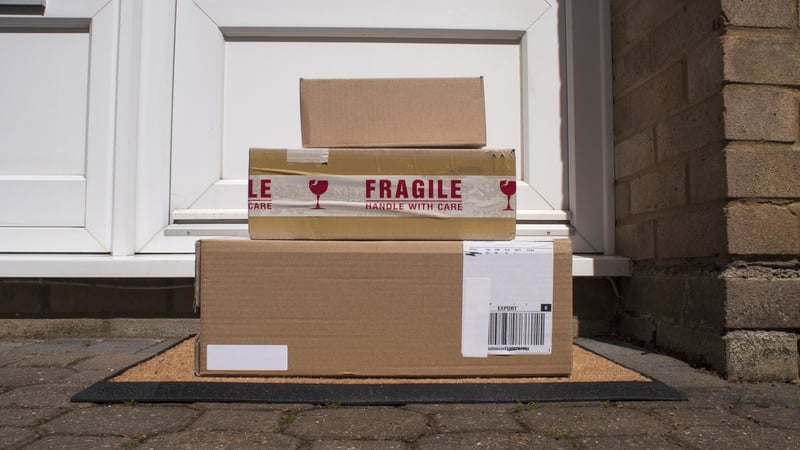
If you regularly shop online for cheap items, new fees could make you reconsider your shopping habits.
New EU customs charges could have significant implications for online shoppers who regularly buy low-cost items from British, Asian, American and other non-EU websites.
From 1 July, a €3 Customs Duty charge per item will apply to all eCommerce packages valued at €150 or less coming into Ireland from outside the EU.
The measure is part of the EU’s Customs Reform.
The aim is to ensure fair competition for business and to protect consumers from risks posed from imports that don’t meet EU safety and compliance standards.
In 2025 alone, almost 5.9 billion of such low-value items were directly shipped from third countries to consumers in the EU, without paying customs duties.
The European Commission says this has created an unfair competition that traditional retailers cannot compete with.
Currently there is no charge on low-value consignments that are under €150, due to the de minimis duty-free rule.
This rule was originally to reduce the administrative burden on companies but now all electronic data is available due to the digitalisation of customs procedures.
This new customs duty is per item, not per package, even if all items are from the same online retailer, except for identical items.
Revenue has provided some simple examples on its website to explain how the €3 charge will be applied.
The first example looks at a mixed package which contains one notepad, one pen and one keyring.
Because the package contains three distinct items, each will have a €3 customs duty charge.
This means in addition to VAT and delivery charges there will be a €9 customs duty charge.
Another example highlights a package containing two identical cotton t-shirts.
This will be classed as one distinct item because the goods are identical and will attract a €3 customs charge.

The charge may be collected at the online checkout, but shoppers need to be aware that some smaller retailers may not apply the charge on their site.
In these instances, duty will need to be paid before delivery to An Post on behalf of Irish Revenue.
An Post said there is admin charge which has been in place since the introduction of the customs charges for non-EU goods in 2021, so it’s not new.
An Post charges a €6.95 administration fee on parcels which have not paid customs charges in their online shopping baskets before delivery.
It said this is a small percentage of the overall volume of parcels coming from non-EU countries, as most customers pay customs charges upfront.
The An Post administration fee applies to the package and not each item.
The customs admin fee covers the administration of the collection of VAT and duties for Irish Revenue, along with the resources needed and storage space, as items must be held in a secure location until paid.
Compared to other postal administrations, the price varies by country and volume – Royal Mail between £8/£12, Bpost €21.50, Austria Post €7.20, La Poste €2-€5 and Deutsche Post €6.
In the majority of cases, customs charges will be paid in the shopping basket, if not paid, the revenue system identifies these items as unpaid.
An Post or another delivery company then notifies the customer vat and duty must be paid and the relevant admin fee for the delivery company.
Shoppers are being urged to check if the company’s warehouse is in the EU as some companies with a ‘.ie’ website may still ship from outside the EU.
As the new charges apply from 1 July, any deliveries arriving from 1 July into Ireland will apply, even if you have bought before that date.
With the changes to the system An Post is anticipating a rise in SCAM texts.
To avoid being scammed An Post said it will never ask you to pay via a link in an SMS, it only asks customers to pay directly on our website or in a post office.
It also said in some cases when buying largely from smaller non-EU retailers An Post will notify people of any charges on their delivery via email or postcard.