
Japan’s core inflation was unchanged in May from April, government data showed today, days after the central bank hiked rates to a 31-year high because of the Middle East war.
Prime Minister Sanae Takaichi’s government has moved to shield consumers from the sharp rise in oil prices resulting from the three-month conflict with fuel and energy subsidies.
The year-on-year rise in “core” consumer prices last month in the world’s fourth-largest economy of 1.4%, which excludes fresh food, was in line with market expectations.
Excluding also energy, the reading was 1.8%, down from 1.9% and in line with market forecasts. Unadjusted, inflation inched up to 1.5% from 1.4%, also meeting forecasts.
The Bank of Japan raised its benchmark rate on Tuesday by 25 basis points to 1%, the highest level since 1995 and marking the first increase since December.
The US and Iran have agreed a peace deal to end their three-month conflict and reopen the Strait of Hormuz, a vital waterway for oil and gas.
But the full resumption of traffic through the strait back to pre-conflict levels is expected to take considerable time.
The European Central Bank hiked rates last week after the war pushed up prices for oil and other goods worldwide. The US Federal Reserve on Wednesday held rates steady.
But with US inflation at a three-year high, expectations are growing that its policy rate will rise later this year, despite pressure from President Donald Trump to cut.
Australia’s central bank, which has raised borrowing costs three times this year, also held rates steady this week as did the Bank of England.
Indonesia has hiked rates three times in four weeks.
Before the conflict began on February 28, Japan relied on the Middle East for around 90% of its crude supplies.
Government subsidies has helped to keep core inflation under the Bank of Japan’s target of 2%.
But the Bank of Japan warned on Tuesday that there was a risk that inflation could accelerate past its objective as firms pass higher prices for raw materials onto consumers.
Marcel Thieliant at Capital Economics said that “there are no clear signs yet that higher energy costs are lifting prices of other goods and services”.
“However, that is only a matter of time,” he said in a note, forecasting inflation excluding fresh food and energy to rise to around 3.5% in the first half of next year.
The yen has also come under major pressure in recent weeks, caused by the rise in oil prices and the gap between US and Japanese interest rates, pushing up resource-poor Japan’s already colossal import bill.
Takaichi’s government spent around 11.7 trillion yen ($72 billion) last month propping up the currency, which has been languishing at around 160 yen against the dollar.
Japan rice prices fall for first time in three and a half years
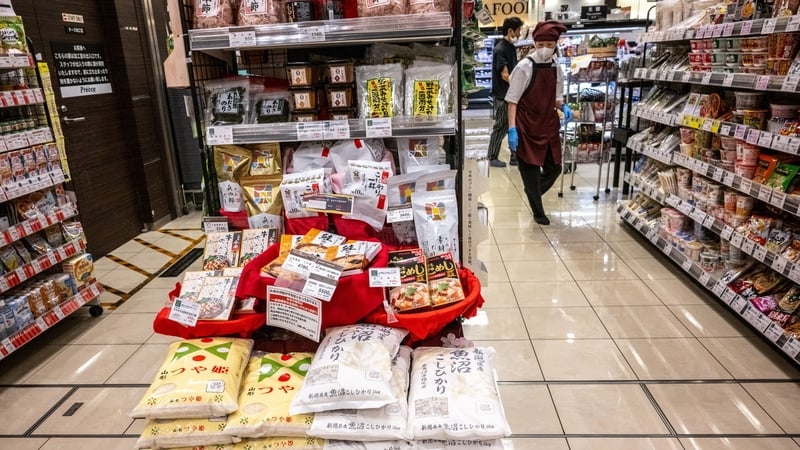
Rice prices in Japan finally fell in May for the first time in three and half years, officials said today, following sharp rises for the staple that put the government under huge pressure.
Rice prices skyrocketed in 2024 and 2025 because of supply problems linked to hot weather and panic-buying after a “megaquake” warning in 2024, amongst other factors.
Combined with falling living standards and corruption scandals, this led to voters deserting the ruling party and the resignation in September of Prime Minister Shigeru Ishiba after less than a year.
Rice prices excluding luxury brand koshihikari were 5.4% lower in May than a year earlier, the first drop since November 2022, a government official told AFP.
The government took various measures to bring rice prices down, including by releasing emergency stockpiles of the grain.