
The Chair of the Public Services Committee of the Irish Congress of Trade Unions (ICTU) has said any pay deal that is agreed by the Government and trade unions must be “closely linked to inflation” in order to maintain living standards.
Speaking on RTÉ’s Saturday with Cormac Ó hEadhra, Kevin Callinan said public sector workers had noted how the Government “mobilised” Exchequer funds to address the demands of fuel protesters in recent months.
“People are struggling out there and they’re struggling badly,” Mr Callinan said.
He added: The Central Bank … can’t be sure of what inflation is going to be the following week.
“We’re arguing that at the outset we should develop a formula linked to the movement in prices if there’s to be a multi-annual agreement, that it should be a formula linked to prices over a few years.
“Our experience, and I think it’s the experience of workers across the economy in general, is that the losses that were suffered as a result of inflation in 2021, 2022 and into 2023 has only been made good in headline pay figures really by now.
“It’s taken that long to catch up. We need a much more tight way where workers can maintain their living standards.”
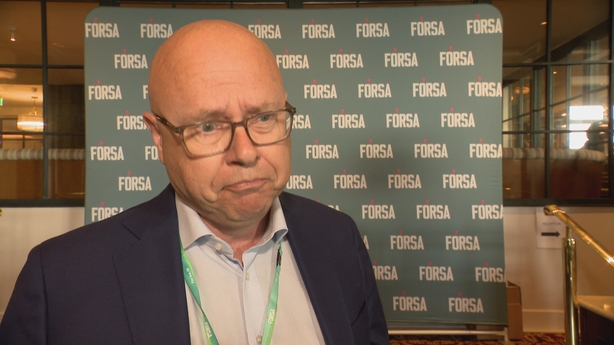
Mr Callinan, who is also General Secretary of the Fórsa trade union, said union members are “very attuned” to where the Government is placing its priorities.
“Members are asking very fair questions… because they have seen a few months ago on the back of the fuel protests how considerable exchequer resources were mobilised to address that.
“And they’re very, very attuned to where are the Government going to make their priorities on this occasion and that’s what we’re trying to get across,” he said.
In a letter to union leaders earlier this week, Mr Callinan raised the possibility of balloting for industrial action after the current public sector pay deal expires at the end of this month, if a successor agreement is not in place.
‘The existing agreement was not fully implemented’
Minister of State Niall Collins said workers are entitled to pay rises, but the Government will be seeking productivity reforms in any deal.
“We want a successor pay agreement. The pay agreements have provided for stability,” Mr Collins said.
He added: “They’ve helped our country grow and prosper and modernise, which is very, very important.
“And yes, they are entitled to pay increases. And obviously the Government will be seeking as part of any negotiation, productivity, flexibility, reform, all of which have been built into previous national and public service agreements.”
Sinn Féin Education Spokesperson Darren O’Rourke said teachers and school communities are “very frustrated” that the previous agreement has not been fully implemented.
“The existing agreement was not fully implemented, certainly as it relates to the local bargaining clauses. So, there is, in my opinion, a breach of trust there in relation to that.
“And like other workers across the public and civil service, they recognise that there are increasing costs every single day and that their wages aren’t matching them,” Mr O’Rourke said.
Social Democrats TD Sinéad Gibney said there is an increased risk of strikes due to the uncertainty around the next public pay agreement.
“I and my party back what seems like a very sensible approach from the unions in terms of the way that they’re looking for earlier commitments from the Government to agree the formula of the negotiations.
“I appreciate why they have trust issues with the Government,” Ms Gibney said.
She added: “We’ve heard very clearly why that is the case, where they’re not honouring agreed negotiations, both in terms of pay agreements, but also as we’ve seen in terms of court agreements as well.
“Those are things that when you’re coming to the negotiation table again, aren’t going to help.”