
Updated / Tuesday, 9 Jun 2026 10:54

Europe’s biggest airlines have urged the European Union not to expand its Emissions Trading System to cover international flights, warning the move would raise ticket prices.
The European Commission is considering expanding carbon costs to outbound international flights – it currently only covers flights within Europe.
The emissions system operates in Europe to try and compensate the planet for the carbon load of airlines, according to aviation journalist Gerry Byrne.
“Aircraft are never going to be like cars, for example, all of our gas-powered cars or petrol powered cars are going to be replaced by Teslas or other battery operated cars,” he said.
“That’s never going to happen with aircraft.”
Speaking on RTE’s Morning Ireland, Mr Byrne explained that airlines pay into a fund to compensate for carbon dumping into the atmosphere every time a plane flies, often with planting forests.
This system currently applies within the EU but the European Commission wants to extend this to other countries which may or may not have carbon balancing systems in play.
“The IATA is saying this is an imposition that they really cannot afford,” said Mr Byrne.
We need your consent to load this rte-player contentWe use rte-player to manage extra content that can set cookies on your device and collect data about your activity. Please review their details and accept them to load the content.Manage Preferences
Aviation industry leaders attending the IATA summit in Rio de Janeiro earlier this week said its landmark pledges to be net zero by 2050 will probably not be achieved.
Mr Byrne said the the target is almost impossible as there are very few alternatives to aviation fuel.
“One of them is alcohol-based fuels – what they call sustainable aviation fuel – but that currently only meets less than 1% of fuel needs,” he said.
“So the chances of ramping that up, huge, huge plantations will be needed to grow crops suitable for turning into ethanol and other alcohol-based tubes. It’s highly unlikely to happen,” he stated.
IATA represents more than 370 airlines which accounts for about 85% of global air traffic.
Before the Middle East conflict it had forecast a record $41 billion for the industry in net profit, but it has since halved that forecast.
Boeing and Airbus delivery delays have forced many carriers to keep old aircraft in service raising maintenance bills. Widely reported oil prices have seen jet fuel prices climb as a result of the war in Iran.
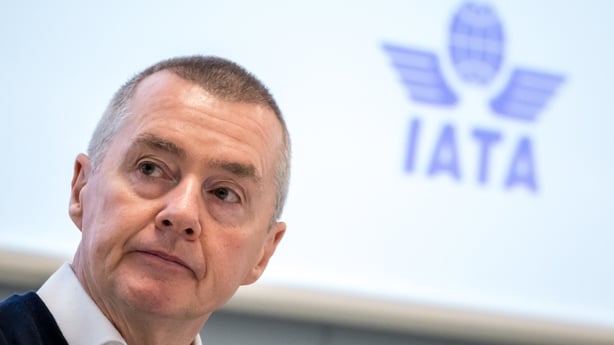
IATA Director General Willie Walsh said they expected jet fuel prices to be 70% higher across 2026.
This is despite many airlines saying they have hedged high percentages of their fuel for months ahead.
“I think within weeks, within months, certainly, they’re going to use up all the fuel that they bought at lower prices,” Mr Byrne said.
“They’re going to have to pay serious money for replacement stocks,” he cautioned.
Additional reporting by Reuters
More stories on