
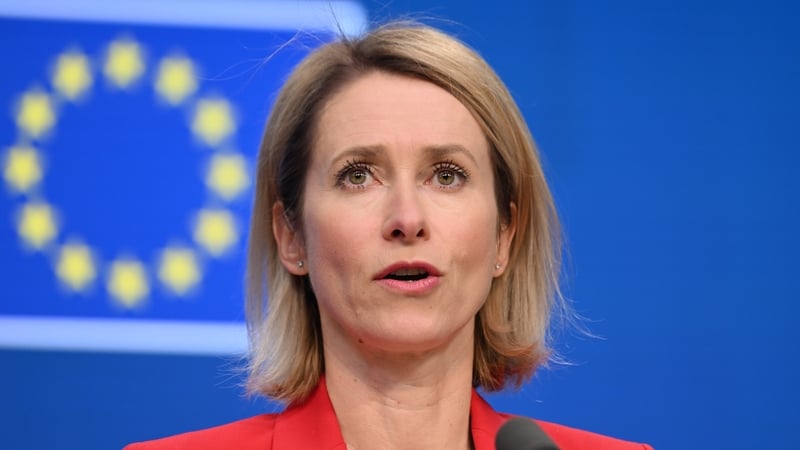
The European Commission has said the EU’s foreign policy chief Kaja Kallas will discuss the issue of Aughinish Alumina and alumina exports to Russia when she meets the Taoiseach Micheal Martin in Dublin tomorrow.
Aughinish Alumina is the refinery in Co Limerick at the centre of a controversy over its raw material allegedly ending up in Russian weapons.
Spokesperson Anitta Hipper told a news briefing: “Several topics will be discussed, including the support to Ukraine and also further pressure on Russia, but also this specific topic will be addressed as a matter of concern.”
Asked whether alumina could be considered in the next EU sanctions package against Russia, commission spokesperson Siobhan McGarry said: “We never comment on our upcoming sanctions packages. We are, with every sanctions package, looking at ways that we can close loopholes, always … with a goal to maximizing pressure on Russia and minimizing any revenues that they would take from this war.”
Asked today about Aughinish Alumina, Taoiseach Mícheál Martin said the Government “have concerns” and that an investigation by the Department of Enterprise and Trade is ongoing.
He said that as soon as that is complete, they will engage with the European Commission.
He said that he understood the issue was a wider European supply chain issue, rather than one specific to Aughinish or Ireland and so alumina was not on the sanctions list
He added that European sanctions are a European competence.

Last month, the European Commission said it had decided not to propose sanctions at this time on Aughinish Alumina.
One European Commission source said at that time that the reason to not to propose sanctions was due to the potential disruption to the European aluminium market, given that Aughinish is the main supplier of alumina to a number of EU smelting companies.
Alumina is a compound of aluminium from which aluminium is extracted. Aluminium is a vital component for hundreds of industrial, commercial, and military goods.
Thirty-nine MEPs from 12 member states had written to the European Commission calling for a ban on alumina exports from the EU to Russia, while the vice president of the European Parliament Pina Picierno called on the Commission to add alumina to the next sanctions package.
Read RTÉ Clarity: Russia’s refinery? Why Europe’s focus has turned to Aughinish
For its part last month, Aughinish Alumina warned the Government that any attempt to sanction its sale of alumina to Moscow would have implications for Ireland’s national gas and electricity grids.
The warning came in a briefing document provided by the Russian-owned plant to the Government and seen by RTÉ News.
The document stated that Aughinish Alumina “exports excess electricity to the national grid, enough to power [circa] 200,000 Irish households”.
The note also warns that Aughinish provides up to €25m each year for the maintenance of the natural gas grid.
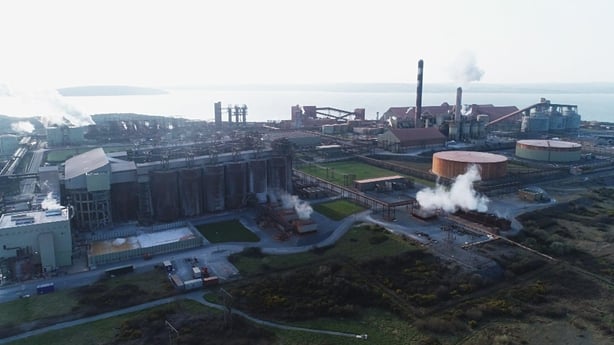
Both the briefing document, and a letter from the company to the Government – also seen by RTÉ News – warned that any attempt to restrict the sale of alumina from the Limerick plant to Russia would mean that the “ongoing viability of the refinery at Aughinish would be severely in question with the potential loss of employment”.
The letter to the Government ultimately warned that, since Russia is a net exporter of aluminium, and that it only relies on Aughinish for 10% of its alumina needs, any EU sanctions would “have no material impact on Russia and potentially stoke inflation in commodity markets in Europe”.
Ms Kallas also today stated that the European Union does not feel the time is right to start talks with Russia regarding the war with Ukraine.
“We feel it is not there yet,” she told a news conference in Cyprus.
“We really also need to have strategic patience when it comes to really pushing Russia into … a situation where they genuinely would negotiate.”
Russian strikes kill four civilians, wound over 30
Russian strikes along the Ukraine war front line killed four civilians today, including a 71-year-old man riding a bicycle, and wounded over 30, authorities said.
Two women were killed and four children aged between five and 12 were among 18 wounded in an attack on a residential building in Zaporizhzhia, the regional governor Ivan Fedorov said.
Mr Fedorov showed on his social media account pictures of bodies under covers and a smashed up building in the centre of the city, which is about 25 kilometres (15 miles) from Russian lines.
In the northeast region of Sumy, governor Oleg Grigorov reported a Russian attack with mortars and drones on the Seredyna-Buda district.
“As a result of the enemy attack, a 71-year-old local resident who was riding a bicycle was killed,” he said.
Another Russian attack targeted an apartment block, a bank and a store in Nikopol, in the Dnipropetrovsk region, the head of the local military administration Oleksandr Ganzha said.
“One person has been killed and four wounded,” he announced.
At least seven people were wounded in strikes at Sloviansk in the Donetsk region and three more in the Odesa region, local authorities said.
Daily Russian attacks that claim civilian lives have intensified in recent months, and Ukraine has hit back with its own drone strikes further into Russian territory, saying these are mainly against military and energy facilities.
According to a UN estimate published in April, at least 15,850 civilians have been killed in Ukrainian zones since Russia’s invasion was launched in February 2022.
Over 2,800 civilians have died in Russian-controlled zones, according to the UN toll, which added that more than 44,800 have been wounded in Ukrainian and Russia-occupied zones.