Recent renewed attention on the Aughinish Alumina plant in Limerick, and reporting about its links to Russia’s military production processes, have raised questions for the Irish Government and European Commission from Europe, Ukraine, and domestic politicians.
The issue is gaining increasing attention across the European Union and in Ukraine. Here’s what it’s all about.
The disagreement in five sentences
Campaigners, politicians and petitioners are demanding answers as to why the industrial plant – the biggest of its kind in Europe – is not included in European sanctions packages while it is exporting material to Russia, more than four years after Vladimir Putin’s full-scale invasion of Ukraine.
They say recent new reporting shows clearly that exports from the plant contribute to the manufacture of Russian weapons and military vehicles which are being used to attack Ukraine.
On the other side of the debate: Government ministers say the evidence is not sufficiently clear to show the alumina eventually ends up in use by the Russian military. They note the European Commission has not included alumina in sanctions packages against Russia for that reason and others.
In their view, alumina is a raw industrial material with extensive civilian uses, and the plant supports hundreds of local jobs.
The details are where it gets interesting.
What is Aughinish Alumina?
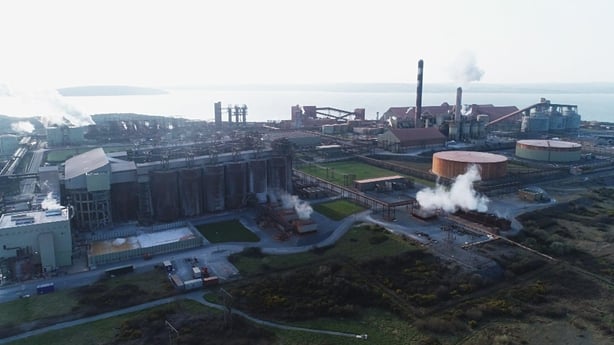
The Aughinish Alumina plant is Europe’s largest alumina refinery and exports much of its material – approximately 50%, though some contend much more – directly to Russia.
The plant refines imported bauxite into alumina, a white powder that is the key ingredient used to manufacture aluminium.
Alumina is exported and goes through a smelting process to create aluminium.
Aluminium is used globally in everything from electronic devices to construction materials, not to mention bombs and military vehicles.
Who controls Aughinish Alumina?
The Limerick plant was bought in 2007 by the Russian conglomerate, Rusal, one of the largest aluminium companies in the world.
Rusal was founded by the Russian billionaire Oleg Deripaska, who has been a close confidant of Russian President Vladimir Putin for decades.
The company that operates the plant says it is in “strict compliance with all applicable European Union laws, including sanctions, export control measures and trade regulations” and that it has implemented “robust sanctions compliance and due diligence framework covering its entire supply chain”.
It employs almost 500 staff, while several hundred other local jobs are supported indirectly by the continued operation.
In the period since 2014, when Russia occupied Ukraine’s Crimean peninsula, western countries have been sanctioning individuals and companies linked to the Kremlin, including Oleg Deripaska.
The US issued sanctions against Deripaska and Rusal in 2018. However, in 2019, a deal was agreed which saw Deripaska reduce his shares in Rusal below 50%, meaning he no longer had a controlling stake in it.
As a result, the US sanctions against the parent company of Aughinish Alumina were lifted.

The European Union has issued more than 20 sanctions packages against Russian entities, increasingly since the full-scale invasion of Ukraine in 2022.
That year, it banned Deripaska from the EU, and imposed an asset freeze against him “in respect of actions undermining or threatening the territorial integrity, sovereignty and independence of Ukraine”.
It has never imposed sanctions on Rusal, despite calls, and the Irish Government has lobbied against any sanctions which would threaten jobs in the plant.
In the years since Deripaska publicly reduced his stake in Rusal, questions have been raised about who or which entities truly control the company.
In 2022, RTÉ’s Prime Time programme examined the ownership structure of Aughinish Alumina, concluding a controlling stake in Rusal was then held by Deripaska, a second Russian oligarch closely linked to the Kremlin, and Russian state development bank VEB.
Yesterday, The Irish Times reported on a more recent confidential investigation carried out by the Swedish tax authorities into Rusal’s operations in Sweden and allegations of breaches of international sanctions targeting Russia.
It found that Rusal “continues to be controlled by sanctioned Russian oligarch Oleg Deripaska”.
What changed to bring it back into the spotlight?
The operations of Aughinish Alumina and its non-inclusion in EU sanctions have been contentious in particular since the 2022 full-scale Russian invasion.
In April that year, it was raised in the Dáil, with Donegal TD Thomas Pringle noting “we appear to be protecting the Aughinish Alumina plant from sanctions”.
“That is hypocritical of us,” he said.
“If we need to protect that plant, the Government should be considering taking it over straight away and [taking it] out of the hands of the oligarchs.”
The Government minister responding, Limerick and Fine Gael TD Patrick O’Donovan, accused Mr Pringle of basing his views on “information from online sources, which tend to be based on rumour and innuendo”.
“The plant employs well over 1,000 people in my constituency and it is not in any way connected to a war machine,” Mr O’Donovan said.
“In fact, it provides Europe with up to 30% of the alumina required for the continent’s construction and aircraft and car manufacturing and is an integral part of Europe’s alumina industry. It is not connected, as some people might want to suggest, to any sort of Russian empire.”
In the years since, the political debate and reporting around the plant remained on similar ground. Those calling for sanctions said the plant was Russian-owned and exporting material used in the production of Russian military assets.
They noted exports from the plant to Russia approximately doubled following the invasion, when Russia ramped up military production lines.
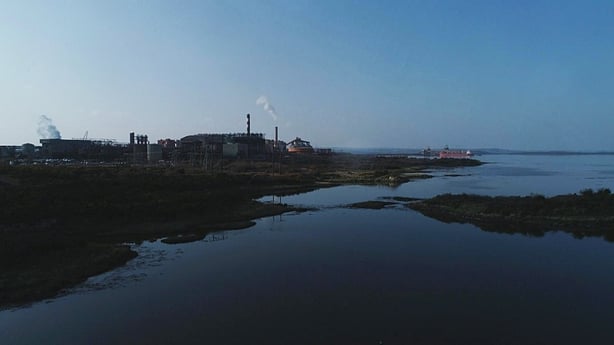
On the other side, local politicians, ministers, and others said there was no evidence clearly showing the alumina exported from Limerick to Russia, once smelted, was used to produce military vehicles or weapons.
That shifted significantly following an investigation published by The Irish Times and a collective of media outlets called the Organized Crime and Corruption Reporting Project (OCCRP) in March.
Using trade data and leaked documents, their investigation traced alumina exported from Aughinish through Russian industrial supply chains.
According to the reporting, alumina from Aughinish was supplied to Russian smelters, which produced aluminium that was subsequently sold through the Russian company ASK to dozens of sanctioned Russian military manufacturers involved in producing weapons and military equipment.
For campaigners opposed to the exports, the investigation provided the evidence others argued had been missing.
The investigation was in March. Why is it back in the news again now?
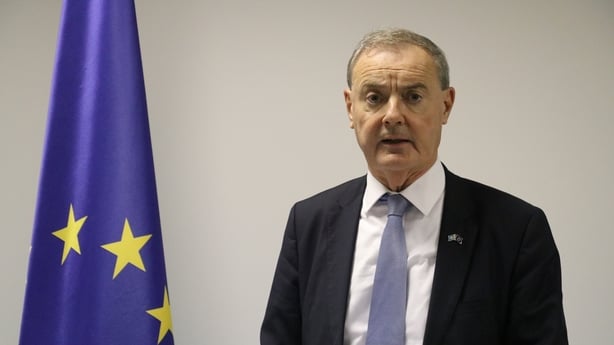
In the days after the publication of the OCCRP/Irish Times reporting, RTÉ asked the EU sanctions envoy, David O’Sullivan, about his views.
Speaking on the This Week radio programme, he said he was “surprised” and “concerned” by what the reporting contained and said that the European Commission was examining the issue closely.
If the report was confirmed, he said: “I think either the company will have to find a way of guaranteeing that will no longer be the case, because they won’t sell on to people involved in this, or we may indeed have to take another look at whether the product should not be sanctioned.”
In the meantime, the process to develop a new round of EU sanctions was being formulated by the European Commission and pressure campaigns began to ramp up, with petitions and political comments published.
On 6 May, the European Parliament’s Vice President Pina Picierno wrote to the European Commission demanding that alumina exports be included in the next round of EU sanctions.
It was “unacceptable that, while the EU funds Ukraine’s defence, a Russian-owned company operates undisturbed within a member state, supplying the Kremlin’s military industry”, she said.
Separately, 39 MEPs from 12 countries wrote to the EU’s foreign policy chief Kaja Kallas and Trade Commissioner Maroš Šefčovič, demanding an end to alumina exports to Russia.
A pro-Ukraine campaign called Alumina21 was also gaining increased attention. It calls for “a close [to] the loophole that still allows alumina exports from Ireland to Russia.” Prominent members online highlighted the scale of maritime traffic from Aughinish to major Russian ports, and encouraged Irish people and Europeans to lobby MEPs on the issue.
The number of MEPs they say have pledged support for sanctions has been growing, now standing at 74.
In the last two weeks, to finalise the new sanctions package, European Commission officials met diplomats from each member state in individual highly confidential meetings referred to as ‘confessionals’. There, potential sanctions on Russian individuals, entities or commodities are discussed.
RTÉ’s Europe Editor, Tony Connelly, reported that “four well-placed sources said that during the confessionals, a number of member states raised the issue of Aughinish”.
The Government warned that over 700 fixed and contract jobs, as well as 1,000 support positions, could be at risk.
The Taoiseach said sanctions would be “devastating”, saying they “were never designed to punish Europe, or indeed to punish Ireland, more than Russia”.
Ultimately, with each member state holding a potential veto, Aughinish was not included in the sanctions package announced at the end of May.
The reaction to the sanctions decision
The decision, coming in the wake of the media investigation, to not include Aughinish in the new round of sanctions prompted pushback from Ukraine.
A senior Ukrainian diplomat, Sergiy Kyslytsya, posted online criticising the decision.

Citing reporting from RTÉ’s Prime Time in 2022 on Oleg Deripaska and Kremlin links to the company which controls the plant, Mr Kyslytsya said: “The Russian military is the top client of a number of his companies, and he owns a military hardware firm that makes armoured vehicles used by Russian forces in Ukraine.”
“The EU Commission has decided that, at this time, imposing sanctions on either the company or imposing trade restrictions on alumina exports to Russia would be disruptive (???) to the vital aluminium supply chain in Europe. Vital for whom or what?!”
Later asked about the issue on RTÉ’s Morning Ireland, Minister for Enterprise Peter Burke again said that the evidence was not yet clear that there is a link to Russia’s military production processes.
He said on foot of the investigative reporting, the Department of Enterprise had launched a review into the export of alumina to Russia from Aughinish. He described the exercise as a “deep dive” to try to establish the facts about whether alumina from Ireland was being turned into weapons for Russia.
The Ukrainian Embassy in Ireland welcomed the announcement of the review. It also issued a statement expressing “serious concern” regarding the continued export of alumina from Ireland to Russia, saying alumina is “extensively used by Russia’s military-industrial complex”.
It too raised questions about the ramp-up in exports from the plant to Russia in the time since the full-scale invasion of Ukraine in February 2022.
“According to trade data, this troubling trade flow has increased significantly, with exports rising from €196 million in 2021 to €318 million in 2025, positioning the Russian Federation as the largest destination for Irish alumina exports and surpassing traditional European partners.”
“These figures raise serious concerns,” the statement added, as “aluminium is used in the manufacture of a wide range of Russian military systems, including Iskander-M ballistic missiles, Tsirkon hypersonic missiles, Kh-101 and Kalibr cruise missiles, as well as Shahed-136/Geran-2 attack unmanned aerial vehicles (UAVs).”
New political statements
Irish MEPs and politicians have since joined or reiterated calls for sanctions or clarity around the use of Irish alumina in Russia.
These included Fianna Fáil MEP, Barry Andrews, who said “the Irish Government and EU Commission must rapidly and fully investigate”.
“EU sanctions must cause more negative impact on the Russian economy than our own. But all of us who strongly support Ukraine must examine every way possible to undermine Putin’s criminal war machine.”
Fine Gael MEPs issued a joint statement on the issue on Thursday. Seán Kelly, Maria Walsh, Regina Doherty and Nina Carberry said they were “deeply concerned” by reports alumina “may ultimately be supporting Russia’s brutal war of aggression against Ukraine”.
Regina Doherty also added in a post online, “at a time when Ukraine continues to suffer the consequences of Russia’s aggression, it is vital that the investigation is concluded rapidly and the facts established. There can be no room for ambiguity on matters like this.”
Responding to comments from Minister for Enterprise Peter Burke, Sinn Féin’s Enterprise Spokesperson Rose Conway-Walsh said “it is simply not good enough for Minister Burke to say the Government has ‘no information’ that shows that the plant’s exports to Russia are being turned into the weapons of war that are potentially being used to kill innocent Ukrainian civilians.”
“The Government must be able to state clearly and confidently that nothing produced at Aughinish is supporting Russia’s war effort. If it cannot do so, it must establish the facts without delay.”
No timeline for when the review is likely to be completed has yet been provided.