
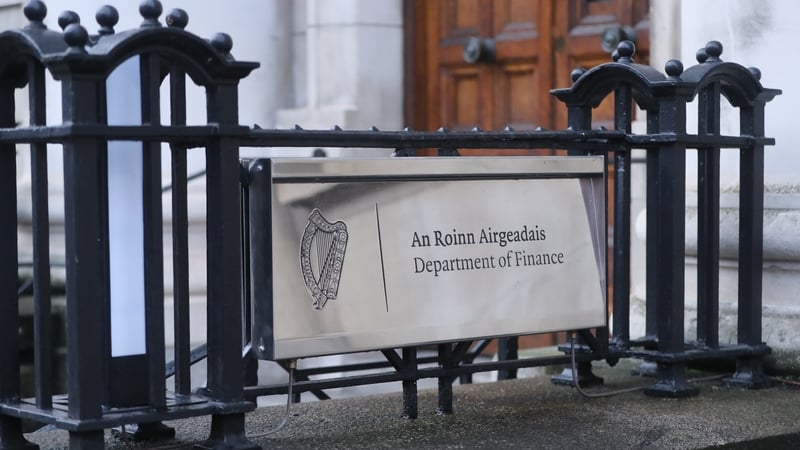
There has been a 9.1% increase in corporation tax collected this year compared to the same period last year as money continued to roll in from multinationals, according to the latest Exchequer Returns published by the Department of Finance.
In the first five months of this year €6.1 billion has been paid by large companies which are mainly foreign owned companies in the technology and pharmaceutical sectors.
In a sign that consumer spending remains strong, VAT was up 7.1% to €12.2bn so far this year.
The healthy jobs market resulted in a 7.5% increase in income tax to €15.6bn.
However, the figures for excise duty fell reflecting the temporary reduction in excise on petrol and diesel introduced by the Government in the wake of the recent countrywide fuel protests.
There were also drops in some smaller categories of taxation with stamp duty, capital gains tax and capital acquisitions tax down.
Overall, the figures mean that the amount collected by the State in tax this year is up by €2.2bn or 6.1%.
Spending by the State to the end of May was €45bn, which was 7.2% ahead of last year and 1.2% below forecast.
However, this was mainly due to slower than expected capital expenditure while current spending, mainly on wages, was ahead of forecast.
There was an Exchequer deficit of €2.3bn largely caused by decisions by the Government to transfer money to two long-term savings funds called the Future Ireland Fund and Infrastructure, Climate and Nature Fund.
The figures show the Government’s current spending on wages, which is up 7.4% so far this year, is ahead of the target set out in the Budget of 6.3%.
Current spending in the Department of Health is up 8.6% so far this year which is ahead of the Budget projection of 4.8%.
We need your consent to load this rte-player contentWe use rte-player to manage extra content that can set cookies on your device and collect data about your activity. Please review their details and accept them to load the content.Manage Preferences
Tánaiste and Minister for Finance Simon Harris suggested there was scope to for measures around childcare, taxation and energy in October’s budget.
“Government has an opportunity in October to take a number of steps that will help permanently structurally reduce some of the costs people face in Ireland,” he told RTÉ News.
“Whether that’s around childcare, their personal income tax bill, what we can do on energy, I’ve been very clear we need to do more in relation to that.”
State now ‘unusually dependent’ on corporation tax
Dan O’Brien, Chief Economist Institute of International and European Affairs, said the figures show that in May, the Government collected “even more” in corporation tax than it did in May 2025.
He said the more than two-and-a-half billion-euro collected in Corporation tax in May alone shows that the tax has become “one of the most important sources of revenue for the Government,” making it “extremely” and “unusually dependent” on Corporation tax revenues “relative to all other taxes.”
Mr O’Brien said that the two sets of figures, from the CSO on the state of economy, and from the Department of Finance, show that consumer spending is growing “quite steadily.”
He said the CSO figures are “directly trying to measure consumer spending” and the VAT numbers are a “very good indication of what’s happening,” and both sets of numbers show that consumers are spending more as incomes rise, “not spectacularly,” but it’s “good.”
“Looking at … all of the data we’ve had today – there’s a lot of it – I don’t think our understanding of the state of the economy has changed much over the past 24 hours …
“It [data] all in the round points to an economy that is growing at a decent clip, it’s not spectacular but it’s growing steadily,” and given all the shocks of recent years, including the pandemic, Ukraine, the Middle East, “it’s glass half full,” Mr O’Brien said.