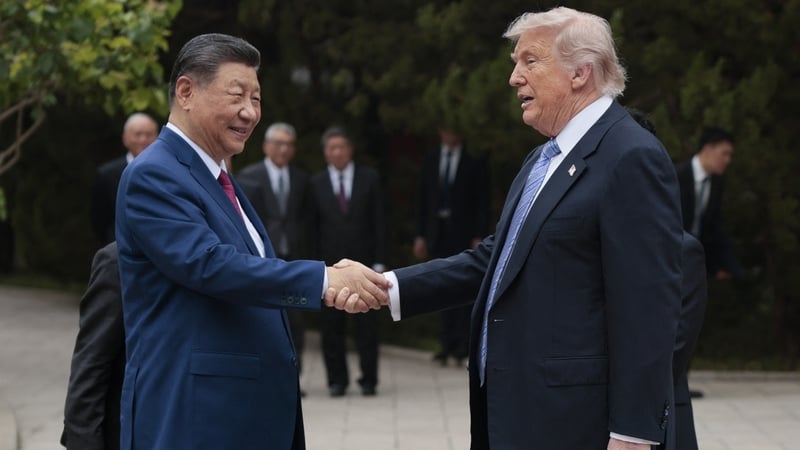
US President Donald Trump has warned Taiwan against declaring formal independence after a visit to China, whose leader Xi Jinping had pressed him against US support to the self-ruling island.
Mr Trump ended a state visit claiming to have made “fantastic” trade deals, although the details were vague and he did not appear to secure any breakthrough with China over his stalemated war on Iran.
Mr Trump invited President Xi Jinping to pay a reciprocal visit to Washington in September, signalling both sides will likely seek stability in the often turbulent relationship between the world’s two largest economies.
On a key issue for Mr Xi, Mr Trump made clear he opposed a declaration of independence by Taiwan and appeared to question why the United States would defend the island in case of attack.
“I’m not looking to have somebody go independent. And, you know, we’re supposed to travel 9,500 miles to fight a war. I’m not looking for that,” he told Fox News host Brett Baier.
“I want them to cool down. I want China to cool down,” Mr Trump said.
“We’re not looking to have wars, and if you kept it the way it is, I think China’s going to be OK with that,” he added.
The United States recognizes only Beijing and does not support formal independence by Taiwan, but historically has also stopped short of explicitly saying it opposes independence.
Under US law, the United States is required to provide weapons to Taiwan for its defence, but it has been ambiguous on whether US forces would come to the island’s aid.
Mr Xi had begun the summit with a warning on Taiwan, whose President Lai Ching-te considers the island already independent, making a declaration unnecessary.
Mr Xi had told Mr Trump that missteps on the sensitive issue could push their two countries into “conflict”.
We need your consent to load this rte-player contentWe use rte-player to manage extra content that can set cookies on your device and collect data about your activity. Please review their details and accept them to load the content.Manage Preferences
While Mr Trump searched for immediate business wins, such as a deal to sell Boeing jets that did not impress investors, Mr Xi talked up a long-term reset and pact to maintain stable trade ties with Washington, underscoring their differing priorities.
Mr Xi pushed the new term to describe the relationship as “constructive strategic stability” – a sharp departure from the framing of “strategic competition” used by former US President Joe Biden, which Beijing disliked.
“Until now, China hasn’t proposed an alternative – now they have – if the US side agrees, that is progress,” said Da Wei, director of the Center for International Security and Strategy at Tsinghua University in Beijing.
Mr Xi is expected to pay a state visit to the US in autumn, Beijing’s top diplomat said according to state media, hours after Mr Trump departed China.
“Chinese President Xi Jinping will pay a state visit to the United States in autumn this year at the invitation of US President Donald Trump, Chinese top diplomat Wang Yi said on Friday,” Chinese state news agency Xinhua reported.
No help on Iran
A brief US summary of yesterday’s talks highlighted what the White House called the leaders’ shared desire to reopen the Strait of Hormuz off Iran, and Mr Xi’s interest in American oil purchases to pare its dependence on the Middle East.
But just before the leaders met for tea today, China’s foreign ministry issued a blunt statement outlining its frustration with the war.
“This conflict, which should never have happened, has no reason to continue,” the ministry said, adding that China supported efforts to reach a peace deal in a war that had disrupted energy supplies and the global economy.
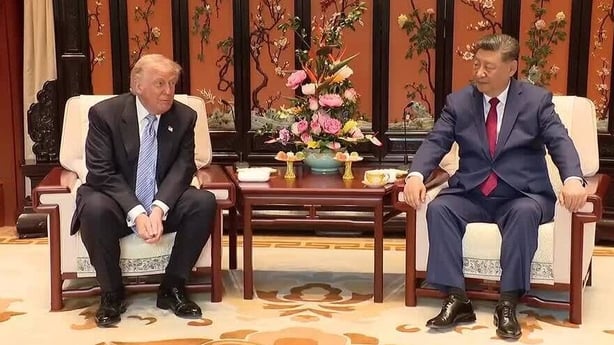
At Zhongnanhai, Mr Trump said the leaders had discussed Iran and felt “very similar”, though Mr Xi did not comment.
On the flight back home, Mr Trump added that he wasn’t “asking for any favours” on Iran.
Still, US Treasury Secretary Scott Bessent had urged Beijing to use its leverage with Tehran to make a deal.
But analysts doubt Mr Xi will be willing to push Tehran hard or end support for its military, given Iran’s value to Beijing as a strategic counterweight to the US.
“What’s notable is that there’s no Chinese commitment to do anything specific with regards to Iran,” said Patricia Kim, a foreign policy fellow at the Brookings Institution.