Analysis: Running for over 50 years, the Irish Hospital Sweepstakes was a big hit before a series of scandals and revelations took the sheen off its success
The Irish Hospital Sweepstakes was once the biggest and most successful lottery in the world. Running for over 50 years, it promised big money wins when lotteries were illegal in most jurisdictions. It my have collected millions of pounds for hospitals in Ireland, but it was also a corrupt organisation which mistreated its workers and made the organisers and their families incredibly wealthy.
The Irish Hospital Sweepstakes was a type of lottery where winnings were based on the outcome of horse races in Ireland or the United Kingdom. Tickets were priced at ten shillings (around 50 cents) for the first sweepstake in 1930 and could be bought from official ticket sellers. Each ticket was assigned to a horse expected to run in one of several horse races, with enormous prizes on offer in the grand draw. The prize fund on the 1932 Grand National was almost £2.3 million (€151 million in today’s money).
Ill-equipped and underfunded, hospitals in the Irish Free State needed help. By 1929, the prospect of closure of the National Maternity Hospital convinced the government to legalise the sweepstakes, which were illegal in Ireland as they were in most countries.
RTÉ documentary on the Irish Hospital Sweepstakes’ scandal
The sweepstakes offered sums of money to Irish hospitals in exchange for running a lottery in their name. 75% of the takings, after audited expenses, was for prize money and the remaining 25% was paid to the hospitals. Over the course of its existence, the sweepstakes contributed over £130 million to the hospitals building fund.
The sweepstakes was the brainchild of three men who brought varying skills and personal connections to the project. Richard Duggan was a Dublin bookmaker who defied the Government’s ban on lotteries and had been successfully running illegal sweepstakes since 1918. Spencer Freeman was a British Army veteran from Wales whose organisational skills were used in devising the elaborate systems of mixing and drawing of tickets for the sweepstakes. Former Government minister Joseph McGrath fought in the 1916 Rising and had many contacts in the political system.
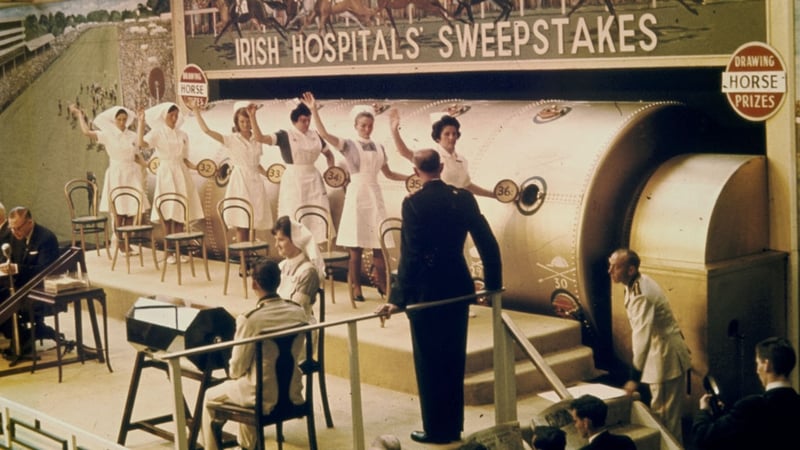
The trio created the Irish Hospital’s Trust (1940) Limited and turned the sweepstakes into a global success. Workers spent two or three days carting the tickets into machines and manually mixing them in the enormous drum. There were three draws per year and with no formal advertising in its early years, the pageantry around each draw was necessary to generate interest. The ticket draws were a Mardi Gras type experience where elaborate floats containing the thousands of tickets were pulled through the streets of Dublin.
From RTÉ Archives, the closing sequence from the long running Irish Hospitals’ Sweepstakes’ radio programme
Showgirls and ticket loaders were dressed in elaborate costumes with different themes including, travel, sport and ancient Ireland. A ticket loader’s dress in the National Museum of Ireland from the 1930s depicts a car, cricket bat and a gold club. The sweepstakes were selling the idea of luxury and luck. They even used the optimistic Disney favourite When You Wish Upon a Star to promote a concept that you could win no matter who or where you were.
Due to the small domestic population, the number of tickets sold within the state was insufficient to raise the required funds, and therefore tickets were also sold to Irish emigrants in the United Kingdom and United States. As time went on, tickets were sold in over 150 countries including United States, Malaysia, India and South Africa. Draw results were issued to the press of all of the countries the tickets were sold in, but only if they sent a stamped addressed envelope so the Sweepstakes didn’t have to pay for international postage.
By the 1950s, the sweepstakes headquarters based in Ballsbridge in Dublin was employing as many as 4,000 people sorting tickets and administering prizes. Prizes reached as much as £100,000 (around €7.6 million today.) In 1969, a carpenter from Waterford, Edward Meagher won a prize of £26,275 after buying sweepstakes for over 20 years. Another RTÉ news report featured a Kildare man who won a prize of £10,000 on his wedding day in 1984.
From RTÉ Archives, the Irish Hospital Sweepstakes Draw in January 1986
The final sweepstake was held in January 1986 after a series of scandalous revelations about how the company had conducted its affairs. Journalist Joe McAnthony broke the story of the corruption in 1973 for the Irish Independent. He eventually lost his job because of exposing the scandal and ended up moving to Canada.
Less than 10% of the turnover found its way to funding Irish hospitals. The mostly female workforce were badly paid with no increments no increase in wages from the 1950s onwards. The rest of the money made its way to the founders of the sweepstakes who became very wealthy as a result. On top of this, there was an elaborate web of worldwide ticket smuggling, law enforcement issues, tickets sold abroad that never made it back to Ireland and tickets that never even made it into the drum.
In 1986, the Government established the National Lottery, but awarded the licence to An Post. The Irish Hospital Sweepstakes went into voluntary liquidation in March 1987 and 147 employees, many with 40 years of service, were made redundant. Because their wages were low, their statutory redundancy and PRSI payments were also low and the former workers found themselves facing financial insecurity.
We need your consent to load this rte-player contentWe use rte-player to manage extra content that can set cookies on your device and collect data about your activity. Please review their details and accept them to load the content.Manage Preferences
From RTÉ Archives, Eamonn Ó Muirí reports for Evening Extra in 1987 on the plight of the 147 Irish Hospitals’ Sweepstake employees who have been made redundant
From huge international publicity surrounding the early sweepstakes to absolute fraud, the story of the sweepstakes is one which goes from riches to rags. The founders, though, never experienced the rags and died before the sweepstakes folded, in the full knowledge that they were scamming the public and Irish hospitals to enlarge their own personal bank accounts.
Sure, the sweepstakes paid out more than £400 million in prize money but the reality was that the rich were getting richer because the public paid their own money in hope of a better future and waited patiently for hospitals to be built. That sounds familiar…
Follow RTÉ Brainstorm on WhatsApp and Instagram for more stories and updates
The views expressed here are those of the author and do not represent or reflect the views of RTÉ