
John LaurensonTechnology Reporter, Paris
Alice & Bob
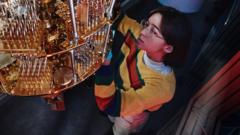
In a lab on the western edge of Paris, where the River Seine flows wide and trams slide past glass-fronted buildings and blossoming cherry trees, a technician called Rémi makes some adjustments with a spanner.
The machine, a cascade of gold and silver-coloured cylinders descending through a cloud of wires, is a cryostat, a device that cools so much it slows activity even at the molecular level.
Minus 273 degrees Celsius in the cylinder at the bottom. A temperature at which even the tiniest particles are still. Isolation from the outside world is complete.
In this cylinder is placed a small case, again of gold and silver colour, in which is inserted a chip.
This chip is another, tinier box inside of which takes place the phenomenon discovered by Albert Einstein and other physicists that seems to defy the mechanics of the world we live in: the quantum leap, when particles change energy levels in ways that are predictable, reproducible and apparently impossible.
Around us there are several vertical cylinders like so many different-sized water heaters. They all contain cryostats like the one Marcel is tinkering with. Oh, and these machines have another name. They are quantum computers.
Alice & Bob
This is the French quantum computer company Alice & Bob. In the next few months it will also open a much larger facility north of Paris, costing $50m (£37m), with a test and run facility to try out bigger and bigger machines, and a clean room where it will make its own chips.
Alice & Bob may sound like an ice-cream company, but the 200-strong team of 20 and 30-somethings you see buzzing around this hive of a start-up do some very serious science, and will soon, says co-founder and CEO Théau Peronnin, be doing serious business too.
“Physicists used to doubt it was possible to leverage the weird behaviour of particles in the quantum. They don’t anymore.
Now we know they work, and in a few years we will have reliable quantum computers that we can hook up to High Performance Computers (HPCs) in data centres to exponentially increase their computing power,” says Peronnin.
“It’s not about being faster. It’s about being so dramatically faster that you change what is feasible. We will be able to solve problems that are absolutely intractable with classical computers,” he says.
For example? “It will make medicine an exact science.” He is only half joking. “At the moment, the development of new medicines is largely a question of trial and error.”
With quantum computers, it will be possible to run massive computes to see how different molecules react with each other to find out what works and with what side-effects.
The prize, then, for the company that is first to build a reliable quantum computer at scale is potentially enormous. It will be “winner-takes-all”, as it was for classical computers and IBM, predicts Peronnin. And, he reckons, there is a fighting chance that his or another French company will be that winner.
The biggest obstacle in quantum computing is fragility which leads to errors.
Conventional computers use electricity within silicon chips to make calculations.
In quantum computers that is done with qubits where, in each qubit, the quantum properties of an individual electron or photon are manipulated.
The big challenge for researchers is that qubits lose their delicate quantum states (decohere) due to noise from the everyday world.
Most approaches fight this with massive redundancy, explains Peronnin: thousands of physical qubits per “logical” one, using what he calls a “majority vote” to correct errors. The pay-off for that is daunting scale and cost.
Alice & Bob have taken a different approach. Their “cat qubits” (named after Schrödinger’s cat) are designed to autonomously correct some errors.
“It’s built-in by design,” Peronnin says. “We cracked a way to compensate for losses continuously.”
This will, in theory, spectacularly reduce process complexity and cost compared to their redundancy-heavy rivals.
Alice & Bob
Peronnin notes big players are shifting towards similar ideas: Google acquired Atlantic Quantum, while others are pursuing cousins of cat qubits. Alice & Bob now stands “shoulder to shoulder” with its US competitors, Peronnin says.
They’re one of France’s “national champions” under the PROQCIMA program, a government initiative to develop a useful quatum computer.
And France has a lot more than Alice & Bob going on. In fact, its companies represent between them the full range of qubit types – all the routes physicists are hoping will lead to the first reliable and ultra-powerful quantum computer.
“If you look at the quantum computing world in France, we have six companies right now, and two being created,” says Olivier Ezratty, an academic whose 1500-page compendium Understanding Quantum Technologies is a popular free download on the internet.
He says there are four other “important” French quantum computing firms: Pasqal, Quandela, Quobly and C12.
Erzatty says they have one advantage in common. “Most of them are in a very favourable position in the cost of the machine and the energetic cost,” he says.
Getty Images
Elsewhere in Europe, the biggest player is Finland’s IQM that announced in February that it would become the first listed European quantum company.
The UK has two significant players in Oxford Quantum Circuits (OQM) and quantum operating system creators Riverlane.
IQM and Pasqal already have quantum computers that are contributing to high-performance computing (HPC) installations across Europe.
Some French firms already have quantum computers placed in companies such as industrial products firm, Air Liquide. This will soon be the case for Alice & Bob.
Their machines are not yet ready to fulfil the promise of quantum computing.
But getting them into the wider world means that a community of specialists can be trained up, who will be ready to use the real thing when it happens.
“At the moment, the machine we have is no more powerful than your telephone,” says Peronnin. “We’re on the flat part of the exponential curve.”
In the quantum race, France has a couple of strong points.
It has some of the world’s best physics teaching at schools such as École Polytechnique and École Normale Supérieure.
“In the past few years three Nobel Prizes have gone to French physicists alone!” Peronnin says. That is critical, he says, as it is a surprisingly-level playing field.
“At the end of the day, it’s a math challenge. There is no unfair advantage from legacy technology like classical computing or something like that, so there is no reason to be shy.”
The main challenge, says Peronnin, is putting the capital together. “But Europe is definitely not poor and this is a technological opportunity for Europe to reshuffle a bit the cards in terms of autonomous strategy and our ability to have economic leading players,” he says.
There is a strong feeling that while Europe missed the boat on so many tech revolutions of recent years, at least when it came to transitioning from the research to the industrial stage, things could be different this time.
“We have what it takes to win it. It’s about believing in ourselves. We’re always, as French, a bit mocking the overconfidence of Americans, but here we need to be a bit bullish. Otherwise, nothing is going to happen, and that would be really a shame because at the moment, we’re in a far better position than anyone could have thought.”
More Technology of Business