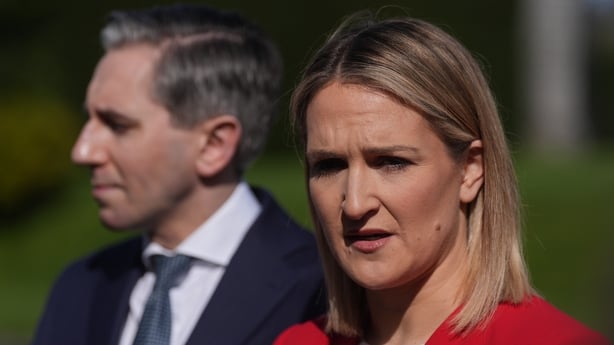
A new defence agreement between Ireland and the UK could see British ships “responding to an issue” in Irish waters, according to Minister for Defence Helen McEntee.
Ms McEntee announced a new Memorandum of Understanding (MoU) between the two nations at the UK-Ireland Summit in Co Cork.
Billed as a “refresh” of existing arrangements, Ms McEntee said she and UK Defence Secretary John Healey had agreed enhanced engagement on security.
She said it would provide a framework for developing cooperation on maritime defence, cyber security, joint procurement initiatives and “information sharing” in the aerial domain.
The agreement also covers training and educational cooperation as well as personnel exchanges.
The Government particularly emphasised threats around critical subsea infrastructure, with Taoiseach Micheál Martin stating the two countries were “interdependent” on subsea cables for energy and communication connections.
In an apparent reference to Russia, he said: “We know what’s happened in other seas where there has been interventions and we know that certain elements have been observing the cables and other vital infrastructure.
“So that’s the context, and it’s to protect that and to make sure we can respond effectively if an event was to happen.”
Asked if would involve the UK Navy patrolling Irish waters, Mr Martin said he “would not get into specifics” but “it’s not patrolling”.
The MoU’s closer liaison between defence and naval organisations, coupled with a new framework on subsea infrastructure, will see a “coordinated response mechanism for addressing major subsea communication cable incidents” that might affect the two countries.
This will include a series of live exercises and simulations of critical incidents, starting in September.
The countries have also agreed joint initiatives on seabed mapping, as the UK and Ireland accelerate ambitions for offshore energy infrastructure.
Ms McEntee insisted the MoU makes clear that each country’s “territorial integrity” and, in Ireland’s case, neutrality is “fully respected”.
Speaking to reporters at Fota House, she said: “We’re militarily neutral, but we’re not neutral to any of the threats that exist at the moment.”
Asked twice if the MoU would see more UK military ships and planes in Irish waters and skies, Ms McEntee did not rule out the possibility.
She said: “It is already the case that there are very clear rules and guidance as to when and where you may have other ships in your waters or planes in the skies.
“So it’s already the case that we have UK ships, for various reasons, military or otherwise in our waters.”
She added: “This is about making sure that if there are threats or issues that emerge, we have structures in place that we can work with each other in cooperation.
“That perhaps might mean in response to an issue, if it happens that there would be support from the UK in the way that there could be support from other countries as well.”
Ms McEntee said this was “appropriate” and “already happening”.
The minister said it was important to increase cooperation with other countries to mitigate risks, adding that she supports increased defence spending.
“I think we need to spend more on defence,” she said, adding “we are spending more on defence, a 55% increase in the most recent capital plan and 43% increase in our current spending”.
However, she said “we need to do more and I want us to be ambitious in that regard”.
Ms McEntee said the MoU was not a “one-sided agreement” and that both partners were “bringing something to the table”.
She said Ireland working with the UK-led Joint Expeditionary Force did not threaten neutrality or require constitutional change.
The last MoU was signed in 2015 and the newly signed document will be laid before respective parliaments “in due course”.
Meanwhile, British Prime Minister Keir Starmer said the conflict in the Middle East has increased the importance of having good relations between the UK and Ireland.
The Taoiseach said increased coordination between the two countries would help to guarantee economic security.
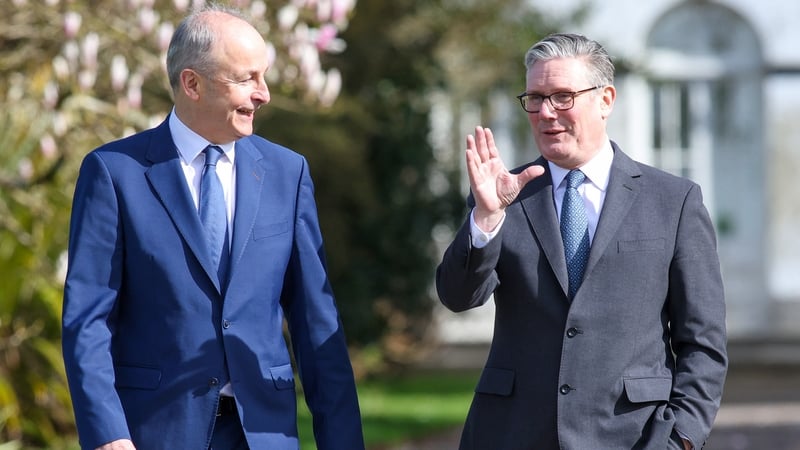
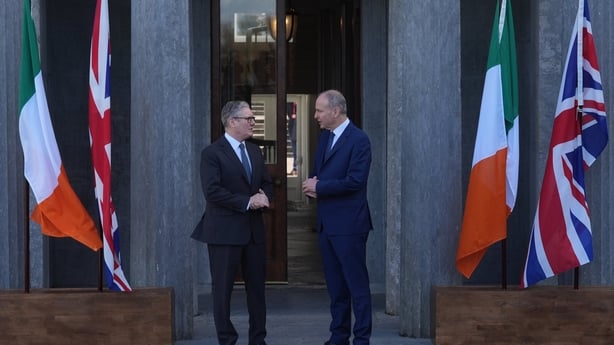
Mr Martin and Mr Starmer met at Fota House ahead of the series of meetings involving ministers from both governments in the second UK-Ireland Summit.
Earlier, the two leaders visited the Tyndall National Institute, an electronics research centre at University College Cork.
Following the meeting, a joint statement was released with a list of agreed actions in the areas of “shared prosperity, shared seas and shared ties”.
Speaking at the start of the summit, Mr Martin said work between the two governments to deal with the legacy of the Northern Ireland Troubles “personifies the benefits of our relationship”.
He added: “We have an agreed memorandum of understanding in terms of defence and security which is very, very important where we are collectively working together in a collaborative way and a cooperative way, work to protect our sub-sea cables, our critical underwater infrastructure, the challenges on cyber-attacks that affect us all and more general security issues.
“I think that level of coordination is very, very important to underpin and guarantee our economic security, but broader security in a very challenging and uncertain world.”
We need your consent to load this rte-player contentWe use rte-player to manage extra content that can set cookies on your device and collect data about your activity. Please review their details and accept them to load the content.Manage Preferences
The Taoiseach said trade continues to grow between the UK and Ireland.
Irish companies have created 150,000 jobs in UK in what Mr Martin described as a thriving economic relationship and one that the Irish government continues to nurture and strengthen.
Mr Starmer highlighted cooperation on trade and energy policies.
An interconnector between Wales and Ireland is expected to provide enough power for 570,000 homes and represent at least €855m of private investment.
A separate energy connector between north and south aims to lower electricity costs on the island.
The Taoiseach said that they had signed off on a series of cultural partnerships between archival institutions, museums and theatre companies.
“We’ll have co-production and so forth, and we’ve put funding up to €5 million behind that particular initiative,” he said.
They were joined at this morning’s meeting by senior Irish and British cabinet ministers.
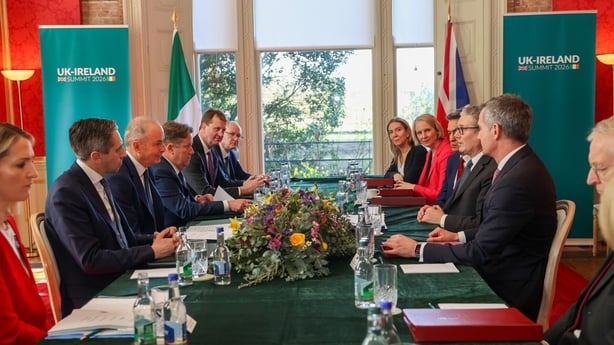
The Irish Government summit delegation comprises: Taoiseach Micheál Martin; Tánaiste and Minister for Finance Simon Harris; Minister for Foreign Affairs and Trade and Minister for Defence Helen McEntee; Minister for Climate, Energy and Environment, and Minister for Transport, Darragh O’Brien; and Minister for Justice, Home Affairs and Migration Jim O’Callaghan.
The UK government delegation comprises: Prime Minister Keir Starmer; Secretary of State for Energy Security and Net Zero Ed Miliband; Secretary of State for Northern Ireland Hilary Benn; Secretary of State for Environment, Food and Rural Affairs Emma Reynolds; and Secretary of State for Business and Trade Peter Kyle.
Ireland, UK agree to work together on maritime security
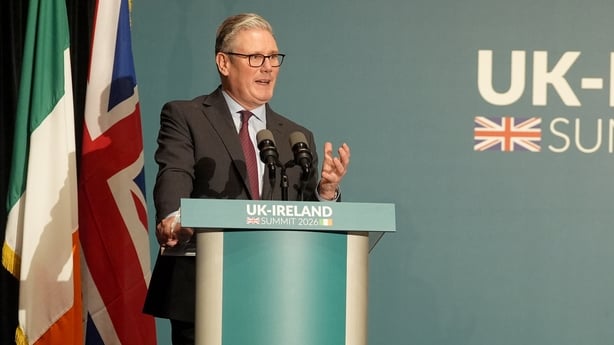
Mr Starmer will also announce later investments of more than €900 million by 15 Irish companies in the UK.
The investments are expected to lead to the creation of 850 new jobs in the UK.
The investments, many of which are supported by Enterprise Ireland, are in areas such as AI-powered corporate services, renewal energy and telecommunications companies.
Read more: €5m funding for 12 Ireland-UK cultural projects announced
Mr Starmer said the investments would make both the UK and Ireland better off and more secure.
“The UK’s close friendship with Ireland is going from strength to strength and I am pleased that we are going further in working together on growth, energy, security and more,” Mr Starmer said.
“This new Irish investment coming into the UK is one part of a much bigger picture of our flourishing cultural, commercial and security ties.
“The action this [UK] government has taken to reset relationships and deepen partnerships with our closest allies is paying off. It will help us withstand global challenges and protect money in the pockets of families up and down the country,” he added.