
Getty Images
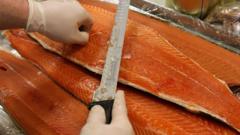
Scottish salmon has retained its position as the UK’s biggest food export, while exports of Scotch whisky have dropped, according to new figures.
HMRC statistics showed the tonnage of salmon exported overseas increased by 9% to about 111,000 tonnes, but because the average price dropped last year, exports were down by £16m, to £828m.
Scotch whisky exports fell by less than 1% last year to £4.36bn, while the total volume exported was down by 4.3% on 2024.
Both faced 10% tariffs that were imposed in April on imports arriving in the USA.
France remained the biggest market for salmon although it declined by more than a quarter in value.
Wholesale markets in France – the largest at Boulogne-sur-Mer – supply a lot of the European Union’s fish demands.
Despite the new tariffs, the value of Scottish salmon exports to the USA topped £300m – an increase of 34%. By volume, shipments rose by 44% to 35,000 tonnes.
Export growth of salmon into Asia has been driven by an increase in direct freight flights between Prestwick and China, while it remains the biggest single product passing through Heathrow Airport.
The Chinese market for Scottish farmed fish increased by 55% in volume.
A spokesperson for Salmon Scotland said China is an “increasingly important” market for Scottish salmon.
“Demand is being driven by consumers looking for premium, high-quality seafood they can trust, with Scottish salmon particularly valued in high-end dining and sashimi markets for its quality, provenance, and consistency,” the spokesperson said.
“The Chinese market does prefer larger fish and demand rises at this time of year due to Chinese New Year celebrations.
“Full traceability from farm to plate is also a major strength, and with a growing appetite for top-tier products among China’s middle class, the market represents a significant opportunity for Scottish salmon.”
China was the third biggest export market for Scottish salmon last year.
‘Challenging time’
For Scotch whisky, figures show the US remained the biggest export market in 2025, with sales worth £933m – a 4% decrease after it has peaked above £1bn in recent years.
It is understood there was a significant stock of imports in the US ahead of the tariffs being introduced in April last year.
Despite a 150% tariff on imported spirits, India was the biggest importer of Scotch by volume last year, importing the equivalent of 220m standard 70cl bottles – nearly twice as much as the USA.
Much of the Indian market is supplied in bulk rather than bottles for blending with Indian-made spirits.
France’s Scotch imports fell by 14% in volume on 2024, and 4% in value.
Exports to Germany and Turkey increased, while the value of exports to Japan and Singapore decreased.
Mark Kent, chief executive of the Scotch Whisky Association, which represents most distillers, said: “The international trading environment continues to be challenging for Scotch whisky producers, with tariffs and geo-political tension causing significant turbulence in some key markets.
“At home, the industry faces soaring costs, from year-on-year duty increases to new packaging taxes.
“Scotch whisky is an iconic product which appeals around the world, and the industry’s great resilience means that our long-term potential for continued growth is clear.”
When the Chinese celebrate New Year, they want to make a statement.
So the bigger the fish, the bigger the celebratory splash.
Large fish command a premium price, and there are price signals in the European salmon market that the demand has been particularly strong ahead of this year’s New Year celebrations.
But a salmon isn’t just for Chinese New Year. The 2025 full-year export figures, published by HM Revenue and Customs, show consistent strong and rising demand in China for farmed salmon from Scotland.
Sales were up 28% by value to £97m. By volume, they rose 55%, to 12,700 tonnes.
The key is air freight. Salmon from Scotland had already established itself as the biggest single product going through Heathrow Airport, often flying in the belly of passenger jets.
To that, the industry can now add a lot of spare capacity for China-bound flights out of Prestwick Airport. Three scheduled flights arrive from China every week, with manufactured products for distribution in the UK and beyond.
Prestwick invested £1m in improved facilities for chilling food, with capacity of 87 tonnes, so that salmon can be air-freighted on return flights.
The industry has yet to find a better way to package and chill them than polystyrene boxes, which is hindering its attempts to reduce waste.
There’s no such rush to get whisky to market. It has to take at least three years to mature in casks in Scotland, so importers can afford to wait a bit longer to get shipments into foreign ports.
Because it also has a long shelf-life, there was a drive early last year to get whisky into the USA before the 10% tariff (which was set to be higher for a while) was introduced.
That means high stock levels without the tariff cost could be run down, helping explain some of the 15% decline in shipments since April.
The 2026 export figures a year from now will give a more reliable picture of the damage to the market as a result of tariffs.
But they could be affected by the next big threat facing Scotch – the imposition of a 25% tariff on single malt Scotch, the more expensive brands that do well in the USA.
That was suspended nearly five years ago by President Joe Biden, after the previous Trump administration targeted whisky to penalise the EU, then including the UK, for its subsidies to Airbus.
American whiskey and other spirits were similarly affected by EU tariffs to penalise the US for subsidies to Boeing. In July, that suspension comes to an end. As with so much else, we don’t know how President Trump will respond.