
Danielle KayeBusiness reporter
Bloomberg via Getty Images
A top US official responsible for suing companies over mergers is stepping down, sparking alarm among critics who say it is a sign the White House is backing away from anti-monopoly enforcement.
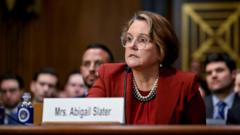
Gail Slater, who was appointed last year by US President Donald Trump to lead the antitrust division at the Department of Justice (DOJ), announced her resignation on social media on Thursday.
“It is with great sadness and abiding hope that I leave my role,” she wrote.
Her announcement marked the latest in a series of leadership shake-ups at the antitrust division since last summer, including the ouster of two other top officials.
The Justice Department confirmed to the BBC that Slater was leaving, but did not comment on the circumstances that led to her departure.
“On behalf of the Department of Justice, we thank Gail Slater for her service to the Antitrust Division which works to protect consumers, promote affordability, and expand economic opportunity,” Attorney General Pam Bondi said in a statement.
Slater had received bipartisan support at her Senate confirmation last year.
The DOJ’s antitrust division is responsible for enforcing laws meant to promote competition and guard against illegal monopolies. It is currently working on lawsuits against major firms including entertainment giant Live Nation, Visa and Apple.
The turbulence in the unit has raised questions about the fate of those cases and sparked alarm among some antitrust practitioners, lawmakers and former officials.
They say senior Trump DOJ officials have in several cases overruled leaders at the antitrust division on enforcement decisions, and accused the administration of taking a softer approach to policing corporate mergers under the influence of lobbyists.
A spokesperson for the Justice Department did not comment on allegations of intervention by higher-ups.
A White House spokesperson did not immediately respond to a request for comment.
The tensions between antitrust officials and higher-ups at the Justice Department started to emerge publicly last summer, when the department agreed to drop a lawsuit challenging the $14bn takeover of Juniper Networks by server maker Hewlett-Packard Enterprise.
The decision came after the companies reportedly appealed to top officials at the DOJ.
In the aftermath, a DOJ official ousted antitrust leaders including Roger Alford, who had been Slater’s top deputy and who had also served in the first Trump administration.
Since leaving his government role, Alford has spoken out about the issue, describing a “battle …being fought within the Department of Justice”.
Slater and her deputies “are united in the battle to protect the average American by vigorously enforcing the antitrust laws,” he said in a speech last year. “The same cannot be said for senior leadership above and around her.”
In a statement on Thursday, Senator Elizabeth Warren, a Democrat, said that Slater’s departure “looks like corruption”.
“Congress has a responsibility to unearth exactly what happened and hold the Trump administration accountable,” Warren said.
John Newman, a law professor at the University of Memphis who worked at the Federal Trade Commission during the Biden administration, said the questions swirling around the DOJ’s decision-making could raise difficulty for businesses considering deals.
Companies that “don’t care about complying with the law” could stand to benefit, he said, while others suffer from regulatory uncertainty.
“If you’re an honest business that wants to honestly try to comply with the laws on the books, this kind of uncertainty and confusion is the worst case scenario,” Newman said.