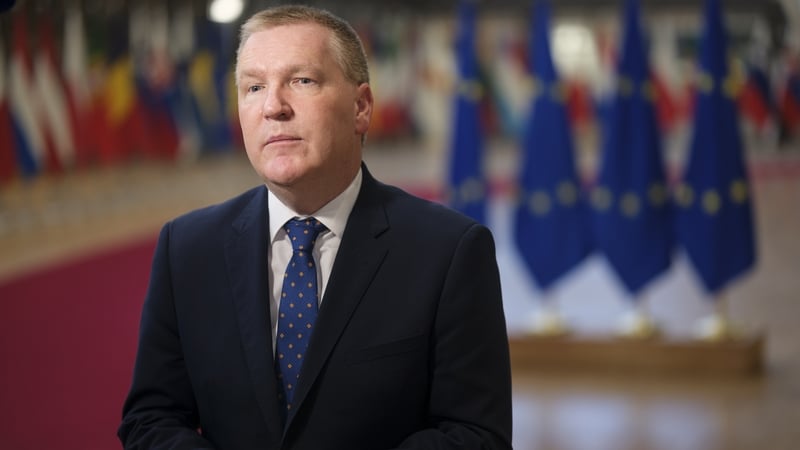
Ireland’s EU Commissioner Michael McGrath has said the transatlantic relationship is at a “pivotal and dangerous” moment.
He warned that if the Trump administration pressed ahead with tariffs on those countries who have opposed the US President’s ambitions to seize Greenland, there would be a “robust” response from the European Union.
Speaking to RTÉ News in Davos, Mr McGrath said: “We are at a moment of danger in the overall transatlantic relationship.
“It has been the bedrock of peace and security and stability for the world over many decades, and everybody should think long and hard about damaging that relationship, because if that breaks down, and if it is a case that the strongest militarily and politically and economically will always get their way, and can set aside international law, set aside the rules based system, set aside the role of the United Nations, then we’re in a very dark place,” he said.
“But in the event that this all goes wrong, and we see unilateral action from the United States, then, of course, we will respond, and it will be a robust response.”
The commissioner said the EU and US had negotiated a trade settlement following many months last year.
Read more:
Live updates from Davos
Europe’s leaders stand firm in Davos as CEOs warn on emotions
“We expect the terms of that agreement to be fully honoured by the US, as they would expect us to do the same, and that provides the stability and certainty and predictability that businesses crave at a time when there’s so much uncertainty in the world.
“To come now and seek to reopen and revisit a hard won negotiation that resulted in an agreement with compromises and remade sacrifices on the EU side – for sure, in the broader interest of achieving an agreement – it’s not possible now to have a fundamental reopening so soon.”
Mr McGrath said the crisis over Greenland meant the EU-Mercosur trade deal must now be seen in a new light.
“What all of this uncertainty underlines is the need for Europe to diversify its trading relationships and to build new alliances, new relationships and to open up new markets for European companies.
“This is what we’re good at. Europe is exceptionally strong at international trade, exporters of goods and services seeking out opportunities all over the world.
“Mercosur opens up a market of over 700 million people, [with] the elimination of tariffs on over 90% of product lines. It’s a massive opportunity for Europe and for Ireland.
“We have listened very carefully to all of the legitimate concerns that have been expressed by the farming community, and I think we have put in place robust defence mechanisms to make sure that those fears don’t come to pass,” he said.
Not exact science to model impacts on Ireland, Tánaiste says
Tánaiste Simon Harris said it was “not an exact science” to model the potential impacts caused by potential Greenland tariffs on Ireland
“You can run a model that if there’s a 15% tariff applied on a country – and we did this before and published it – that would have an effect on what we call ‘modify domestic demand’, effectively growth, by 1.4% to 1.5% annually over a medium term, that it would result in roughly around 60,000 fewer jobs being created if there were tariffs.
“But what those models can’t capture is what happens if the transatlantic relationship, as we know it, doesn’t exist into the future.
“I do want to caveat this, because it is a time for cool heads.
“All we have at the moment is noise, statements, threats, vulgarity in terms of some public commentary, so nothing has factually changed,” Mr Harris said.
He said Donald Trump “doesn’t have all the cards” on this issue, adding he had met with major multinational companies in the US last week that want to continue trade with Europe.
Mr Harris said that the EU was “taken aback” by the threat of tariffs, particularly after an EU-US trade deal was struck last year.
“When you work so intensively and when those interpersonal relationships develop, and then you find before the agreement is even through the European Parliament, you’re learning on Truth Social and elsewhere that he’s changed his mind.
“But I do think there’s a way to go on this, I think there’s quite a number of twists and turns, and I think the intelligent and responsible thing to do is, step by step, and also not just respond to all the noise in the days ahead, but prepare.”
He added: “Our priority right now is on working to make sure that actually the end position turns out to be very different to the Truth Social posts.”