
Big Tech companies raced to dominate AI in 2025 as the booming technology continued to captivate Wall Street.
Throughout the year AI received much criticism and speculation over its position in the market.
Mainly, it raised the AI bubble question, and if it is about to burst.
US chip maker Nvidia became the first company in the world to hit a record market value of $5 trillion.
The chipmaker, along with six other big tech companies, now makes up nearly a third of the entire US stock market.
The Magnificent 7 stocks – Apple, Microsoft, Amazon, Alphabet (Google’s parent company), Meta (formerly Facebook), Nvidia and Tesla – are seven of the world’s biggest and most influential tech companies.
As of mid-November, these seven companies, had a combined market cap of about $21.5 trillion.
So how did their year play out?
January
Turbulence in some of the biggest tech names reminded investors of one of the major risks to the US stock market’s record-setting rally: reliance on a handful of mammoth companies to power those gains.
Deepseek’s chatbot surged to become the most downloaded free app on Apple’s US App Store in January, displacing OpenAI’s ChatGPT.

The Chinese artificial intelligence startup claimed that it developed its latest model, the R1, at a fraction of the cost that major companies are investing in AI development, primarily on expensive Nvidia chips and software.
The development was significant given the AI boom, ignited by ChatGPT’s release in late 2022, has propelled Nvidia to become one of the world’s most valuable companies.
By the end of January, investors sold technology stocks across the globe over concerns the emergence of a low-cost Chinese artificial intelligence model would threaten the dominance of the US-based AI leaders.
February
The “Magnificent 7” technology companies declined in value as the sell-off that began in late December continued.
Market turbulence was driven by US policy developments and renewed inflation worries.
Investors were concerned about future demand for Nvidia’s pricey AI chips as they awaited its quarterly results.
worries about hefty spending on the technology ALSO mounted since DeepSeek’s low-cost AI models rattled the industry.
March
Continuing the trend seen in January and February big tech stock fell with Meta being the last to sink.
LSEG created a chart titled “The Magnificent Seven versus the market”.
It highlighted the performance of the seven largest stocks falling by 13.8%, compared to the rest of the S&P 500 which was down by 0.5% for the year to date.
Fears of US President Donald Trump’s tariffs and “Liberation Day” rhetoric and slowing economic growth weighed on markets as a whole.
But Big Tech was also subject to investor speculation and criticism over whether vast AI spend would be able to turn into future profits.
April
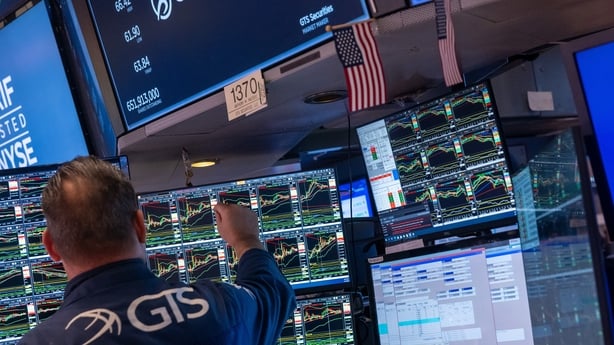
Wall Street benchmarks slumped on 3 April, ending with the largest one-day percentage loss in years.
It followed President Trump’s sweeping tariff announcement which ignited fears of an all-out trade war and a global economic recession.
Investors fled from risky assets, seeking the safety of government bonds, after he slapped a 10% tariff on most US imports and much higher levies on dozens of other countries.
High-flying technology stocks suffered big declines after pushing Wall Street to record highs in recent years.
Apple sank, reeling from an aggregate 54% tariff on China, the base for much of the iPhone maker’s manufacturing. Nvidia also slumped, as did Amazon.
A week of historic market volatility ensued as the US and China engaged in tit for tat tariffs.
On 8 April, the Wall Street Journal reported that the S&P edged closer the day before to bear-market territory, defined as a 20%-plus decline from a recent peak, adding that the tech-heavy Nasdaq Composite fell into a bear market last week.
It said on April 3 and 5, US stocks lost $6.6 trillion in value after President Trump announced larger tariffs than Wall Street expected and China said it would match the duties on all US-made goods.
May
By mid-May the US and China reached a tariff truce, signalling a joint effort to stave off a global economic downturn.
Following the announcement the S&P 500 and the Nasdaq closed higher for a second day in a row after softer-than-expected inflation numbers added to investor optimism.
Among the S&P 500’s 11 major industry sectors, six advanced, with technology the biggest gainer, ending up 2.25% while healthcare was the biggest loser, down 2.97%.
The S&P 500 and the Nasdaq recovered losses since April 2 – or “Liberation Day”.

A 90-day pause announced on April 9 for countries other than China, along with solid earnings reports and a limited US-UK trade agreement, helped the S&P 500 and the tech-heavy Nasdaq regain lost ground.
After a rough start to 2025, the Magnificent 7 tech and growth stocks surged back.
By the end of May, megacap technology and growth stocks had retaken US market leadership.
The group accounted for over 40% of the S&P 500’s total return since the close on April 8.
And the tech trade got a fresh boost as shares of Nvidia gained 3% after the AI chipmaker’s sales beat quarterly expectations.
June
The US stock market completed a roller-coaster first half of the year at record-high levels but warned a host of factors could knock equities off their perch over the rest of 2025.
The benchmark S&P 500 was up over 5% on the year so far, rebounding from its April plunge.
Tech was the best-performing S&P 500 sector in the second quarter, while the “Magnificent Seven” megacap stocks overall surged since the market’s April lows.
The performance revived concerns about a relatively small number of large stocks propelling the market, including that the advance may not be as strong beneath the surface.
July
Early in July chip maker Nvidia reached a market capitalisation of $4 trillion on its AI dominance.

It was the first company in the world to reach the milestone, and it solidified its position as one of Wall Street’s most-favoured stocks.
By the end of the month Mircrosoft briefly reached the $4 trillion valuation after solid results.
However also in July, a widely cited MIT study claimed that 95% of organisations that invested in generative AI were getting “zero return.” Tech stocks briefly plunged.
The recent MIT Technology Review said while the study itself was more nuanced than the headlines, for many it still felt like the first hard data point confirming what sceptics had muttered for months: Hype around AI might be outpacing reality.
August
Markets went down in August as jitters continued following MIT’s study in July and OpenAI CEO Sam Altman said what everyone in Silicon Valley had been whispering.
He said investors as a whole are overexcited about AI, warning that while some may profit, some investors are likely to lose a lot of money.
He also compared the current moment to the dot-com bubble.
“When bubbles happen, smart people get overexcited about a kernel of truth,” he explained. “Tech was really important. The internet was a really big deal. People got overexcited.”
His comments followed recent earnings results that exceeded expectations for Microsoft, Alphabet and Meta.
They all posted strong growth and showed no signs of pulling back on AI.
September
US equities had a good month, led by Magnificent 7 stocks which gained almost 9% for the month.
US independent financial advisory firm Clearstead reported it was pleasantly surprised by the strong up-draft in US financial markets in September which has historically been a volatile month
Clearstead said they are also generally optimistic about the prospects for markets in 2026.
Nonetheless, they added they would not be surprised if some volatility crept back into the markets in the coming weeks.
October
Nvidia made history in late October as the first company to reach $5 trillion in market value as the AI boom powered its meteoric rise.
Apple briefly passed a market cap of $4 trillion for the first time this month.
However, warnings of a possible rapid “correction” due to concerns about these staggering tech valuations also rose in October.

The Guardian’s Financial Editor Nils Pratley said the “The AI valuation bubble is now getting silly,”.
“The broad parallels are genuinely close to the madness of the late-1990s dotcom bubble,” he added.
But a burst bubble does not mean the technology will end, it may lead to job cuts, company failures, investor losses and stock market correction, but the underlying technology will remain.
November
Investors were again in for a bumpy ride.
Nvidia delivered record earnings seeing its stock pop, only to decline again the next day as confidence in AI trade wavered.
CEO Jensen Huang swatted away concerns saying the market did not appreciate Nvidia’s numbers and that the company was in a no-win situation amid AI bubble chatter.
Money is pouring into artificial intelligence, with spending expected to reach more than $2 trillion worldwide in 2026, according to the consulting firm Gartner.
But concern is growing. Stock markets are closely monitoring tech giants Apple, Microsoft, Google, Amazon and Nvidia, and startups like OpenAI, amid fears of a speculative bubble.
Several major investors – including Japan’s SoftBank and Peter Thiel – divested Nvidia shares in mid-November.
“No company is going to be immune, including us,” Google CEO Sundar Pichai warned.
Yet Nvidia reported “off the charts” demand for its chips, indicating the fever continues.
December
“Long Magnificent Seven” stocks are still considered the most crowded trade, as they were last year too. After stellar 63% gains this year, gold joins them in second place on that list.
However, investors appear to be picking between winners and losers rather than just choosing tech stocks as concerns continue over whether AI spending is creating a bubble in tech stocks
Fortune this month reported that between October 2022 and November 2025 roughly 75% of gains in the S&P 500 came from the Magnificent 7.
It noted that as we draw near to the close of the year, only two of those stocks – Alphabet and Nvidia – have actually beaten the market as a whole, year to date.
The Magnificent 7 currently make up about 35% of the US large-cap stock market index.
But how will these companies fare in 2026? Analysts say there could be divergence with the likes of Nvidia, Microsoft and Google doing well, some doing not so well and some in the middle.
And whether the AI bubble bursts next year…well that remains to be seen.
Additional reporting Reuters and AFP