
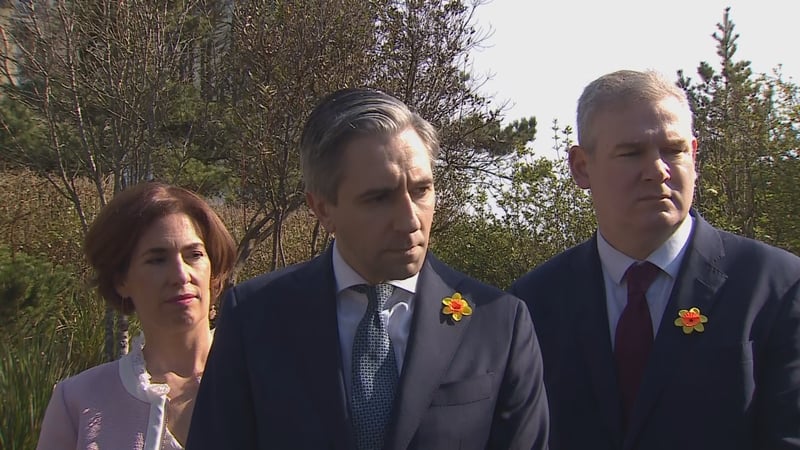
Tánaiste Simon Harris has said the Government will work over the weekend to bring forward a series of measures by next Tuesday to address the rising costs of fuel.
Speaking on RTÉ’s Six One, Mr Harris said that “To be blunt, excise is probably the most effective way we’ve used in the past to alleviate some pressure.
“It can be done quickly, it can be passed on quickly, and it has been done in the past.”
He said the Government “need to do something to help people with the cost at the pumps – with petrol and diesel.
“We’re going to have to do something to help those most in need, those most vulnerable to things like fuel poverty.
“And we’re going to need to take action to try and help key parts of the Irish economy – particularly I’m thinking of the hauliers at the moment who are so important to our supply chains.”
He said “different measures ” than the main three he intends to prioritise may be required during the course of the year, and that any potential energy credits, which would require legislation, would “take longer” to introduce.
He said initial measures should be for the “short-term” because the situation is so fast-moving and that it was “impossible to predict where things will be in six days, six weeks, let alone six months.”
The Tánaiste added that if supports need subsequently to be extended, “that’s okay.”
“It may equally be that the situation drastically changes, maybe even improves, de-escalates – I accept that doesn’t look likely.
“Or indeed that the challenge gets deeper and there’s different areas of the economy that need assistance.”
He said measures need to be “effective” to help people “here and now” while staying flexible enough that they can be “revised” to respond to the situation as it evolves.
He said the “full economic impact” of the war cannot yet be predicted but it was a “moment of real existential economic challenge globally and we have to be nimble in our response.”
His comments came as oil prices gained again today with Brent futures rising to $112.58 (up 3.66%) a barrel today, while US West Texas Intermediate (WTI) crude rose 2.78% to $98.81.
When asked whether Ireland would follow some other European countries and cap energy bills, Mr Harris said he would not “rule anything out at this stage.”
He said the “scale of the economic challenge” could not be “overstated and that it showed that Ireland and Europe need to “wean” themselves off their reliance on energy from elsewhere in the world and “accelerate” their own “energy independence.”
Speaking to reporters in Galway earlier, Mr Harris dismissed calls by Sinn Féin for legislation to cut excise duty on fuel for six months.
“We can bring a financial resolution that’s much more speedy, much more effective. Secondly, their (Sinn Féin) proposal doesn’t reference anything in relation to fuel allowance, and I do think people at risk of fuel poverty need to be in our minds as well as people at the pumps. And thirdly, I really feel very, very strongly on this, anything we do in the first instance should be a short for a short period of time.”
Mr Harris added that the Government was in a position to help because the economy is “in good health”.
“So, a series of measures introduced for a short period of time allows us take stock, see where the economy is at, see where our European counterparts are at. We’re having a lot of engagement at European level and have an ability to adapt demand and revise as needed.”
We need your consent to load this rte-player contentWe use rte-player to manage extra content that can set cookies on your device and collect data about your activity. Please review their details and accept them to load the content.Manage Preferences
Tax cuts would be passed on but prices still rising – Fuels Ireland
Kevin McPartlan, CEO Fuels for Ireland, said he “agrees” with the Tánaiste that “knee-jerk responses” to the surge in diesel and petrol prices “is not the way” to address the increase.
Mr McPartlan acknowledged there is “an emergency right now, we have a need to deal with the current crisis.”
But he said “we also have to look at how we got ourselves in to this situation.”
“Why it is that Ireland pays more tax than any other European Union member state for its fuel, why it is that we have one of the highest prices of fuel in the European Union? And it’s down to Government policy.”
McPartlan said “there’s no reason” why any reduction in VAT or / and excise duty on petrol and diesel that could be announced by the Government “wouldn’t be passed on” to consumers on filling station forecourts.
“It will be passed on … the difficulty is that commodity prices continue to increase.”
He said that in the last 48 hours, the commodity or wholesale price for diesel has gone up around 13 cent per litre.
“And you add the VAT on top of that, you’re talking about 15 cent.
“So since the Tánaiste announced that he was going to make this announcement on Tuesday, we’ve already had a 15 cent a litre increase.”
‘We can’t fire every bullet now’
Fianna Fáil TD Shane Moynihan said it is important that the Government takes a “timely approach” to the introduction of measures to ease the cost of fuel prices.
Speaking to the Today with David McCullagh programme, he said: “We are only three weeks into this crisis … we’re one of the first governments in Europe that will bring together a set of measures that will assist families and households – and that’s right and that’s proper – but we can’t fire every bullet now,” he said.
“We have to make sure that whatever introductions or whatever supports we put in place are things that are sustainable, that provide assistance to the people who need it, and are ultimately sustainable in the long term.”
Labour TD Marie Sherlock said it was “absolutely disgraceful” that the Government has had to be “brought kicking and screaming” to introduce measures.
She said there was already a cost-of-living crisis in Ireland before the Iran war broke out.
“People are already struggling with their gas and electricity bills. Food prices have gone up by over 25% over the last four years. The Government already in the Budget failed to respond to the cost-of-living crisis that is there and now we have what has happened over the last two-and-a-half, going on three weeks now,” she said.
“We absolutely need to see emergency measures taking place … there’s families out there living from week to week who are having to make choices.”
We need your consent to load this rte-player contentWe use rte-player to manage extra content that can set cookies on your device and collect data about your activity. Please review their details and accept them to load the content.Manage Preferences