MaryLou CostaBusiness reporter
Dan McKenzie
Both the UK and US’s research facilities in Antarctica are on the hunt for the next batch of workers to “go south”.
You don’t need to be a scientist, as vacancies are available for everything from carpenters, to electricians, chefs, and even a hairdresser. But could you cope with the cold and isolation?
Since leaving his hometown of Wigan in the north of England aged 19, Dan McKenzie has worked in numerous far-flung places around the world.
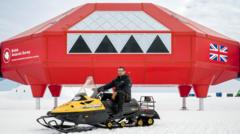
Now 38, the former marine engineer’s most remote and challenging role by far is his current job as the station leader at the Halley VI Research Station in Antarctica.
This is one of five facilities on the icy continent run by the British Antarctic Survey (BAS), the UK’s polar research institute.
“I’ve always been adventurous and interested in finding the most wild places,” says McKenzie, speaking to the BBC via a satellite-connected video call.
“I used to be a seafarer, and I didn’t want to carry on on ships, but to do something similar. I thought this would align pretty well with the skills that I’ve got.”
As McKenzie speaks about his job, it is a stunning Antarctic summer’s day, a balmy -15C. The view outside his window is a vast expanse of white as far as the eye can see, smoothed over by an equally vast layer of pure blue.
“That temperature is pretty nice here, really,” he says. “Minus five is as warm as it gets. It can get down to about -40, but you’re looking at about -20 being the average.”
McKenzie is responsible for a team of 40 people based at Halley VI for Antarctica’s summer season from November to the middle of February.
BAS stations monitor different aspects of wildlife and the environment. Halley VI is focused on space and atmospheric data, as well as studying the Brunt Ice Shelf on which it’s located close to the coast, and the hole in the Earth’s ozone layer.
Not only do the team experience extreme cold, but summer in Antarctica also comes with non-stop daylight, ending with a sunset that lasts weeks.
Dan McKenzie
McKenzie worked his way up to the job of station leader after completing his first contract “on the ice” in 2019. He started as a mechanical maintenance engineer at BAS’s Rothera Research Station, 1,000 miles away from Halley VI.
His station leader role involves managing supplies, health and safety, and training. McKenzie also has to provide emotional support to the team when issues like isolation and interpersonal conflict in close quarters get too much.
“People come into your office and say they’re not having a very good day, or something’s happened at home, and you have to try and see if you can support them. It’s very varied.”
McKenzie is one of 120 BAS employees in total who were in Antarctica for the summer season that is now coming to an end. Most, including McKenzie, will return to the UK by the end of May, yet up to 50 will stay for the darkness of winter.
McKenzie will be based at BAS’s headquarters in Cambridge for the remainder of the year, but he has previously overwintered in Antarctica. “When the winter comes, you feel this incredible sense of freedom as most people leave,” he says.
“You just feel like you’re the most free person in the world. You’ve got this tight knit group of people, and you all really care about each other – you become like a little family. Everyone looks after each other.”
BAS
BAS takes on up to 150 new recruits for Antarctica each year. While specialist science and engineering roles form the backbone, around 70% of the jobs are the operational roles required to keep the stations functioning.
In addition to the likes of electricians and chefs, the workforce includes medics, doctors and plumbers. Salaries start at £31,244 per annum, with travel, accommodation, meals and gear to withstand the extreme temperatures all provided.
In total, some 5,000 people work in Antarctica during its summer months, across 80 research stations operated by about 30 countries.
Both BAS and its American equivalent, the US Antarctic Program, advertise their jobs online. BAS also holds an open day in March.
But those enticed by the call of adventure must ensure they know what they’re signing up for. Fresh food is scarce and alcohol is limited. And accommodation at BAS facilities is shared dormitories. Staff work a seven-day shift rota.
BAS’ selection process tests for conflict-handling and problem-solving abilities, which is followed by thorough pre-deployment training for successful candidates.
BAS
Yet rather than the physical challenges – and the cold – it’s the close proximity to colleagues, and structured routine, that can cause the most issues for people, according to Mariella Giancola, BAS’ head of HR. She likens it to “going back to uni”.
“We get a lot of people saying, ‘I don’t have a problem dealing with people’. And then they realise that they are not comfortable sharing spaces with other people.
“It’s important to be comfortable with the fact that you are not going to have any privacy because people are right in your face. Then they go from the freedom they have at home, to being told by a station leader about the rules and regulations. A small number of people struggle with that.”
Dr Duncan Precious is a clinical psychologist who served in that role in both the British and Australian armed forces, from 2013 to 2020. He’s now the clinical director and resilience consultant for defence consultancy, CDS Defence & Security.
While the potential for physical hazards in Antarctica is high, Precious says social dynamics can prove more problematic. When relationships break down, the fallout can be hard to rectify, and hard to control, he says.
He notes, though, that the type of people drawn to living and working in Antarctica would tend to thrive on what he refers to as “good stress” – in a similar way certain people are drawn to serving in the military.
Despite the physical and emotional demands of the job, McKenzie says nothing beats the incredible experiences he’s had – as well as the satisfaction of contributing to environmental research.
“When I first got down here, it was hard to be sharing a room with people, and the weather was quite miserable. For the first month I thought, ‘maybe this isn’t the thing for me’,” he acknowledges.
“But then you start to get out, and you see whales, seals and islands on boats, and then little trips out in small aircraft. And you think, ‘this is pretty brilliant’. This year, I’ve been so lucky to see an emperor penguin colony. It’s like something from a David Attenborough documentary.”
Read more global business stories