When I first started investing back in 2009, it wasn’t really even a mainstream thing.
I had to go to the library and read books on investing so that I could learn (online resources were nothing like they are now) how to invest.
And buying stocks was actually an expensive endeavor, involving pretty heavy commission fees.
Nowadays, with the way investing has been popularized and democratized, almost anyone can pop on an app, do an infinite amount of research at will, and invest at practically no cost.
It’s incredible.
However, one thing hasn’t changed: the power of dividend growth investing over time.
This long-term investment strategy is all about buying and holding shares in world-class businesses which are so prolific at generating rising profit that they’re able to pay shareholders ever-larger cash dividend payments.
If you want to see what I mean, you can find hundreds of examples on the Dividend Champions, Contenders, and Challengers list.
This list has invaluable information on US-listed stocks that have raised dividends each year for at least the last five consecutive years.
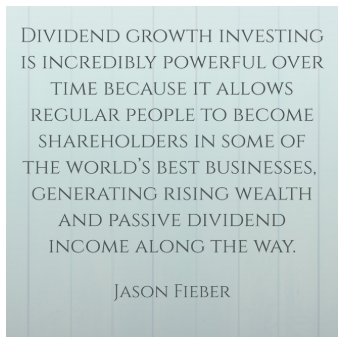
Dividend growth investing is incredibly powerful over time because it allows regular people to become shareholders in some of the world’s best businesses, generating rising wealth and passive dividend income along the way.
With enough passive dividend income, you can even pay for all of your bills and become financially independent.
That’s what happened for me.
By steadfastly applying dividend growth investing, I was able to reach financial independence and even retire in my early 30s.
My Early Retirement Blueprint shares a lot of the blow-by-blow details behind all of that.
The FIRE Fund, which is my real-money portfolio, generates more than enough five-figure passive dividend income for me to live off of,
Another thing that hasn’t changed?
The importance of valuation at the time of making any investment.
It’s as true today as it was 100 years ago: Price is what you pay, but value is what you get.
An undervalued dividend growth stock should provide a higher yield, greater long-term total return potential, and reduced risk.
This is relative to what the same stock might otherwise provide if it were fairly valued or overvalued.
Price and yield are inversely correlated. All else equal, a lower price will result in a higher yield.
That higher yield correlates to greater long-term total return potential.
This is because total return is simply the total income earned from an investment – capital gain plus investment income – over a period of time.
Prospective investment income is boosted by the higher yield.
But capital gain is also given a possible boost via the “upside” between a lower price paid and higher estimated intrinsic value.
And that’s on top of whatever capital gain would ordinarily come about as a quality company naturally becomes worth more over time.
These dynamics should reduce risk.
Undervaluation introduces a margin of safety.
This is a “buffer” that protects the investor against unforeseen issues that could detrimentally lessen a company’s fair value.
It’s protection against the possible downside.
While a lot of things have changed since I first started investing, routinely buying undervalued high-quality dividend growth stocks remains as timeless a way to build wealth, passive income, and freedom as ever.
You know what’s also timeless?
Lesson 11: Valuation.
Written by fellow contributor Dave Van Knapp, its a fantastic guide that explains the ins and outs of valuation using simple terminology, and it even provides an easy-to-use valuation template that can quickly estimate the fair value of just about any dividend growth stock out there.
With all of this in mind, let’s take a look at a high-quality dividend growth stock that appears to be undervalued right now…
RELX PLC (RELX)
RELX PLC (RELX) is a UK-based multinational information and analytics company.
Founded in 1993, but with roots dating back to the late 1800s, RELX is now a $56 billion (by market cap) data and analytics giant that employs more than 35,000 people.
The company reports revenue across four segments: Risk, 34% of FY 2025 revenue; Scientific, Technical & Medical, 32%; Legal, 20%; and Exhibitions, 13%.
North America accounts for roughly 60% of all revenue; Europe accounts for about 20%, whereas the remainder of revenue comes from the rest of the world.
RELX provides valuable, technical, and proprietary data and analytics to a range of industries, including the medical and legal professions – professions that constantly require vast amounts of on-demand, specialized, and precisely accurate information.
While there are fears that AI could displace vast swaths of the global software complex, including the likes of RELX, this company’s data-driven tools and insights are proprietary treasure troves and embedded in the daily workflows of countless professionals.
The company’s renowned LexisNexis platform, for instance, which operates massive databases, offers machine-to-machine solutions firmly incorporated as part of daily procedures for clients, helping to make decisions and process an untold number of individual operations.
Unless we’re going to live in a world where AI steals all IP (in which case, no company is safe), or the legal and healthcare systems are held hostage to possible AI mistakes that leave lives hanging in the balance – a world, quite frankly, I can’t imagine living in – RELX is not only going to survive but thrive in the age of AI due to the increase in productivity and efficiency across both its enterprise and clients’ enterprises.
That translates to the future quite possibly being even better than the past, and RELX already has an incredible track record as it pertains to revenue, profit, and dividend growth.
Dividend Growth, Growth Rate, Payout Ratio and Yield
RELX has now increased its dividend for 15 consecutive years.
Its 10-year dividend growth rate is 7.7%.
As solid as this is, what’s more impressive is the consistency of it.
If you go back over the last decade, RELX hands out dividend raises at somewhere between 7% and 8% like clockwork.
In fact, RELX just released its 2025 results only days ago.
And guess what?
The company increased its full-year dividend by 7.1%.
Again, clockwork.
Along with this reliable high-single-digit dividend growth comes the stock’s market-beating yield of 2.8%.
This yield, by the way, is way higher than what’s usually available on this particular stock.
To put that in perspective, this yield is 90 basis points higher than its own five-year average.
And with a payout ratio of 52.5%, the dividend remains as healthy and poised for growth as ever.
This is a super balanced dividend profile, offering a great blend of yield, growth, and safety.
Revenue and Earnings Growth
As great as it might be, though, much of this is based on what’s happened previously.
However, investors must always be thinking about what may be yet to come, as today’s capital gets risked for tomorrow’s rewards.
Thus, I’ll now build out a forward-looking growth trajectory for the business, which will be taken into account during the valuation process.
I’ll first show you what the business has done over the last decade in terms of its top-line and bottom-line growth.
I’ll then reveal a professional prognostication for near-term profit growth.
Blending the proven past with a future forecast in this way should empower us to draw up an idea of where the business could be going from here.
RELX grew its revenue from £6.9 billion in FY 2016 to £9.6 billion in FY 2025.
That’s a compound annual growth rate of 3.7%.
This is decent top-line growth.
I usually like to see a mid-single-digit top-line growth rate from a mature business like this; RELX is pretty close.
Meanwhile, earnings per share increased from 56.3 pence to 112.6 pence over this period, which is a CAGR of 8%.
That’s very solid bottom-line growth for this business model at this level of scale.
Again, though, what’s particularly impressive about it is the consistency of it, with RELX marching ahead in an almost relentless way.
The 8.7% YOY growth in EPS RELX reported for FY 2025 is a perfect example of this.
Looking forward, CFRA believes RELX will compound its EPS at an annual rate of 11% over the next three years.
After looking at RELX’s reports, it seems to me that this is a business reliably growing at a high-single-digit rate on the back of 70%+ recurring revenue with very high returns on capital and margins (because there’s almost no incremental increase in costs to scale up subscriptions, which already make up more than half of the sales base).
And this was before the AI threat was on the scene.
Against that backdrop, a sizable acceleration in bottom-line growth seems aggressive to me.
Nonetheless, CFRA correctly identifies numerous strengths from RELX that insulates it from that AI threat, including proprietary datasets built over decades, leadership in fragmented markets with high barriers to entry (even for AI), and the secular growth occurring from compliance stemming from preventing fraud.
Furthermore, AI could actually turn out to be a boon for RELX, as it will likely improve productivity and efficiency across the entire enterprise.
But the most important point as it relates to AI is that RELX is centrally built upon risk management.
This company is handling and disseminating vast amounts of precise, proprietary data designed around risk, and this information is embedded into daily workflows.
AI is not going to be providing insurance companies with proprietary data on drivers so that risk can be priced appropriately, and there’s no room for inaccuracies in law or healthcare where lives are on the line.
The value of RELX’s data is very high, but the costs are a very small portion of a client’s total overhead.
While there might be some pressure at the margins, the core business model is nearly impossible to completely displace.
Balancing everything out, I’m predisposed to assume a continuation of the status quo out of RELX.
That should mean more high-single-digit dividend growth on top of the starting yield of nearly 3%, setting shareholders up for a low-double-digit annualized total return over time.
That’s not bad at all.
Financial Position
Moving over to the balance sheet, RELX has a good financial position.
The long-term debt/equity ratio is 1.5, while the interest coverage ratio is nearly 10.
The former ratio is more a function of low common equity than a high absolute debt load.
Its net debt/EBITDA ratio is 2, which is fairly moderate.
And RELX has excellent credit ratings well into into investment-grade territory: A3, Moody’s; A-, S&P.
Profitability is outstanding.
Return on equity has averaged 52.8% over the last five years, while net margin has averaged 19.3%.
ROE benefits from that low common equity I just mentioned, but ROIC is also routinely over 20%.
These are very high returns on capital, speaking to the power of the capital-light business model focused on subscriptions an recurring revenue.
Overall, it’s hard to argue against the idea that this is a great business.
And with economies of scale, brand power, barriers to entry, switching costs, embedded subscriptions, and IP, the company does benefit from durable competitive advantages.
Of course, there are risks to consider.
Litigation, regulation, and competition are omnipresent risks in every industry.
There are unknown implications surrounding AI, especially in terms of pressure at the margins, but the business model appears to be largely insulated against severe disruption.
Being a global enterprise, RELX is exposed to exchange rates and geopolitics (but its lack of physical goods mitigates tariff concerns).
The company will have to prove that AI is more a friend than foe by showing growth acceleration and innovation.
There is almost no cyclicality that I can see in results, but a major global slowdown could negatively impact renewal rates.
AI may reduce barriers to entry/switching costs over the long run, and RELX will have to continue to invest in the business in order to maintain its leadership role and prove its value proposition.
This has historically been a very low-risk business, but AI has raised the stakes a bit.
However, that has resulted in the stock getting crushed – down nearly 50% from its recent high – now already pricing in a lot of disruption that hasn’t even happened yet…
Valuation
The P/E ratio has dropped to 20.1.
While not super low in isolated absolute terms, this earnings multiple is almost unheard of for this specific stock.
For perspective, its own five-year average P/E ratio is 32.1.
The quality and consistency of RELX has almost always commanded a healthy premium.
Now, maybe that premium was too much.
But we’ve swung from premium to discount in a hurry.
The P/CF ratio of 14.8, which is really not high at all even by itself, is well off of its own five-year average of 22.1.
And the yield, as noted earlier, is significantly higher than its own recent historical average.
So the stock looks cheap when looking at basic valuation metrics. But how cheap might it be? What would a rational estimate of intrinsic value look like?
I valued shares using a dividend discount model analysis.
I factored in a 10% discount rate and a long-term dividend growth rate of 7.5%.
I’m assuming the next decade will look a lot like the last one, as this growth rate would be just a touch below the demonstrated dividend growth over the prior 10 years.
With the payout ratio being where it’s at and RELX consistently generating high-single-digit EPS growth, along with the big acceleration in bottom-line growth CFRA is forecasting, it’s hard to imagine the dividend not keeping up with this kind of expectation.
If anything, again, I’m building in a very slight slowdown in order to account for AI pressure at the margins.
I think this model is strongly rooted in the reality of the business.
The DDM analysis gives me a fair value of $39.56.
The reason I use a dividend discount model analysis is because a business is ultimately equal to the sum of all the future cash flow it can provide.
The DDM analysis is a tailored version of the discounted cash flow model analysis, as it simply substitutes dividends and dividend growth for cash flow and growth.
It then discounts those future dividends back to the present day, to account for the time value of money since a dollar tomorrow is not worth the same amount as a dollar today.
I find it to be a fairly accurate way to value dividend growth stocks.
This stock looks like a classic example of market overreaction to me, as it went from too expensive to too cheap in a matter of months.
But we’ll now compare that valuation with where two professional stock analysis firms have come out at.
This adds balance, depth, and perspective to our conclusion.
Morningstar, a leading and well-respected stock analysis firm, rates stocks on a 5-star system.
1 star would mean a stock is substantially overvalued; 5 stars would mean a stock is substantially undervalued. 3 stars would indicate roughly fair value.
Morningstar rates RELX as a 5-star stock, with a fair value estimate of $57.00.
CFRA is another professional analysis firm, and I like to compare my valuation opinion to theirs to see if I’m out of line.
They similarly rate stocks on a 1-5 star scale, with 1 star meaning a stock is a strong sell and 5 stars meaning a stock is a strong buy. 3 stars is a hold.
CFRA rates RELX as a 4-star “BUY”, with a 12-month target price of $49.00.
I’m definitely on the low end, but we all agree that the crash has resulted in attractive value. Averaging the three numbers out gives us a final valuation of $48.52, which would indicate the stock is possibly 37% undervalued.
Bottom line: RELX PLC (RELX) is a wonderful business with consistent growth, recurring revenue, and high returns on capital. Despite the AI threat, the truth of the matter is that this company’s solutions are embedded into daily workflows where precision is non-negotiable. With a market-beating yield, a balanced payout ratio, high-single-digit dividend growth, 15 consecutive years of dividend increases, and the potential that shares are 37% undervalued, this looks like the time to pounce on a high-quality name after an epic crash.
-Jason Fieber
Note from D&I: How safe is RELX’s dividend? We ran the stock through Simply Safe Dividends, and as we go to press, its Dividend Safety Score is 67. Dividend Safety Scores range from 0 to 100. A score of 50 is average, 75 or higher is excellent, and 25 or lower is weak. With this in mind, RELX’s dividend appears Safe with an unlikely risk of being cut. Learn more about Dividend Safety Scores here.
P.S. If you’d like access to my entire six-figure dividend growth stock portfolio, as well as stock trades I make with my own money, I’ve made all of that available exclusively through Patreon.
Disclosure: I’m long RELX.