
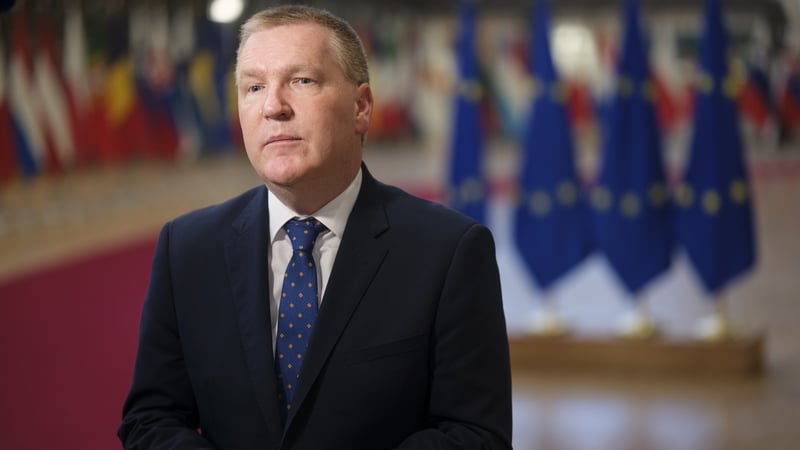
Ireland’s EU Commissioner Michael McGrath has travelled to Brazil and Colombia for talks on data protection, judicial cooperation, consumer rights and democratic resilience – the first commissioner to travel to the region following the signing of the EU-Mercosur trade deal and the subsequent referral of the agreement by the European Parliament to the European Court of Justice (ECJ).
In a statement, the European Commission said the visit signalled “a renewed determination to deepen strategic, political, and economic partnerships across South America.”
Mr McGrath is expected to push for a mutual data protection adequacy agreement between the EU and Brazil.
Although the visit is not related to the EU-Mercosur issue, it’s understood a data adequacy arrangement would be seen as facilitating the flow of personal data across borders, which, the Commission says, would reduce red tape and promote digital trade between the two blocs.
The EU is Brazil’s second largest trading partner, with two way trade reaching €89.5 billion in 2024.
The Commissioner will meet Brazil’s justice minister Wellington César Lima e Silva, the president of the Data Protection Authority Waldemar Gonçalves Ortunho Júnior, and the minister of Development, Industry, Trade and Services Geraldo Alckmin.
In Colombia, Mr McGrath – the Commissioner for Justice, Democracy, the Rule of Law and Consumer Protection – will discuss transnational organised crime with the country’s foreign affairs and justice ministers.
The visit comes amid continuing fallout over the EU-Mercosur agreement, which was signed by the EU and the four Mercosur countries – Brazil, Paraguay, Uruguay and Argentina – in Asunción on January 17.
It’s understood the European Commission will take soundings from member states and the European Parliament about whether or not to apply the trade deal provisionally, despite the fact that it has been referred to the ECJ, a process which could delay full ratification by up to two years.
In Davos last week, Taoiseach Micheal Martin said he strongly opposed any attempt to apply the trade agreement provisionally, while German Chancellor Friedrich Merz said he expected provisionally implementation to be agreed shortly.
The Commission insists that it would be legally entitled to apply the EU-Mercosur deal provisionally if approved by member states.
A weighted majority of member states approved the trade agreement on January 9. Ireland, France, Austria, Poland and Hungary opposed ratification.
The EU has been keen to diversify its trade ties away from the United States in light of the ongoing breakdown in trust between Europe and the Trump administration, an unravelling of the transatlantic relationship which came to a head over President Trump’s ambitions to acquire Greenland.
Commission president Ursula von der Leyen, and president of the European Council António Costa have just concluded negotiations on a trade deal with India to be announced tomorrow, according to India’s trade secretary.
The deal paves the way for free trade of goods between the EU and India, which together make up a quarter of the world’s gross domestic product and a market of two billion consumers.
“It will be a balanced, forward-looking deal for better economic integration with the EU. The deal will propel trade and investment between both sides,” said Trade Secretary Rajesh Agrawal.
Trade between the two sides stood at $136.5 billion in the fiscal year through March 2025.
The formal signing would take place after legal vetting expected to last five to six months, according to an Indian government official.
The EU signed trade deals last year with Indonesia, Mexico and Switzerland.
After nearly two decades of on-off negotiations, the deal will see India open up its vast and guarded market, the world’s largest, to free trade with the EU, its biggest trading partner.
India and the EU pushed to close the deal after Prime Minister Narendra Modi and European Commission President Ursulavon der Leyen agreed to fast-track negotiations last year.
Two-way talks, relaunched in 2022 after a nine-year lull, gathered momentum after President Trump imposed import tariffs on several trading partners, including a 50% tariff on goods from India.
An India-U.S. trade deal collapsed last year after a breakdown in communication between their two governments.
Both the EU and India had been locked in last-minute give and take over cars and steel trade, among the final points of contention.
The EU had sought sharp cuts by India in import duties on its cars that can exceed 100%, while India – a major steel producer – has been pushing the EU to reduce trade curbs to its steel exports.
Reuters reported on Sunday that India was planning to slash tariffs on cars imported from the EU to 40% from as high as 110% as part of the deal.
Negotiations excluded some sensitive farm and dairy items, as New Delhi maintains the need to protect millions of subsistence farmers.