

In 2011, Marc Andreessen proclaimed in a blog that “software is eating the world.” Like many of his bets and predictions, Marc Andreessen’s quote aged like a fine wine. Andreessen wrote: “Six decades into the computer revolution, four decades since the invention of the microprocessor, and two decades into the rise of modern internet, all the technology required to transform industries through software finally works and can be delivered at global scale.” He added, “we believe that many of the prominent new internet companies are building real, high-growth, high-margin, highly defensible businesses.” That’s exactly what would happen.
Over the past 15 years, the iShares Tech-Software ETF (IGV) ran from under $10 to ~$120 as investors gravitated to software stocks due to their lucrative, high-margin, defendable and predictable businesses.
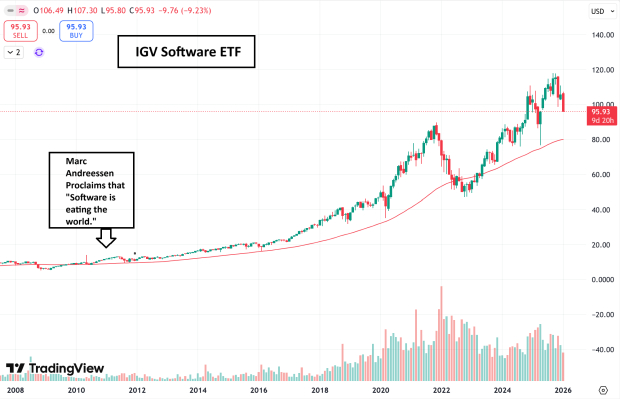
Image Source: TradingView
Software Stocks Have Plummeted Recently
Despite the software industry’s robust long-term performance, the group’s performance has deteriorated dramatically over the past few months. Below are some of the software group’s biggest losers (sorted by drawdown from all-time highs):
· UiPath (PATH): -84%
· Paycom Software (PAYC): -73%
· The Trade Desk (TTD): -70%
· DocuSign (DOCU): -65%
AI is Disrupting Software
The horrific performance in many former leading software stocks is no accident. With the advent of advanced AI tools, investors are increasingly concerned that AI will disrupt these once-lucrative businesses. In fact, there are plenty of signs that this is already occurring. The latest AI tools, like Anthropic’s “Claude Coworker”, help companies perform tasks much faster than legacy software companies and at a fraction of the cost.
Evidence that AI is Disrupting Software
Disruptive AI tools are beginning to pressure software margins and pricing power. For instance, Docusign once enjoyed a return on equity (ROE) of 169%. Today, DOCU’s ROE has plummeted to 39% – an all-time low for the stock as a public company.
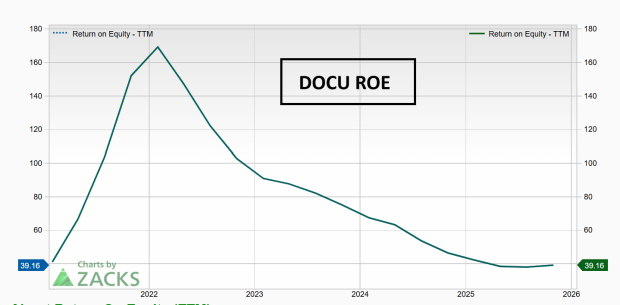
Image Source: Zacks Investment Research
Meanwhile, Atlassian, a company that sells management and integration software, is experiencing sluggish growth. After growing EPS at a double-digit clip for the past three years, Zacks Consensus Estimates predict that the company will grow at just 7.59% in 2026.
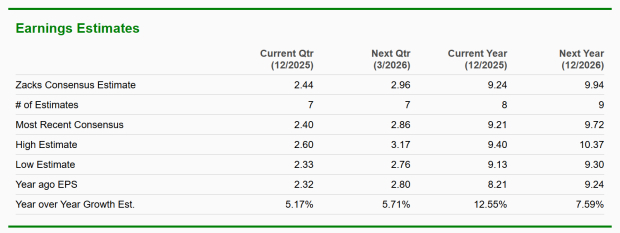
Image Source: Zacks Investment Research
To make matters worse, many software companies are racing to implement AI features into their products, but for the most part, those efforts are not bearing fruit.
Not All Software Companies Are Doomed
Although most software companies are being disrupted by AI, some, like Shopify (SHOP), are weathering the storm. Unlike many software companies, Shopify has adopted an all-hands-on-deck approach to AI adoption. For example, the company has unveiled a 24/7 AI-powered chatbot to help merchants and has partnered with OpenAI to allow users to purchase products straight from the wildly popular “ChatGPT” large language model.
Bottom Line
After a decade of growth and soaring stock prices, the software industry is being disrupted by AI. As AI tools get more complex and improve, software companies are becoming dispensable.
5 Stocks Set to Double
Each was handpicked by a Zacks expert as the #1 favorite stock to gain +100% or more in the coming year. While not all picks can be winners, previous recommendations have soared +112%, +171%, +209% and +232%.
Most of the stocks in this report are flying under Wall Street radar, which provides a great opportunity to get in on the ground floor.
Today, See These 5 Potential Home Runs >>
Want the latest recommendations from Zacks Investment Research? Today, you can download 7 Best Stocks for the Next 30 Days. Click to get this free report
UiPath, Inc. (PATH) : Free Stock Analysis Report
Paycom Software, Inc. (PAYC) : Free Stock Analysis Report
Shopify Inc. (SHOP) : Free Stock Analysis Report
The Trade Desk (TTD) : Free Stock Analysis Report
iShares Expanded Tech-Software Sector ETF (IGV): ETF Research Reports
Docusign Inc. (DOCU) : Free Stock Analysis Report
This article originally published on Zacks Investment Research (zacks.com).
Zacks Investment Research
The views and opinions expressed herein are the views and opinions of the author and do not necessarily reflect those of Nasdaq, Inc.