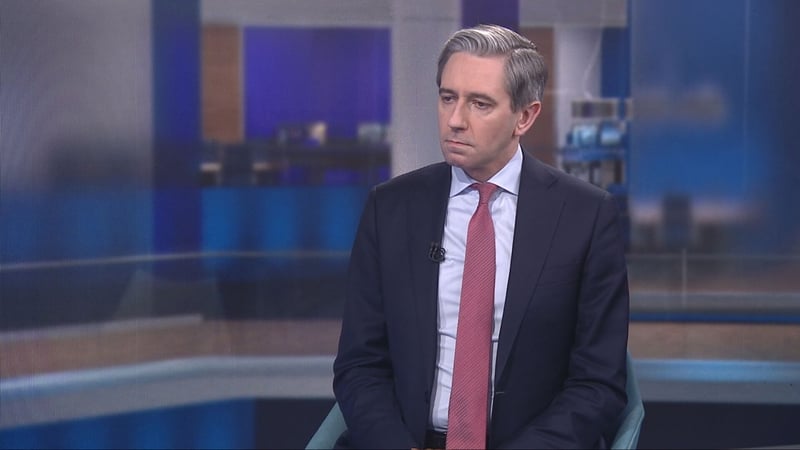
Tánaiste and Minister for Finance Simon Harris has said “everything is on the table” in relation to how Europe may respond if the US was to “annex” Greenland or part of Greenland.
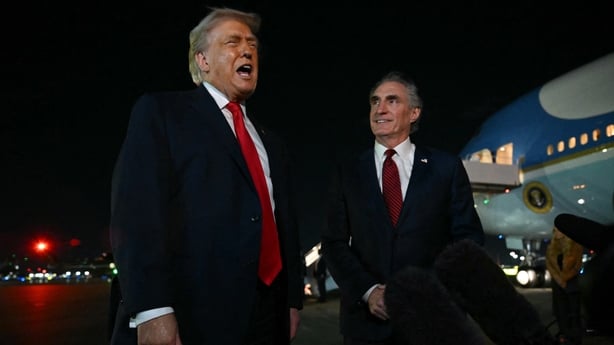
US President Donald Trump has said he will hit eight European allies with 10% tariffs from 1 February unless they agree to his purchase of Greenland, a semi-autonomous Danish territory, and he has refused to rule out using military force to seize the island.
Speaking on RTÉ’s Six One News, Mr Harris said any action taken at a European level would be proportionate, but he warned against getting involved in a “spiral” of “tit-for-tat tariffs”.
“Ireland wants to find a way forward, so does Europe, but everything is on the table should we see a situation where the United States of America intends to annex in some manner or means, Greenland.
“We have to be absolutely crystal clear on that. At the end of the day, you have to have values, you have to have principles.
“President Trump does not hold all the cards here, the EU, when it acts together, is a powerful economic block,” he said.
Follow live: France prefers respect over bullies, says France’s Macron
The Tánaiste said if there was any form of annexation of Greenland, no matter how that might come about, there was no doubt in his mind that that would be a “Rubicon moment”.
“And the risk there is that that would cause a spiralling effect, a chain of events which could cause significant financial damage to European economies and to the US economy,” he added.
Asked about the Government’s stance on tech companies being hit with tariffs would change if it had to, Mr Harris said Ireland “didn’t want tariffs full stop”.
“Ireland will be part of any coordinated European response because our strength is being in Europe.
“We’re a small, open economy, joining the European Union transformed our fortunes in so, so many ways.
“We’re clearly on team Europe, we’re in the European Union, we’re sitting around the table,” he added.
Ireland facing ‘grave moment’ in US relationship – Taoiseach
Earlier, Taoiseach Micheál Martin has said that Ireland and the EU are facing a “grave moment” in terms of our relationship with the US.
Speaking during Leaders’ Questions today, Mr Martin said that the US-Ireland economic relationship is “critical”.
“We have to do everything we possibly can to protect the jobs that depend on it, without sacrificing basic principles,” he said.
“We have to be clear-eyed about what is at stake and it’s very serious.”
Europe will adopt a “firm, principled and robust stance”, Mr Martin added.
“We have to be very clear-eyed about what is at stake, and it is very serious. It is a grave moment for the transatlantic relationship.
“Europe will be strong and unified, and the principle of European Union solidarity is absolutely key here.”
He said it would be better if the issues are resolved through dialogue.
“If the US wants to arbitrarily tear up an agreement, that’s a matter for the US.
“But Europe should be very clear. We entered into an agreement. We want to honour agreements that we entered into.”
The Taoiseach added: “A trade war would be very, very damaging indeed to workers across Europe, workers across the United States and indeed the world.”
Tariff threat would ‘rip up’ EU-US trade deal – McEntee
Minister for Foreign Affairs Helen McEntee had earlier said that Mr Trump’s threats of tariffs would “rip up” an EU-US trade deal struck last year.
Speaking on her way into this morning’s meeting of the Cabinet, Ms McEntee said it was “deeply regrettable”.
The comments came as Mr Trump and other leaders headed to Davos, Switzerland, for the World Economic Forum.
Ms McEntee told reporters it was clear that support for Greenland and Denmark was “absolute”.
She said if the threatened tariffs are introduced, €93 billion of countermeasures would be “back on the table” as the EU needed to “respond strongly”.
She emphasised it was “really important” for efforts to “engage in dialogue” with the US to be intensified over coming days, but added it is also important to have “a number of possible options to respond” if the threats come to fruition.
Read more:
Von der Leyen warns US that new tariffs against EU would be ‘mistake’
Ms McEntee said: “Of course, a threat of tariffs on eight member states is essentially a threat of tariffs on all member states, and it would be hugely regrettable for last year’s deal between the US and the EU to essentially be ripped up.”
She said the threat of tariffs would not change “the overall resolve of Europe in support for Greenland”.
“It is utterly regrettable that a president of the US would say that they’re not focused on peace, but we need to engage, we need to use our voice, as we always have in Ireland, to try and bring reason and to try and bring calm to the current situation.”
Watch: Next number of days will be ‘crucial’ for EU-US relations – Harris
Earlier, Mr Harris said that the next number of days will be “crucial” for EU-US relations.
He was in Brussels earlier attending a Eurogroup meeting and told reporters there was “not an hour to spare” as efforts continued to de-escalate tensions.
He said: “It’s absolutely important that intensive diplomatic efforts are put under way to try and de-escalate an extraordinarily dangerous economic situation.
“We all know that tariffs are bad for the Irish economy, they’re bad for the European economy, they’re bad for the US economy as well. But this is now deeper than that also.”
‘We cannot negotiate on territorial integrity’
Minister for Public Expenditure Jack Chambers has said that “we should not and cannot negotiate on territorial integrity and sovereignty”.
“The fact that President Trump is potentially going to escalate a serious deterioration in relations between the EU and the US only feeds into other countries that want to see Atlantic unity divided,” he said.
Speaking on RTÉ’s News At One, Mr Chambers said Ireland wants to see “constructive dialogue and de-escalation”.
“The EU has an ability to escalate if that’s what occurs from a trade perspective. We need to have respect for the European Union and its function in the context of the world.
The EU has to stand up for its own principles in terms of international law, democratic principles and territorial integrity, which are critical to a functioning world overall and deterioration around that is really worrying.”
Additional reporting Mícheál Lehane