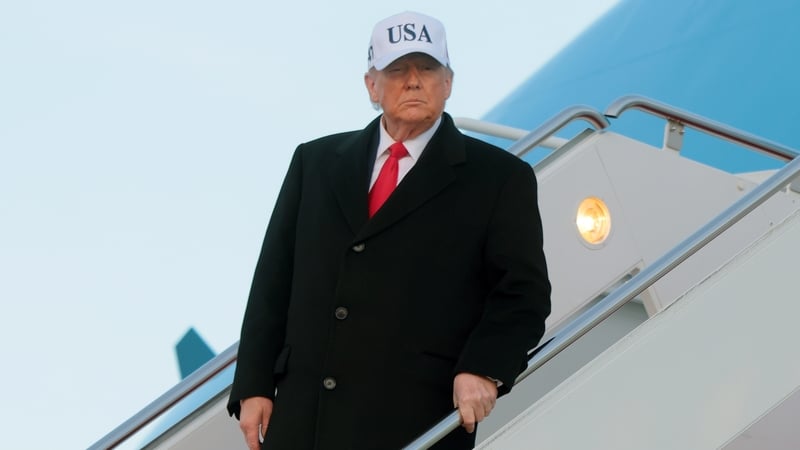
In the attention economy, US President Donald Trump has cornered the market in this most valuable commodity.
He is the bulk supplier of attention-grabbing statements to the people of the world.
His announcement of a new round of tariffs on the European countries that have sent token military forces to Greenland is the latest example.
“Take him seriously but not literally” has long been the standard advice for interpreting the president’s actions. But a 10% tariff – rising to 25% in June if he does not get control of Greenland – is too stark for anything other than literal interpretation. And that makes it even more serious.
Suddenly Greenland is a zero-sum game, with no room for the kind of creative ambiguity the Danish Foreign Minister Lars Løkke Rasmussen was peddling after his visit to Washington earlier this week.
No kicking the issue of Greenland to the long grass of an expert group to bury it in fudge. Either President Trump wins or he loses: either Europe wins or it loses.
And so we appear to be heading for the most serious crisis yet in transatlantic relations in the Trump era.
And for what? Sovereignty over Greenland? 75% of Americans polls last week on the president’s plan to seize control of Greenland said it was wrong.

This is not a burning issue for ordinary Americans, who are puzzled.
For those with an interest in foreign policy, the reaction is one approaching horror. Nobody gets his obsession with owning Greenland. Most of the MAGA media is in a holding pattern, as if it’s unsure what to say.
Is this the moment Mr Trump jumps the rubber shark with ‘Joe Biden’ painted on it?
The point of no return, like Mr Biden’s disastrous withdrawal of US forces from Afghanistan, when the credibility of his presidency was holed below the waterline, and slowly, irreversibly, sank?
President Trump’s speech to the World Economic Forum in Davos on Wednesday should be most interesting.
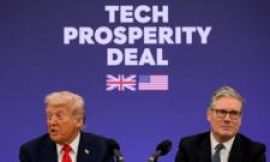
After a period of calm after a 15% general tariff rate was agreed between the EU and US (and a 10% rate for the UK), the US seems set to tear up that agreement by imposing additional tariffs on a select group of EU states, along with the UK and Norway.
The European Parliament seems set to block ratification of the US tariff agreement, which is only provisionally in force. A meeting of party leaders on Wednesday is likely to stop the ratification process in response to Mr Trump’s new tariffs.
And what of government responses? What happens if other EU states send token reconnaissance forces of their own? Do they get tariffed in a Spartacus-like act of defiance?
Or are we about to witness a divide and conquer approach by Mr Trump, splitting off the EU states which have not (yet) sent any military contingents to Nuuk? It’s a nasty dilemma. Nice trade surplus you got there – shame if something was to happen to it.
How do the EU states play it now – especially Ireland, a US dependent economy that received a big lump of EU solidarity during the Brexit negotiations when it faced bullying from a bigger, more powerful neighbour.
And Italy, the fourth European G7 state, led by Georgia Meloni, who appears to have skilfully become Europe’s chief “Trump Whisperer”?
Torn loyalties, divergent economic and political interests.
The Brexit playbook seems like the closest thing to a guidebook on how to get through such an unprecedented situation.
Read more: Trump vows tariffs on European nations over Greenland
There are some general principles from the Brexit period, like when faced with a provocation, refuse to be provoked. Keep calm and carry lots of paperwork. Talk softly and carry a big anti-coercion instrument. Be consistent.
Above all, stay united.
The Ukraine War has forged a pretty tight consensus among EU leaders (Hungary’s Viktor Orban apart).
But it’s one thing facing off against Russia when it’s waging a horrific war of conquest, quite another when facing up to a US administration that appears to have an irrational obsession with capturing a place where it can get anything it wants without the financial and political cost inherent in Mr Trump’s policy.
Amidst all the talk of the security threat posed by Greenland in its current state, a big bust up between the Atlantic allies over its ownership will have two clear winners: Russia and China.
As British historian and author Timothy Garton Ash put it last week, Europe is under attack – militarily from Russia, economically from China, and politically from America.
With yesterday’s escalation, Mr Trump seems to be taking over China’s work, and suggesting he might take Russia’s job too.
But amidst all the foreign policy action from the Trump administration over the past week – Iran, Greenland, Venezuela, Gaza etc – it’s been easy to lose sight of internal drama gripping this vast country.
Such as the government orchestrated investigations of the head of the central bank, five members of Congress, and a looming prosecution of a former President.
Not to mention the ICE storm that has hit Minneapolis, with violent protests against the immigration police leading the President to threaten to invoke the insurrection act – effectively Martial Law – in the city where Federal agents killed a woman and injured a man in shooting incidents.
Protests are expected to peak on Tuesday, the first anniversary of Mr Trump’s inauguration.
Let’s start with the easy stuff – an unprecedented investigation by prosecutors in DC of the Chairman of the Federal Reserve, Jerome Powell, whom they accuse of lying to Congress about the cost of refurbishing the Fed’s headquarters buildings in Washington.
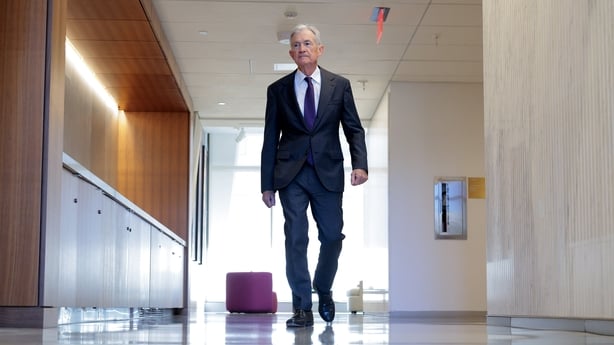
At $2.5 billion, it’s not cheap – but it is an extremely difficult technical challenge – extending a nearly 100 year old building underground (there are height restrictions in DC) by digging below the water table in what was a swampy tidal basin and canal in the 19th century.
The president and his allies have denounced the refurbishment as an extravagance.
In Euro, the refurb cost is €2.15bn – which makes it cheaper than the current €2.24bn cost of the National Children’s Hospital in Ireland.
And according to Blomberg calculations, the cost per square foot of the Fed building project is lower than the cost per square foot of the new White House Ballroom.
Yes, the latter is supposed to be paid for by private donors. But the Federal Reserve – like all central banks – is still a bank, and normally makes profits on its operations.
The charge against Mr Powell is that in giving an accounting of the cost overruns (of circa $600 million) to Congress last summer, he said there was no rooftop garden.
But the government spending watchdog said the plans called for a “vegetated roof”. So Mr Powell needs to be investigated by the US Attorney’s office for “lying to congress”.
Mr Trump has been ripping into his Central Bank chief since taking office (and before) – criticising him for not cutting interest rates faster, despite persistently higher than desired inflation. It’s gotten to the point where markets have now “priced in” such criticism.
But this one is different: it’s the start of a criminal investigative process against the head of the world’s most important central bank.
Mr Powell himself came out swinging from the hip. After a year of silence in the face of persistent attacks from the President, he has had enough.
Last Sunday night – immediately after the news of the indictment against him was made public – he released a video statement denouncing the move as intended to pressurise him into cutting interest rates.
In it he said: “This new threat is not about my testimony last June or about the renovation of the Federal Reserve buildings. It is not about Congress’s oversight role; the Fed through testimony and other public disclosures made every effort to keep Congress informed about the renovation project.
“Those are pretexts. The threat of criminal charges is a consequence of the Federal Reserve setting interest rates based on our best assessment of what will serve the public, rather than following the preferences of the president,” he said.
“This is about whether the Fed will be able to continue to set interest rates based on evidence and economic conditions – or whether instead monetary policy will be directed by political pressure or intimidation,” he added.
In other words, the head of America’s central bank is pushing back against President Trump.
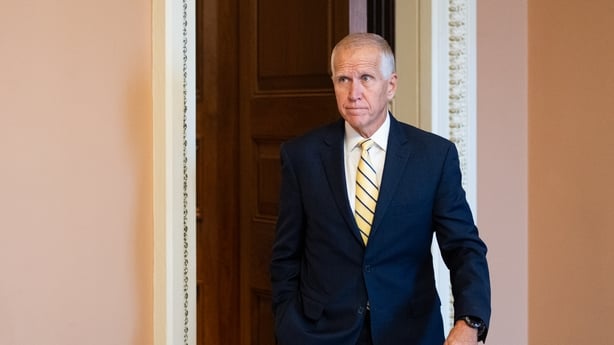
Also pushing back was Republican Senator Thom Tillis, who posted to social media, “If there were any remaining doubt whether advisers within the Trump Administration are actively pushing to end the independence of the Federal Reserve, there should now be none.”
“It is now the independence and credibility of the Department of Justice that are in question. I will oppose the confirmation of any nominee for the Fed – including the upcoming Fed Chair vacancy – until this legal matter is fully resolved,” he added.
Mr Tillis has also criticised the Greenland policy, whilst on a visit to Copenhagen with a congressional delegation.
Central Bank bosses are supposed to be independent of the government, setting interest rates with a view to medium term stability in inflation and unemployment rates.
Last week Ireland borrowed €5 billion from investors happy to make a yield of 3.15% on a ten year bond. It’s effectively the interest rate governments pay to borrow.
Here in the US, the ten year yield closed Friday night at 4.23%. Okay, the US has an enormous debt pile and a huge 6.5% budget deficit – the gap between what it borrows and what it spends. And higher inflation.
But surely some of that higher borrowing cost comes from the President’s attacks on his Central Bank Chair.
And maybe not having the President attacking the Central Bank Chief and pressuring him to cut interest rates might make investors a little more relaxed in their pricing of US debt.
The mild mannered Mr Powell has served on the Fed under four Presidents, Democrats and Republicans, and takes his independence seriously.
His term as Fed Chair ends in May, and a public process for finding a successor is being carried out by the President, who muses openly about who he is thinking about as a successor (a former Fed Governor Kevin Warsh is this week’s favourite).
But Politico’s economics correspondent has reported growing signs that Mr Powell may stay on the Fed board for another two years to serve out his full mandate – and annoy the President.
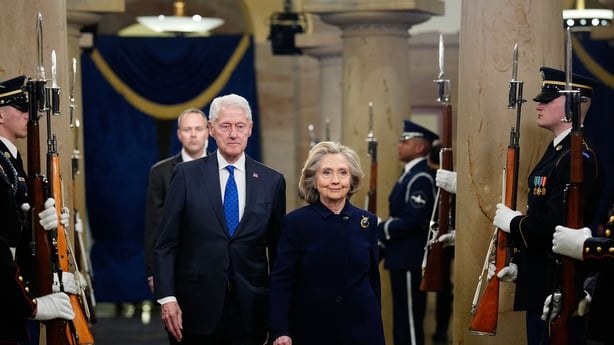
Also pushing back last week were the Clintons. Former President Bill and former Secretary of State Hillary were subpoenaed to appear before the House Oversight Committee’s investigation into the Epstein Files.
They refused to appear, saying other witnesses have been allowed to make written submissions, and besides they had nothing to add to what is known about Epstein’s sexual predations. (Mr Trump’s chief of staff, Susie Wiles said in her now-famous Vanity Fair interview that she had seen nothing in the Epstein files suggesting any sexual wrongdoing by Bill Clinton).
But the Clintons are Democrats, and the President and his supporters are keen to shine the spotlight of the Epstein inquiry into Democrats – and away from the current President.
It’s likely the Oversight Committee will refer the Clintons to the Department of Justice, where Pam Bondi will decide whether to prosecute them for Contempt of Congress.
It carries a potential sentence of up to a year in prison.
It hasn’t been used much – until recently: Steve Bannon, the eminence grise of MAGA, and Peter Navarro, now a senior White House staffer working on trade and tariff policy, were both sentenced to and served four months in prison for refusing to appear at the 6 January Committee investigation.
Neither have received Presidential pardons for their contempt of congress convictions (though the Department of Justice says it no longer supports Navarro’s conviction: his appeal continues).
Navarro and Bannon’s convictions – along with the President’s own travails with Special Prosecutors and District Attorneys – now all behind him – have been denounced as politically motivated “lawfare” – tying up political enemies in interminable and extremely costly legal cases to get opponents of the political playing field, even if the cases ultimately go nowhere.
The impending prosecution of the Clintons fits that pattern – even if the boot is on the other foot now.
Another pattern seeming to emerge over the past couple of weeks has been the use of investigations and law cases to go after political opponents.
New York attorney general Letitia James is a particular target, as is former Special Prosecutor Jack Smith and former FBI head James Comey.
Now action is being taken against some politicians – notably a small group of Democrats who put out a social media video before Christmas reminding armed forces personnel that they do not have to obey illegal orders.
Senator Mark Kelly, a former Navy pilot with combat experience and a former Space Shuttle commander, was the first of the group to be investigated by Defence Secretary Pete Hegseth’s department, which is looking at administrative sanction that could see the Navy Captain’s rank or seniority reduced, and along with it his Navy pension. He is pushing back hard.
The other five politicians who appeared on the video now say they are under criminal investigation by the US attorney for the District of Columbia, former Fox News presenter Jeanine Pirro.
One of them, former CIA analyst Senator Elissa Slotkin, spoke out about the investigation, calling it an attempt to silence her and discourage other politicians from speaking out against Mr Trump’s policies, especially foreign policy.
Unlike the first year of Mr Trump’s second presidency, more and more people, institutions and countries are pushing back against the President, sensing political weakness at the very moment he increases the velocity of his departure from Washington political norms.
Taken together the domestic and foreign policy adventures of the Trump administration – and the President’s constant craving for attention, and his willingness to say almost anything to get it – is creating an increasingly fraught atmosphere in DC and the wider United States at the start of this second year of his term.
But unlike his first term, the unsettling picture emerging is one that flows from careful design. It’s not chaos, it’s intentional. Take it seriously.